 how-to
How to Style Minimalist Abstract Art at Home
Table of Contents
- Understanding Minimalist Abstract Art and Your Space
- How to Decorate with Abstract Art: Start with Your Color Palette
- Choosing the Right Artwork Size and Scale for Your Walls
- Abstract Art Above a Sofa: Placement, Balance, and Visual Impact
- Abstract Art Placement and Hanging Height: Measurements That Matter
- Creating Minimalist Gallery Wall Ideas with Negative Space
- Styling Single Statement Pieces and Small Spaces
- Lighting, Glare, and Installation Tips for Lasting Impact
- Frequently Asked Questions
Last Updated: October 10, 2026
Understanding Minimalist Abstract Art and Your Space
Minimalist abstract art strips away unnecessary detail to focus on color, form, and composition. Bold brushstrokes, restrained palettes, and clean lines create pieces that speak without overwhelming a space. At Susan Fielder Art, we believe this approach transforms a room by creating visual calm while maintaining emotional depth.
Before selecting artwork, understand your room. Walk through at different times of day and notice how light moves across your walls. Check furniture placement and existing color scheme. A minimalist abstract painting will anchor your space, so the room's bones matter.
Minimalist abstract art works best in spaces where negative space breathes. Open walls and calm backgrounds let the artwork become the focal point. A single statement piece can make cramped spaces feel larger by drawing the eye upward and outward.
How to Decorate with Abstract Art: Start with Your Color Palette
Your color palette is the foundation of decorating with abstract art. Choose artwork that complements existing colors or introduces one new accent color intentionally. Minimalist abstract paintings with muted tones work in neutral rooms; bold colors work best when walls and furniture are calm.
Identify your room's dominant colors (wall, sofa, rug, major furniture). Most successful rooms have three to five colors maximum. Ask: does your abstract art match these, or add something new?
For neutral rooms, consider these approaches:
- Monochromatic abstract art: Shades of gray, black, and white create sophisticated visual depth
- Warm neutrals with accent color: Beige walls paired with abstract art featuring terracotta or ochre
- Cool neutrals with blue accent: Gray or white walls with minimalist abstract paintings in navy or slate
- Restrained palette with single bold element: Cream walls with abstract art featuring one vibrant color
If your room has bold colors, choose minimalist abstract art that echoes one of those colors. Repetition creates harmony. A deep blue sofa pairs beautifully with abstract art featuring blue tones.
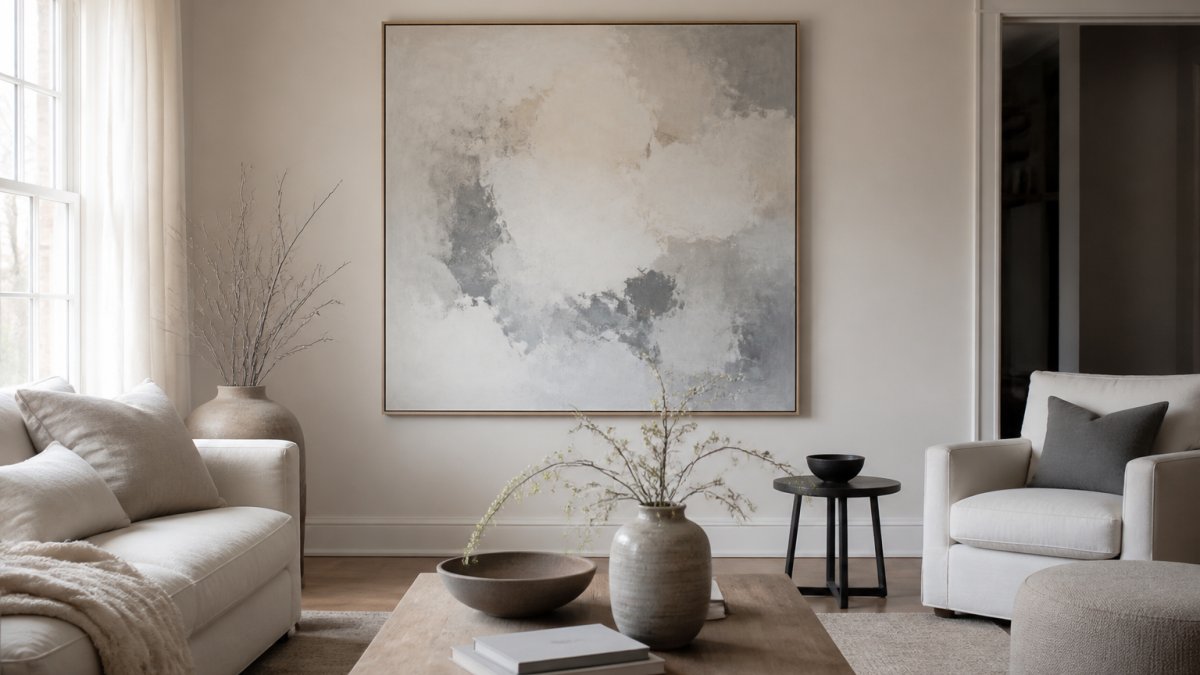
Choosing the Right Artwork Size and Scale for Your Walls
Artwork size matters significantly. Your artwork should take up 50-75% of the wall space above furniture, or 60-75% of empty wall space.
Measure your wall. For an 84-inch sofa, choose artwork roughly 48-60 inches wide. For empty walls, your minimalist abstract painting should occupy a significant portion of the space.
Consider these sizing guidelines:
- Small spaces (under 150 sq ft): 24-36 inch artwork
- Medium rooms (150-300 sq ft): 36-48 inch artwork
- Large rooms (300+ sq ft): 48-72 inch artwork
- Walls over 10 feet wide: 60+ inch artwork
Scale means proportion to furniture. A painting above a sofa should align with the sofa's width. Minimalist abstract art with negative space can feel smaller than densely packed paintings, so consider visual weight, not just frame size.
Abstract Art Above a Sofa: Placement, Balance, and Visual Impact
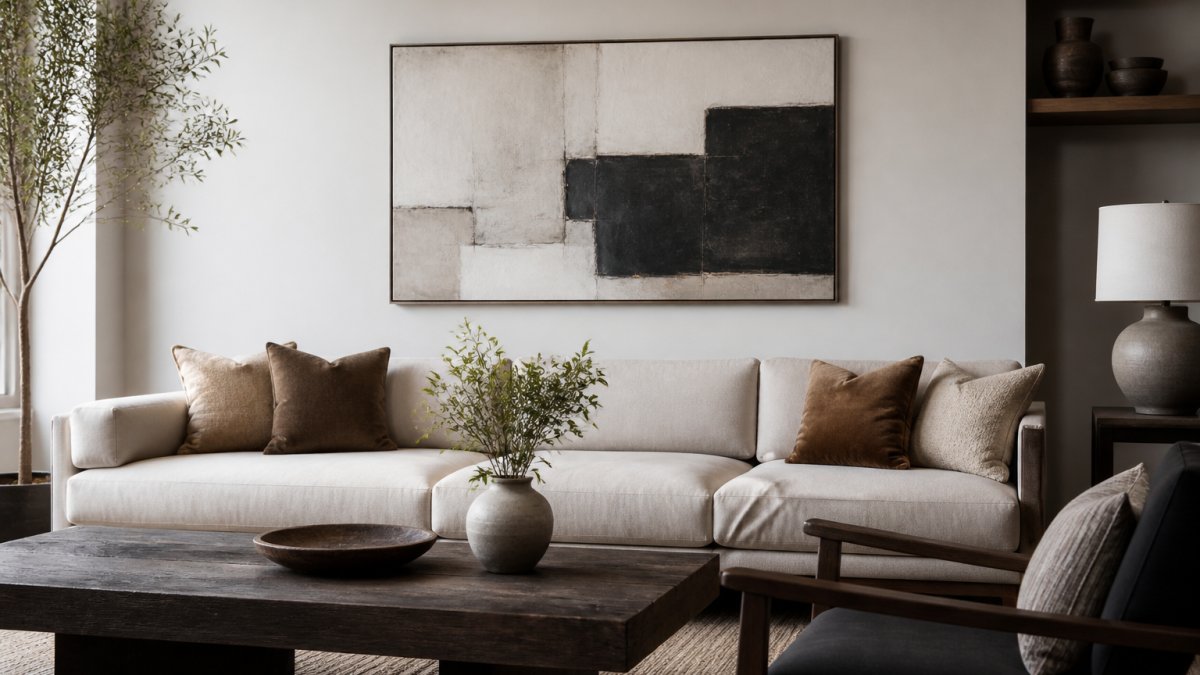
Abstract art above a sofa creates an instant focal point and anchors your seating area. Your minimalist abstract painting should feel intentionally positioned.
The painting's width should be 50-75% of your sofa's width. For an 84-inch sofa, choose 42-63 inches wide artwork.
The center of your abstract art should sit 57-60 inches from the floor (eye level). The gap between sofa and painting should be 8-12 inches.
Lighting affects how your minimalist abstract art reads. If your sofa faces a window, afternoon light may create glare. Position a picture light or wall sconce if needed, bright enough to show colors and composition without glare.
One large, well-placed minimalist abstract painting above a sofa is more powerful than three smaller pieces. The negative space is part of the design. Let the artwork breathe.
Abstract Art Placement and Hanging Height: Measurements That Matter
The center of artwork should be 57-60 inches from the floor (eye level) to feel connected to your space and create visual comfort.
In high-ceiling rooms (10+ feet), raise the center to 62-65 inches. In low-ceiling rooms (under 8 feet), keep it at 57-60 inches for proportion.
For gallery walls or grouped pieces, maintain consistent spacing. If you're hanging multiple abstract art prints together, keep 2-3 inches between frames. The group should feel intentional, not scattered. Measure the group's overall height and width first, then find its center point on the wall. This center point should still align roughly with eye level.
Placement relative to furniture creates visual relationships:
- Above a sofa: 8-12 inches from sofa back
- Above a console table: 8-12 inches from table top
- On empty wall: 57-60 inches from floor to center
- Above a bed: 8-12 inches from headboard
- In a hallway: 60-65 inches from floor (slightly higher for passing views)
Use a level when hanging. Crooked artwork immediately looks careless. Mark your holes lightly in pencil before drilling. For minimalist abstract art with clean lines, even a slight tilt becomes obvious.
Creating Minimalist Gallery Wall Ideas with Negative Space
A gallery wall done right uses negative space as intentionally as the artwork itself. The empty wall is part of the design. This principle defines minimalist gallery wall ideas, restraint creates impact.
Start with a clear concept. Are you creating a monochromatic gallery wall (all black and white, all grays, all one color family)? Are you grouping abstract art prints by size? By theme? By color?
For a minimalist gallery wall, consider these approaches:
- Same-size grid: Four to six pieces of identical size, evenly spaced
- Salon style with breathing room: Varied sizes, but with intentional spacing (3-4 inches between frames)
- Linear arrangement: Pieces hung in a horizontal or vertical line with consistent gaps
- Clustered asymmetry: Grouped tightly on one side with significant negative space elsewhere
The frames matter in a minimalist context. Matching frames create cohesion. White, black, or natural wood frames work best with minimalist abstract art. Avoid ornate frames, they contradict the minimalist aesthetic.
Spacing between pieces should feel deliberate. If you're using 3-inch gaps, use 3 inches consistently. If you're using 4 inches, keep it uniform. Inconsistent spacing looks accidental.
Start with your largest piece as an anchor. Build around it. Smaller pieces can flank it, or you can create a grid below it.
Styling Single Statement Pieces and Small Spaces
A single statement piece of minimalist abstract art solves the design problem in small spaces. One large, well-chosen artwork creates visual interest without clutter. It anchors the room and gives the eye a clear focal point.
In small spaces, scale is everything. A 24-inch artwork in a 100-square-foot bedroom feels right. A 60-inch painting would overwhelm it. Measure your wall and choose artwork that occupies 60-75% of the available space.
For renters or people who move frequently, consider these installation options:
- Adhesive picture hangers: Hold up to 16 pounds without wall damage
- Damage-free strips: Remove cleanly without paint damage
- Leaning against the wall: For smaller pieces or temporary displays
- Floating shelves: Mount the artwork on a shelf instead of directly on the wall
A single minimalist abstract painting becomes more powerful when it's the only artwork in the room. Resist the urge to add more pieces. One statement piece, properly placed and lit, transforms the space more effectively than three smaller pieces ever could.
In small spaces, negative space becomes precious. Don't fill walls just because they're empty. A calm, mostly empty wall with one striking piece of abstract art feels intentional and spacious. The empty wall amplifies the artwork's impact.
Lighting, Glare, and Installation Tips for Lasting Impact
Lighting transforms how viewers experience your minimalist abstract art. Poor lighting makes even beautiful artwork look flat and dull. Good lighting brings out color, texture, and composition.
Natural light is ideal, but it's inconsistent. Morning light differs from afternoon light. If your artwork faces a window, afternoon sun might create glare.
For artificial lighting, use these strategies:
- Picture lights: Mount above the artwork, angled down at 30 degrees
- Wall sconces: Place on either side of the artwork for balanced illumination
- Track lighting: Flexible option for adjusting light direction and intensity
- Ambient room lighting: Ensure general room light reaches the artwork
The color temperature matters. Warm light (2700K) brings out warm tones in abstract art. Cool light (4000K+) enhances cool colors. Match your lighting to the artwork's palette.
Installation must be secure and level. Use appropriate hardware for your wall type:
- Drywall: Heavy-duty anchors rated for your artwork's weight
- Plaster: Plaster anchors or toggle bolts
- Concrete: Masonry anchors
- Wood: Standard screws into studs
Check weight limits. Most minimalist abstract paintings on canvas weigh 5-15 pounds framed. Verify your hardware can support the load.
For emotionally resonant abstract artwork, secure, thoughtful placement that honors the piece's integrity is important.
Styling minimalist abstract art at home is about intention. Choose pieces that resonate with you emotionally. Place them thoughtfully. Let negative space do its work.
Frequently Asked Questions
How do I know if minimalist abstract art will actually look good in my space before I buy it?
Request detailed photos from multiple angles and, if available, scale reference images showing the piece in a room setting. Check the artwork dimensions against your wall space using painter's tape to outline the frame size. Consider the color palette of the piece against your existing furniture and wall color. Many artists, including those at Susan Fielder Art, provide guidance on how pieces work in different interiors. If you're uncertain, start with a smaller statement piece to test how the style feels in your home before investing in larger works.
What's the best way to hang minimalist abstract art so it complements my room's layout?
Center the artwork at eye level, approximately 57 to 60 inches from the floor to the center of the frame. Above furniture like sofas, maintain 8 to 12 inches of space between the top of the furniture and the bottom of the frame. In gallery walls, space pieces 2 to 3 inches apart for a cohesive look. Use negative space intentionally, don't fill every wall. A single statement piece often creates more impact than multiple smaller works in a minimalist setting, allowing the abstract art to anchor the room's visual balance.
Can minimalist abstract art work in a small room or rental space?
Yes. In small spaces, choose one focal-point piece rather than multiple artworks to avoid visual clutter. Select artwork with restrained palettes and clean lines that won't overwhelm the room. For rentals, use removable hanging systems like damage-free strips or adhesive hooks. Smaller-scale abstract pieces (16x20 inches or smaller) work well in compact areas. The emotional resonance of minimalist abstract art makes it ideal for renters, it transforms a space without permanent changes, and you can take it with you when you move.
How do I choose abstract art colors that match my home's existing decor?
Start by identifying your room's dominant color palette, neutral tones, bold colors, or muted tones. Select abstract art that either complements these colors (matching the mood) or provides subtle contrast (adding visual interest without clashing). Minimalist abstract pieces with restrained palettes work well in any room because they don't demand attention. Consider the emotional tone: serene, flowing compositions calm a space, while dynamic, bold brushstrokes energize it. View artwork samples in your actual lighting to ensure the colors work with natural and artificial light in your room.