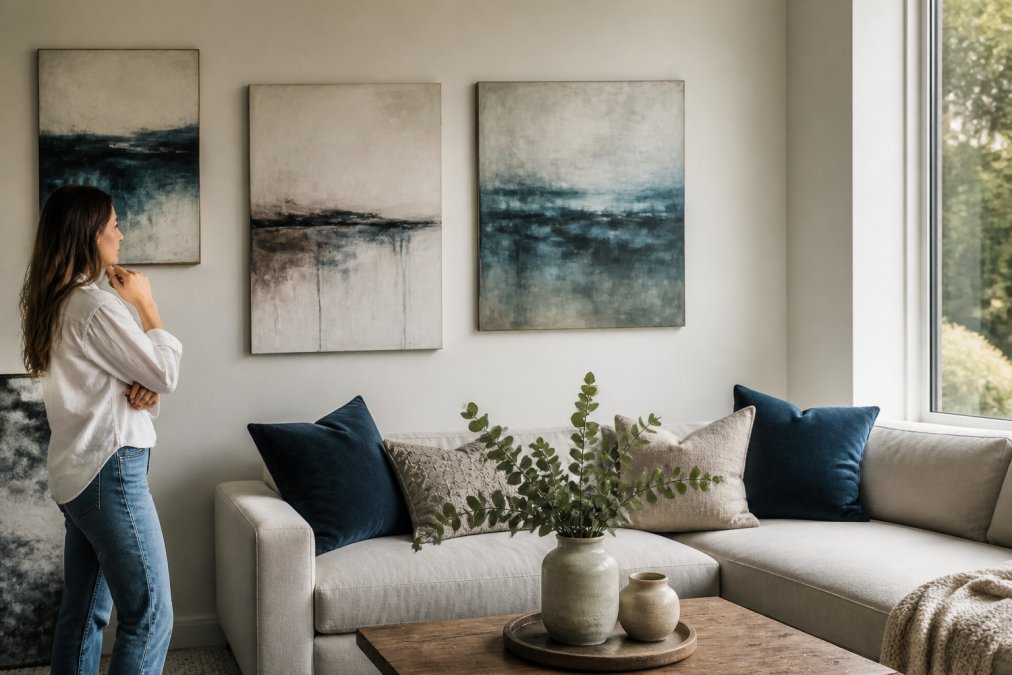
 how-to
How to Choose Abstract Art for Your Living Room
Table of Contents
- Define Your Personal Style and Aesthetic Vision
- Selecting Abstract Paintings for Living Room Decor
- Best Color Palettes for Abstract Art in Your Space
- How to Style Large Wall Art as Your Focal Point
- Lighting, Texture, and Preservation Considerations
- Visualizing Your Choice Before Committing
- Original Art Versus Prints: Making Your Decision
- Frequently Asked Questions
Last Updated: August 29, 2026
Define Your Personal Style and Aesthetic Vision
Before purchasing abstract paintings for your living room, understand what resonates with you emotionally. Start by collecting visual references from art websites, design platforms, and social media. Save pieces that stop you, then look for patterns in 15-20 images. Do you gravitate toward bold compositions or quieter ones? Specific color families? These patterns reveal your aesthetic instincts.
According to Buildworld's 2023 survey on home decor motivations, 68% of respondents decorated their homes to make their space feel personal. When you choose abstract art that aligns with your genuine preferences, you're creating a space that reflects your identity.
Consider your lifestyle too. Are you minimalist or maximalist? Do you prefer calm environments or spaces full of visual energy? Your art should amplify what makes your space feel like home.
Selecting Abstract Paintings for Living Room Decor
Once you've clarified your aesthetic, evaluate specific pieces with confidence. The best abstract paintings for living room decor elevate your entire space by introducing intentional contrast or harmony.
Original artwork carries a presence that reproduction cannot replicate. There's an energy in brushstrokes, texture, and the artist's hand that photographs miss. If budget allows, original work is worth the investment because it deepens your connection to the piece over time. At Susan Fielder Art, we focus on emotionally charged original abstract work that transforms spaces with vibrant energy and carries meaningful narratives of resilience.
Understanding Canvas Dimensions and Wall Proportions
Canvas size is where most people make their biggest mistake. According to Frametheworld's 2026 research on art scaling, well-chosen pieces that are properly proportioned increase client satisfaction by 20-30%.
A common misconception is that smaller pieces feel more sophisticated. In reality, undersized art makes walls feel empty and spaces feel smaller. If you're hanging a single piece above a sofa, it should span roughly two-thirds of the furniture's width. For an empty wall, fill 60-75% of the available expanse. Research shows that well-proportioned art can increase perceived spatial perception by up to 15% and comfort levels by 20-25%.
Measure your wall carefully. If you have an 8-foot-wide wall, a 4-foot-wide canvas is appropriate. A 2-foot canvas on that same wall will feel lost, no matter how beautiful.
The 70/30 Rule and Scale Guidelines
The 70/30 rule is a practical framework for balancing your focal point with the rest of the room. Your primary artwork should occupy approximately 70% of the visual attention in that zone, with surrounding elements making up the remaining 30%.
For most living rooms, this means one statement piece rather than a gallery of small works. A single large abstract canvas commands attention and sets the tone for the entire room. Think about scale in relation to your furniture too. A massive 6-foot-wide abstract above a delicate side table creates uncomfortable tension. The same piece above a substantial sectional feels intentional and grounded.
Best Color Palettes for Abstract Art in Your Space
Color is where abstract art truly transforms a room. Unlike representational art, abstract work gives you complete freedom to introduce colors that energize, calm, or balance your space.
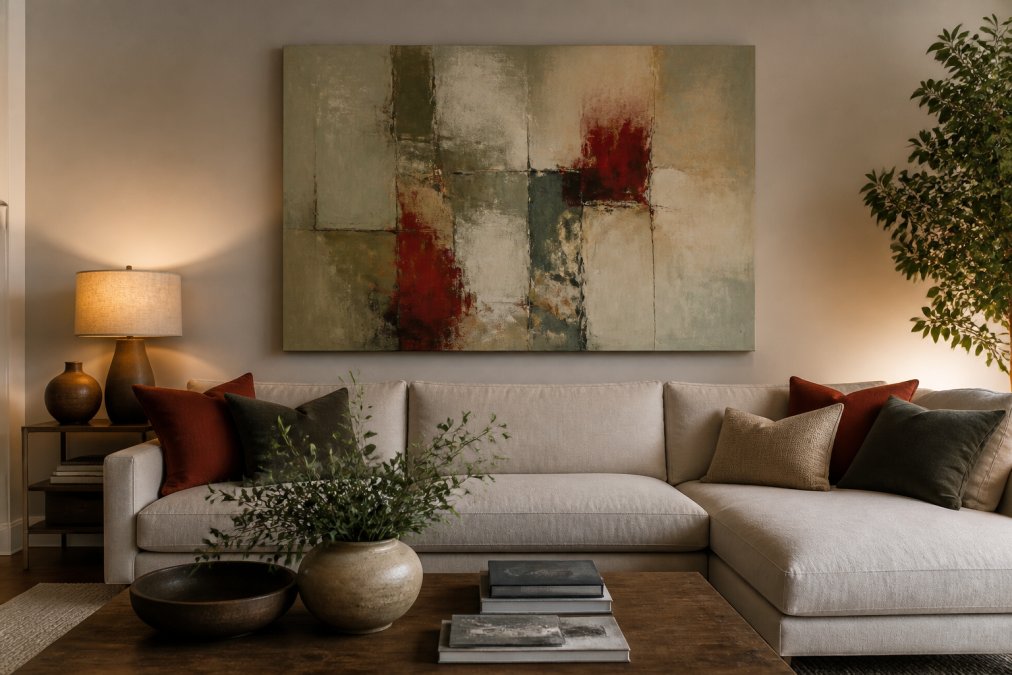
Start with your existing palette. Your abstract art doesn't need to match these colors perfectly. Instead, pull subtle tones from the art that appear just 5-10% in the piece and echo them in your decor. This creates intentional harmony without looking overly coordinated.
Current design trends lean toward sophisticated, muted palettes punctuated by striking color contrasts. Think taupe, ash gray, and sage as your base, with electric blue, crimson, or gold as accent points. If you prefer warmer tones, organic forms and biophilic inspiration drawn from nature are gaining momentum in abstract art for living spaces.
The psychology of color matters too. Warm colors energize and create intimacy. Cool colors calm and expand perception. Neutral abstracts with strong texture work well in high-stress environments where you want visual interest without stimulation. If your living room is your refuge, consider art with cooler tones and organic, flowing shapes. If it's your gathering space, bolder contrasts and geometric elements work better.
How to Style Large Wall Art as Your Focal Point
A focal point is the element your eye lands on first when you enter a room. In most living rooms, this should be your primary piece of abstract art.
Position your art at eye level, roughly 57-60 inches from the floor to the center of the canvas. This is the natural sightline when you're standing or sitting in the room. Hanging art too high makes it feel disconnected from the furniture below.
Lighting dramatically affects how your focal point reads in the space. A piece that looks vibrant in daylight can feel flat under harsh overhead lighting. Position your art where it receives natural light during the day. For evening viewing, consider picture lights or accent lighting that highlights the canvas without creating glare.
Creating Visual Balance and Composition
Visual balance doesn't mean symmetry. An asymmetrical composition can feel more dynamic and interesting than a perfectly centered arrangement. The weight of your art should feel balanced against other elements in the room.
If you have a large, dark abstract on one wall, balance it with lighter elements elsewhere: an open bookshelf, minimal furniture, or bright windows. If your art is busy with lots of movement and color, simplify everything around it.
Look for pieces with clear focal points within the abstract work, areas where your eye naturally settles. These internal focal points should align roughly with your sightline when you're sitting in the room.
Placement and Eye-Level Positioning
Beyond the 57-60 inch standard, placement depends on what furniture sits below your art. Above a sofa, the canvas should hang about 8-12 inches above the furniture. This creates a cohesive grouping without feeling disconnected.
In rooms with high ceilings, resist hanging art higher just because you have the space. The standard eye-level rule still applies. High ceilings give you more flexibility to use larger canvases, which helps fill the vertical space without hanging the art itself higher.
Lighting, Texture, and Preservation Considerations
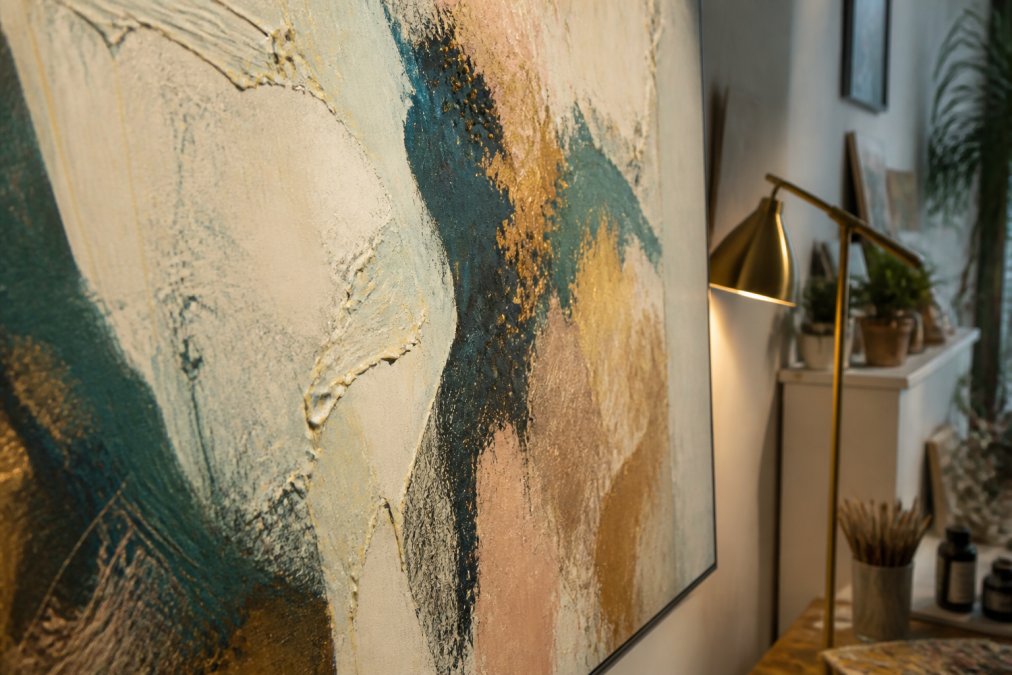
The way light interacts with your abstract art changes how it reads in your space. Matte finishes diffuse light evenly and work well in bright rooms. Glossy finishes reflect light and make colors appear more vibrant. Textured surfaces with layered colors or varied brushstrokes introduce a tactile quality that makes a space feel richer and more inviting.
Texture is often overlooked in abstract art selection. A piece with visible brushstrokes and dimensional surface feels more engaging than a flat, digitally-created image. This tactile quality is one reason original paintings outperform prints.
Keep your abstract paintings away from direct sunlight, which fades colors over time. Maintain consistent humidity levels to prevent canvas warping. Dust gently with a soft brush or cloth, never with water or cleaning products.
According to University of South Carolina research on art therapy and mental health, those who engaged with abstract art experienced significantly improved mental health outcomes. This suggests that your choice of art directly affects your wellbeing in the space.
Visualizing Your Choice Before Committing
One of the biggest objections to buying art online is uncertainty: Will this piece actually look good in my space? Virtual visualization tools have made this easier, but they're not foolproof.
Take a photo of your wall and use basic photo editing to overlay the art at the size you're considering. Many art retailers now offer augmented reality tools that let you see how a piece looks in your actual space using your phone's camera.
A better approach: order the piece with a clear return policy. Many galleries offer 30-day returns or exchanges if the art doesn't work in your space. Susan Fielder Art provides a secure, verified checkout experience and stands behind the quality of original work, so you can purchase with confidence knowing you have options if the piece doesn't feel right in your home.
If you're spending significant money, ask the gallery for multiple photos of the piece in different lighting conditions and measurements.
Original Art Versus Prints: Making Your Decision
The choice between original paintings and prints comes down to budget, space, and how you want the art to function in your life.
Original abstract paintings carry presence and energy that prints cannot replicate. The texture, visible brushwork, and subtle color variations create depth and movement that photographs miss. Original work also holds or appreciates in value over time. If you're drawn to abstract art as an investment and a long-term part of your home, original work makes sense.
Prints are more affordable and accessible. High-quality art prints on canvas can look beautiful and serve the same visual function as originals. The downside: prints lack the tactile quality and presence of original work, and they don't appreciate in value.
At Susan Fielder Art, we specialize in emotionally charged original abstract paintings designed to transform your space with vibrant energy. Each piece carries a narrative of healing and resilience, and 10% of all proceeds support pancreatic cancer research. When you purchase original art from a gallery committed to both artistic integrity and social impact, you're investing in something that beautifies your home and supports a greater cause.
Choosing abstract art for your living room is ultimately about creating a space that feels authentically yours. The process requires understanding your aesthetic, respecting scale and proportion, and committing to pieces that resonate emotionally. When you get it right, your room feels more intentional, more alive, more like home. Start with these principles, trust your instincts, and don't settle for pieces that almost work. The right abstract art is out there, waiting to transform your living room into a space that reflects who you are.
Frequently Asked Questions
What is the 70/30 rule for hanging abstract art in a living room?
The 70/30 rule suggests that your abstract art should occupy 60-75% of the available wall space. For a single piece above a sofa, aim for the artwork to span roughly two-thirds of the furniture's width. This sizing approach prevents the common mistake of choosing pieces that are too small for the wall, which can make a room feel disconnected and unfinished. Well-proportioned art can increase client satisfaction.
How do I choose abstract art that actually matches my living room without the space feeling flat?
Instead of seeking a perfect color match, pull subtle tones from the abstract piece that appear just 5-10% within it and echo them in your decor through accent pillows or throws. This approach creates visual harmony without the 'matchy-matchy' showroom effect that results from over-coordinating. Abstract art works best when it provides a slight color surprise while maintaining tonal balance with your existing furniture and wall colors.
Can I visualize how abstract art will look in my space before buying online?
Yes. Take a photo of your wall or room, then use digital visualization tools to overlay images of artworks you're considering. Measure your wall space and compare it to the canvas dimensions to ensure proper proportionality. Many online galleries provide detailed product images and dimensions. If you're concerned about how a piece will perform in your specific lighting, ask the seller for photos taken in natural and artificial light before committing to your purchase.
Should I buy original abstract paintings or high-quality prints for my living room?
Original paintings offer one-of-a-kind character, texture, and tonal depth that prints cannot replicate, plus they tend to hold their value as art investments. High-quality prints are more affordable and offer flexibility if you move frequently. Consider your budget, how long you plan to stay in your space, and whether the emotional connection to a unique piece justifies the investment. Both options can serve as effective focal points when properly scaled and positioned.