 how-to
How to Verify Abstract Art Authenticity Online
Table of Contents
- Research the Artist and Their Background
- How to Authenticate a Painting Online: Examine Materials and Technique
- Conduct a Painting Provenance Check
- Review the Art Certificate of Authenticity and Documentation
- Use Reverse Image Search for Artwork Verification
- Inspect Signatures, Dates, and Identifying Marks
- Request High-Resolution Photographs and Video Evidence
- Compare with Known Examples and Assess Historical Alignment
- Frequently Asked Questions
Last Updated: October 6, 2026
Research the Artist and Their Background
Before you invest in any abstract artwork, start by learning who created it. Understanding the artist's background, training, and exhibition history forms the foundation of your verification process.
Search for the artist's official website, social media presence, and gallery affiliations. Look for consistent information across multiple sources.
Check whether the artist is listed in major art databases and directories. If you're verifying abstract art authenticity, cross-reference the artist's name across different sources to confirm their identity and body of work.
Review any interviews, articles, or press coverage featuring the artist. Publications often document an artist's creative journey, technique, and artistic evolution.
How to Authenticate a Painting Online: Examine Materials and Technique
Understanding how the artist created their work is essential when you're trying to verify abstract art authenticity online. Abstract paintings rely heavily on material choices and execution style rather than representational subject matter.
Request detailed information about the materials used: canvas type, paint medium (oil, acrylic, mixed media), and any special techniques. The artist should be able to describe their process clearly. Inconsistencies here often signal a problem.
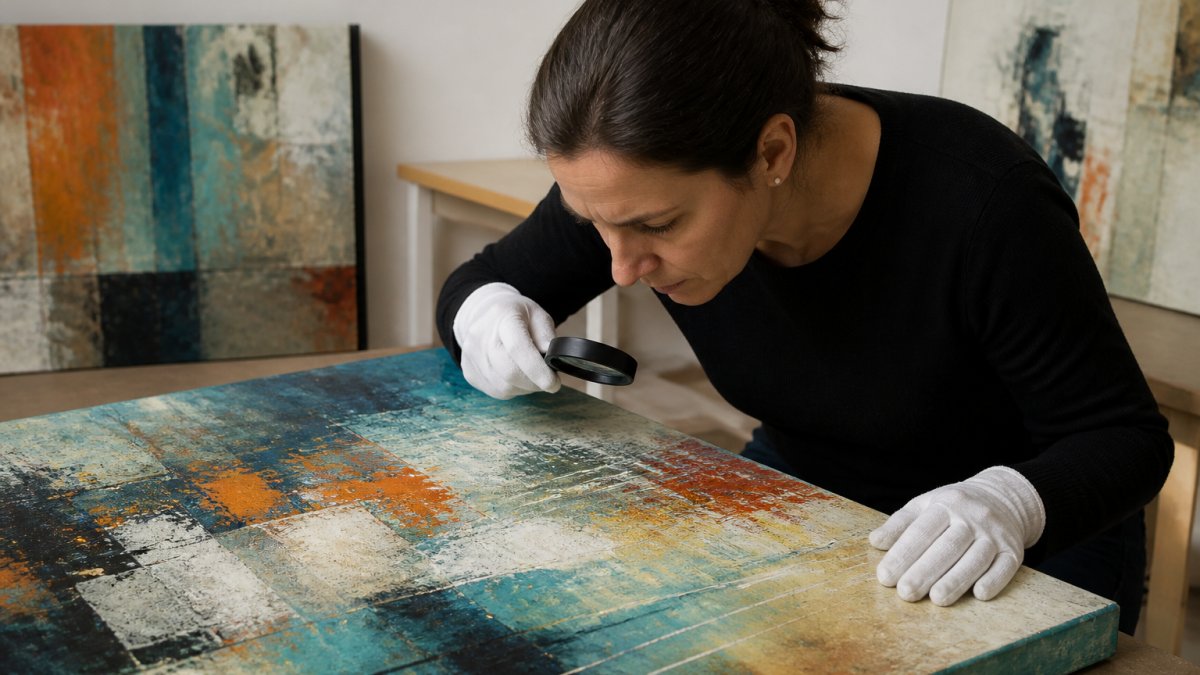
Examine the painting's brushwork and surface texture through high-resolution images. Abstract art's authenticity depends significantly on technique consistency. Look for:
- Consistent brushwork patterns across the piece
- Appropriate aging and wear for the claimed date
- Paint layering that matches the artist's known methods
- Texture visible in close-up photography
Ask the seller for detailed photographs of the painting's reverse side, edges, and any labels or markings. Original paintings often show specific characteristics on the back that reproductions lack.
Conduct a Painting Provenance Check
Provenance is the documented ownership history of an artwork. A strong provenance chain significantly strengthens authenticity claims. When you verify abstract art authenticity, provenance becomes your paper trail.
Ask the seller to provide complete ownership records from the current owner back through previous owners.
Look for documentation such as:
- Original purchase receipts or invoices
- Gallery exhibition records
- Insurance appraisals from previous owners
- Auction house catalogs if the piece was previously sold
- Correspondence between owners
Gaps in the provenance chain don't automatically mean the work is inauthentic, but they do require additional verification.
Research whether the artwork appears in any published exhibition catalogs or art historical records. Established works often have documented exhibition histories that can be verified through gallery archives or museum records.
Review the Art Certificate of Authenticity and Documentation
A certificate of authenticity is an official document stating that an artwork is genuine. When evaluating this certificate, examine its source and specificity carefully.
The certificate should include:
- Artist's signature or official authorization
- Detailed artwork description (dimensions, materials, date created)
- Certificate issue date and issuer information
- Unique identification number
- Artist's statement confirming authenticity
Verify that the certificate comes from a reputable source. Certificates issued directly by the artist or established galleries carry more weight than generic third-party certificates.
Cross-reference the certificate number and details with the issuing organization. Legitimate certificates can typically be verified through the issuer's records. Contact the gallery or authentication service directly to confirm the certificate's validity.
Be aware that a certificate alone doesn't guarantee authenticity. A well-forged certificate combined with other documentation can be convincing but still fraudulent.
Use Reverse Image Search for Artwork Verification
Reverse image search tools help you track where an image of the artwork has appeared online.
Start with Google Images reverse search. Upload a high-resolution photograph of the artwork and see where else that image appears.
Search for the artwork on art databases, museum websites, and gallery archives. Established pieces often appear in online collections.
Use specialized art search platforms that catalog known artworks and their locations.
Document your search results. Screenshot where the image appears and note any discrepancies in descriptions, artist attribution, or pricing. These inconsistencies become important evidence in your verification process.
Inspect Signatures, Dates, and Identifying Marks
The artist's signature, date, and any identifying marks on the painting provide crucial verification information. These details must be consistent with the artist's known practices and the artwork's claimed creation date.
Examine the signature carefully:
- Does it match the artist's known signature style?
- Is it applied with the same medium as the painting?
- Does the placement align with the artist's typical practice?
- Is the signature consistent in size and pressure with other known works?
Research the artist's signature evolution over time. Many artists change their signature style throughout their career.
Check for any dates, titles, or labels on the back of the canvas or frame. These identifying marks often provide authentication clues.
Look for artist stamps, gallery marks, or exhibition labels. These physical marks tell the artwork's history and help verify its journey through the art world.
Request High-Resolution Photographs and Video Evidence
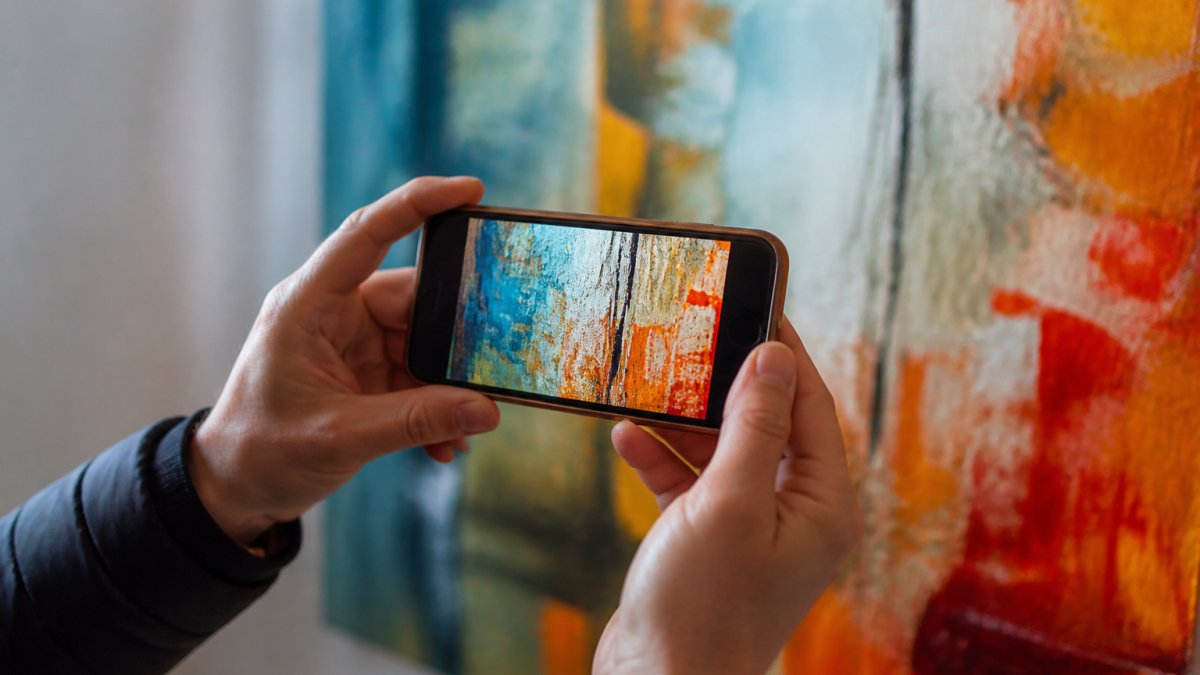
Never purchase abstract art online without detailed photographs and video evidence. High-resolution images reveal details that prove or disprove authenticity claims, and they also become your record if a dispute arises later.
Request multiple photographs showing:
- Full artwork from a straight-on angle
- Close-up details of brushwork and texture
- Edges and sides of the canvas
- Back of the canvas and frame
- Any signatures, dates, or labels
- The painting in different lighting conditions
Ask the seller to provide a video walkthrough showing the artwork from multiple angles.
Pay special attention to how light interacts with the paint surface. Original paintings show authentic aging, wear, and light reflection patterns.
Online Transaction Safeguards
Photographs and video are evidence, not protection. Pair them with transaction safeguards before money changes hands.
- Written authenticity guarantee, Ask for a signed statement that identifies the artist, title, date, medium, dimensions, and a clear promise of refund if the work is later shown to be inauthentic. A verbal assurance is not enough.
- Escrow or protected payment, Use a payment method that withholds funds until you confirm receipt and inspection. Credit card and established escrow services generally offer stronger dispute rights than wire transfers or peer-to-peer apps.
- Return window, Confirm a written return period long enough to arrange an in-person inspection or a specialist review. Get the return shipping responsibility and condition requirements in writing.
- Dispute documentation, Save the listing, all messages, the seller's representations, the photographs and video, the payment record, and the certificate or documentation. If authenticity is later questioned, this file supports a chargeback, platform dispute, or legal claim.
- Seller identity, Verify the seller's legal name, business address, and platform history. A seller who will not provide identifying information is a risk regardless of how good the artwork looks.
What to Do When Evidence Conflicts
If your photograph review, provenance check, or comparison analysis produces conflicting signals, do not proceed on hope. Pause payment. Request the specific missing evidence in writing. If the seller cannot or will not provide it, treat that as a decision point: walk away, negotiate a price that reflects the uncertainty, or make the purchase contingent on a qualified specialist's opinion. Document every step so that if you later need a refund, you have a clear record of what was promised and what was delivered.
Compare with Known Examples and Assess Historical Alignment
Abstract art breaks the usual comparison method. With a representational painting, you can ask whether the subject, pose, or landscape matches known works.
Start by building a reference set of 5-10 verified works from the same artist and the same claimed period. Pull them from gallery archives, museum collection pages, estate or foundation websites, and published exhibition catalogs. For each reference work, note the following:
- Compositional structure, Does the artist favor all-over fields, central masses, grid systems, diagonal thrusts, or asymmetrical balance? Abstract painters often repeat a structural habit even when the palette changes.
- Color behavior, Look at how colors are mixed, layered, and placed against each other. A painter who consistently uses optical mixing, hard edges, or muddy neutrals will usually show that habit across decades.
- Mark-making and gesture, Compare brush scale, stroke direction, drips, pours, scraping, and tool marks. Gesture is often more consistent than color across an artist's career.
- Edge and boundary treatment, Do forms bleed, stop hard, or get taped off? Edge handling is one of the hardest things to fake convincingly.
- Surface and material signature, Canvas weave, ground color, paint thickness, and varnish presence should align with the artist's documented practice.
Then assess historical alignment. Abstract art movements have documented timelines: Abstract Expressionism, Color Field, Minimalism, Op Art, and later pluralist and digital-influenced practices each carry recognizable material and conceptual assumptions.
Create a side-by-side comparison document. Place the candidate work next to your reference set and score each dimension above as consistent, uncertain, or inconsistent. This is not a pass/fail test, it is a pattern check. One inconsistency may have a reasonable explanation.
Frequently Asked Questions
What should an art certificate of authenticity include?
A genuine art certificate of authenticity should contain the artist's name, title of the work, date of creation, medium and dimensions, artist's signature or seal, the issuer's credentials and contact information, and a unique certificate number. It may also include exhibition records, provenance information, and details about the original ownership. Request certificates issued directly by the artist, their estate, or a recognized gallery rather than generic templates.
How can I check an abstract painting's provenance online?
Start by asking the seller for ownership records, exhibition history, and previous sale documentation. Search the artist's name and artwork title on gallery websites, auction house databases, and artist registries. Check if the work appears in the artist's published catalogue raisonné. Request receipts and gallery records from all previous owners. Cross-reference any claimed exhibitions with gallery archives. Be cautious of gaps in ownership history or vague seller responses, as these are red flags for authenticity concerns.
Can I use reverse image search to verify if a painting is original?
Reverse image search is useful for identifying if an image has been copied or mass-produced online, but it has limits. It can detect reproductions, prints, and unauthorized digital copies, but it won't prove authenticity on its own. Use it alongside other verification methods: search on Google Images, TinEye, and Pinterest to see if the same image appears on multiple sites or in unauthorized contexts. If the image appears only on the seller's site and the artist's official channels, that's a positive sign. Always combine reverse image search with provenance checks and artist research.
How do I know if an abstract painting's style and composition are historically plausible?
Research the artist's career timeline, documented style evolution, and the art movements active during the claimed creation date. Compare the work with authenticated pieces from the same period and artist. Check if the technique, brushwork, materials, and composition align with what the artist was known for at that time. Abstract art can be harder to assess than representational work, so focus on the artist's signature style elements, color palette preferences, and medium choices. If the work contradicts the artist's known body of work or uses techniques they didn't employ until later, question its authenticity.