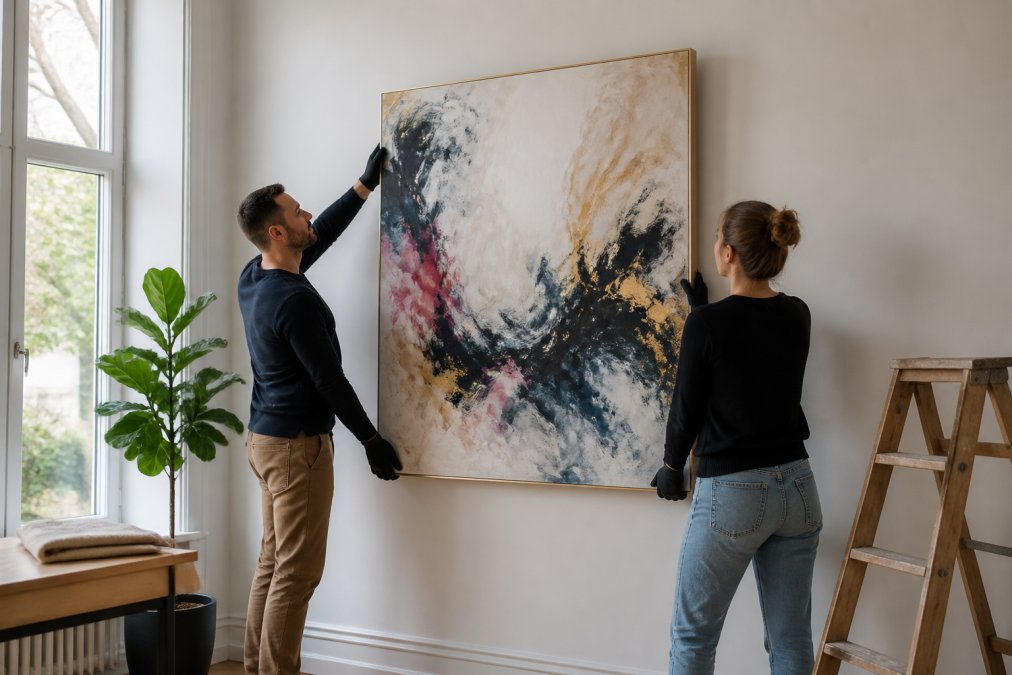
 ultimate-guide
How to Hang Large Abstract Art: 2026 Pro Guide
Table of Contents
- Art Hanging Height Standards: The 57-Inch Rule and Two-Thirds Rule
- How to Measure for Wall Art Placement: Step-by-Step
- Best Hardware for Hanging Heavy Canvas: D-Rings, French Cleats, and More
- Structural Wall Reinforcement for Oversized Abstract Art
- How to Hang Large Abstract Art in Rentals Without Damaging Walls
- Lighting and Visual Weight: The Finishing Touches for Large Abstract Art
- Conclusion: Hang with Confidence and Enjoy Your Art
- Frequently Asked Questions
Last Updated: September 22, 2026
Art Hanging Height Standards: The 57-Inch Rule and Two-Thirds Rule
When you hang large abstract art, its center should sit 57 to 60 inches from the floor, measured to the middle of the canvas. This is the industry's standard eye-level placement, and it's the single most important measurement in the entire process. Get this number right and the piece will feel intentional in any room.
The 57-inch rule works because it mirrors the average human sightline. When the center point of a canvas lands at eye level, the viewer's gaze settles naturally on the composition rather than drifting toward the ceiling or floor. According to YMI Painting's guide to ideal artwork height, maintaining a consistent center-point height across different wall types prevents visual clutter and keeps every piece in a home professionally aligned.
The second rule governs scale. The Two-Thirds Rule states that artwork or a grouping should occupy roughly 60 to 75 percent of the available wall space above a piece of furniture. A 60-inch sofa, for example, calls for art spanning 36 to 45 inches across. Skip this rule and even a beautiful abstract canvas will look undersized or overwhelming.
When to Adjust the Standard Height
The eye-level rule is a starting point, not a law. Designers like Laurel Bern Interiors argue that placement should shift based on the furniture below and the ceiling height above. If a sofa back sits at 32 inches, art floating 57 inches up can feel disconnected. For rooms with 12-foot ceilings, nudging the center point to 62 or 63 inches keeps the composition from looking lost. The rule bends to the room, never the other way around.
How to Measure for Wall Art Placement: Step-by-Step
Good placement starts with two measurements: the width of the furniture below and the height of the wall above it. From there, the math is simple.
- Measure the furniture width. For a sofa or console, note the full width in inches.
- Calculate target art width. Multiply furniture width by 0.6 to 0.75 for the Two-Thirds Rule.
- Find your center point. Measure 57 to 60 inches up from the floor and mark it lightly with pencil.
- Mark the horizontal center. Find the midpoint of the furniture below and extend a faint vertical line upward.
- Test with painter's tape. Outline the canvas dimensions on the wall using tape before drilling.
- Step back 10 feet. Assess the balance from a distance, then adjust before committing.
- Mark hardware points. Measure down from the top of the taped outline to your planned D-ring height.
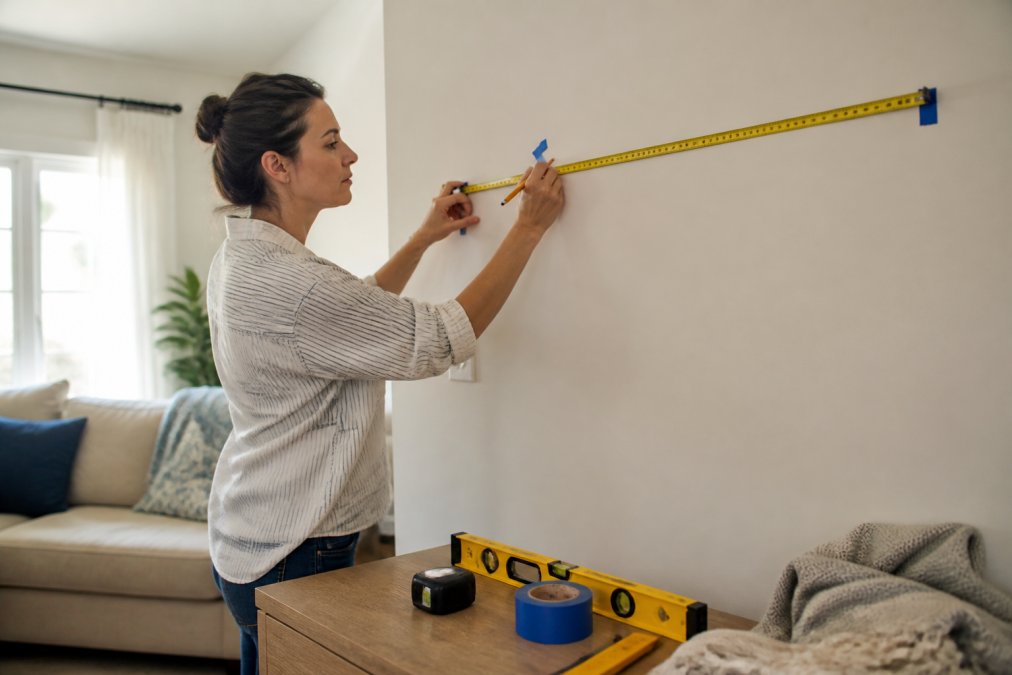
Centering Art Over Furniture
Center art over the furniture, not over the room. A sofa pushed slightly off-center still anchors the composition. Use the furniture's midpoint as your vertical guide and the 57-inch mark as your horizontal guide. Where the two lines cross is the center of your canvas.
Best Hardware for Hanging Heavy Canvas: D-Rings, French Cleats, and More
The right hardware depends on the weight of the piece. For light canvases under 10 pounds, a single nail or picture hook works. For anything heavier, D-rings and wire, or a French cleat, are the reliable choices.
Here's how the three options compare:
| Hardware | Best For | Weight Capacity | Wall Damage |
|---|---|---|---|
| Picture hook | Light frames under 10 lbs | Up to 10 lbs | Minimal |
| D-rings + wire | Medium canvas, 10-30 lbs | Up to 30 lbs | Small holes |
| French cleat | Heavy canvas, 30+ lbs | 50+ lbs | Larger anchors |
D-rings should be installed one-third of the way down from the top of the frame on each side, per J. Cianelli's hardware placement guide. This position keeps the canvas balanced and prevents tipping. A French cleat, by contrast, distributes weight across the full width of the piece and keeps it flush against the wall, which is why it's the standard for oversized work.
Wall Surface Considerations: Drywall vs. Brick
Drywall holds weight only where it's anchored to a stud. For heavy art, drive screws into studs whenever possible, or use toggle bolts rated for the load. Brick and concrete need masonry drill bits and plastic or lead anchors; standard drywall anchors will pull straight out. Rental-friendly alternatives like adhesive strips work for pieces under 10 pounds but should never carry a heavy canvas.
Structural Wall Reinforcement for Oversized Abstract Art
Any canvas over 30 pounds needs at least two mounting points, and both should reach structure rather than drywall alone. That is the rule most installers learn the hard way, usually after a canvas has already pulled a hook out of the wall.
The first step is finding the studs. A magnetic stud finder locates the drywall screws that hold the panels to the framing, which is often more reliable than an electronic edge-finder on textured or double-layer drywall. Standard wood framing sits 16 inches on center, though older homes and some newer construction use 24 inches on center. Mark each stud's center with a pencil line and verify with a thin finish nail before you commit.
Once you know where the studs are, the load math matters. A 40-pound canvas carried by two anchors puts roughly 20 pounds on each point under static load, but the dynamic load when someone bumps the wall or the canvas swings can be several times that. Size your anchors for the dynamic load, not the static one. A common pattern is to use lag bolts or heavy-duty structural screws rated well above the canvas weight rather than drywall anchors, even toggle-style ones.
For oversized abstract canvases, the safest approach is a French cleat bolted into two studs. The cleat's interlocking rails distribute weight across its full length and hold the canvas flush to the wall, which also prevents the top edge from tipping forward. If the studs don't align with the cleat's mounting holes, install a plywood backing board spanning at least two studs, then mount the cleat to the board. A 3/4-inch plywood backer spreads the load across multiple anchor points and eliminates the single-point failure that causes most heavy-art collapses. Paint the backer to match the wall if you want it to disappear.
For a canvas that is too wide for two studs to carry alone, add a third mounting point at the center.
How to Hang Large Abstract Art in Rentals Without Damaging Walls
Renters face a real constraint: no holes, or as few as possible, and a security deposit riding on getting it right. The workable solutions fall into four categories, and the right one depends on the canvas weight and how long you plan to stay.
Lighting and Visual Weight: The Finishing Touches for Large Abstract Art
A great canvas can look flat under the wrong light. Abstract art with layered texture and color needs a light source that grazes the surface rather than hitting it head-on.
Conclusion: Hang with Confidence and Enjoy Your Art
Hanging large abstract art comes down to three numbers: 57 to 60 inches for the center point, 60 to 75 percent wall coverage, and two mounting points for anything over 30 pounds. Get those right and the rest is refinement.
Frequently Asked Questions
How to hang oversized art on a wall?
For oversized art, first locate wall studs with a stud finder. Use at least two mounting points if the piece weighs over 30 pounds, as recommended by Eman's Gallery (2026). Attach D-rings one-third of the way down from the top of the frame on each side. Use a French cleat for very heavy pieces. Measure carefully, mark with painter's tape, and drill pilot holes. Always use appropriate anchors for your wall type, and consider professional help for pieces over 50 pounds.
What is the 57-inch rule for hanging art?
The 57-inch rule states that the center of the artwork should be placed at 57 to 60 inches from the floor, which is average eye level. According to YMI Painting (2026), this standard prevents visual clutter and ensures professional alignment. It applies to most residential spaces, but you can adjust slightly based on ceiling height or furniture. For example, if your sofa is taller than usual, you might raise the art a few inches to maintain proper proportion.
How do you center large art above a sofa or console table?
To center large art above furniture, measure the width of the furniture and the art. The art should be about two-thirds the width of the furniture, or occupy 60-75% of the available wall space above it, per the Two-Thirds Rule from Modern Memory Design (2026). Mark the center point of the furniture on the wall, then align the center of the art with that mark. Leave 6 to 8 inches between the bottom of the art and the top of the furniture for visual breathing room.
What hardware is best for hanging heavy abstract canvas prints?
For heavy canvas prints over 30 pounds, use a French cleat system or heavy-duty D-rings with picture wire rated for the weight. Eman's Gallery (2026) advises at least two mounting points. Install D-rings one-third of the way down from the top of the frame on each side, as recommended by J. Cianelli (2026). For drywall, use toggle bolts or heavy-duty anchors; for brick, use masonry anchors. Always check the weight rating of your hardware and consider professional installation for very large pieces.