 ultimate-guide
Abstract Expressionism in Home Decor: A 2026 Guide
Table of Contents
- What Is Abstract Expressionism in Home Decor
- The Role of Emotion and Self-Expression in Abstract Art
- Abstract Paintings for Living Room Decor: Selection and Placement
- How to Style Abstract Art in Any Interior
- Color Theory, Palette Selection, and Visual Harmony
- Balancing Chaos and Control: Compositional Principles
- Technical Framing, Lighting, and Psychological Impact
- Frequently Asked Questions
Last Updated: September 23, 2026
What Is Abstract Expressionism in Home Decor
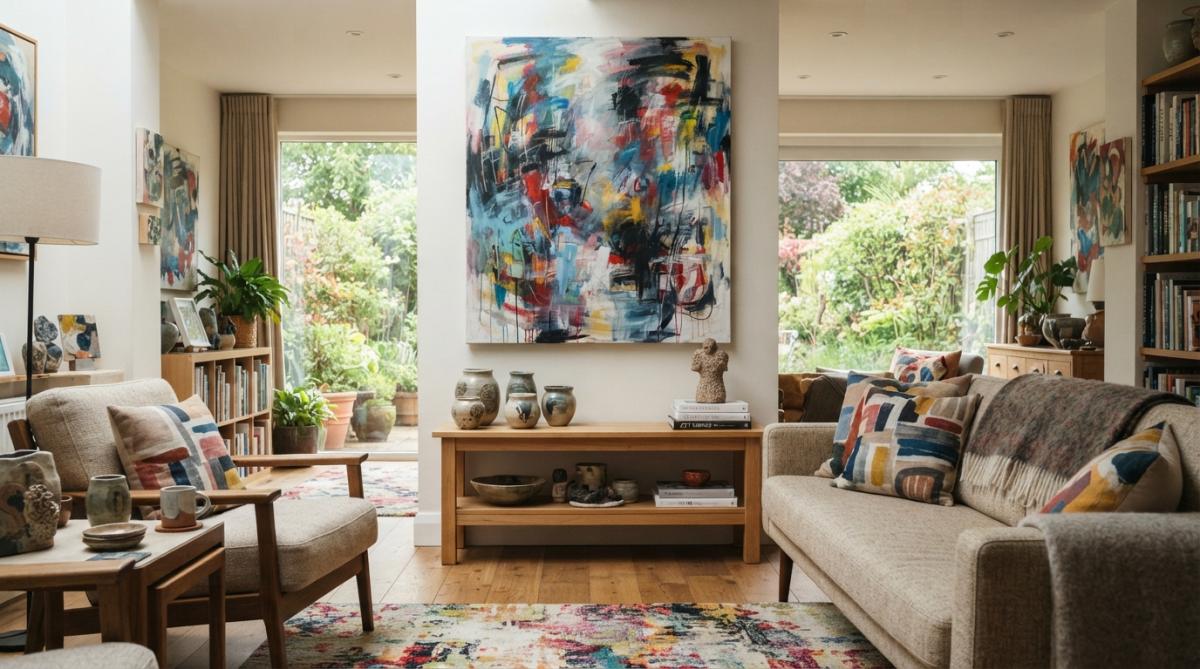
Abstract expressionism in home decor represents a bold departure from representational art, emphasizing emotional resonance and gestural expression over literal imagery. This artistic movement, characterized by non-representational forms and visible physical gestures, has become one of the two largest categories in the wall art market, commanding 30.49% market share Fortune Business Insights Wall Art Market Report. Unlike traditional art that tells a specific story or depicts recognizable subjects, abstract expressionism invites viewers to respond to color, form, and composition on a deeply personal level.
Selecting the right abstract expressionism home decor requires understanding how these pieces transform spatial dynamics and emotional atmosphere. The movement's adaptability across diverse interior styles makes it uniquely suited to contemporary homes seeking authentic visual interest.
The Role of Emotion and Self-Expression in Abstract Art
Emotion forms the foundation of abstract expressionism's power in domestic spaces. These works communicate feeling through color intensity, compositional balance, and visible brushwork, creating a unique connection between viewer and artwork that representational pieces often cannot achieve.
The artist's self-expression becomes the primary subject. When you hang an abstract expressionist painting in your home, you're not displaying a scene, you're displaying the artist's authentic emotional gesture. This authenticity resonates with modern homeowners seeking meaningful, soul-speaking decor that reflects their own values and sensibilities. According to YMI Painting's 2026 Design Analysis, the movement's resurgence stems directly from this lack of fixed narrative, allowing each viewer to project their own emotional experience onto the work.
Abstract expressionism engages the viewer's subconscious, creating a visceral response that influences mood and spatial perception. A room anchored by a powerful abstract expressionist piece feels more intentional and personally curated.
Abstract Paintings for Living Room Decor: Selection and Placement
Selecting abstract paintings for living room decor requires understanding the artwork's visual weight, your space's architectural features, and how lighting will interact with the piece's surface texture and color depth.
Lighting's Technical Role in Revealing Texture
Abstract expressionist paintings rely on visible brushwork and surface texture to communicate emotion. North-facing natural light reveals subtle value shifts without harsh shadows, while south-facing windows introduce warm afternoon light that intensifies warm hues but may wash out cooler tones.
LED bulbs rated 4000K to 5000K provide neutral color rendering and reveal the artist's intended palette. Picture lights mounted 12 to 18 inches above the frame at a 30-degree angle illuminate the surface without glare, a technique museums use to reveal texture while minimizing reflective glare.
For paintings with heavy impasto, side-lighting at a shallow angle emphasizes the three-dimensional quality of brushstrokes. If your living room relies on overhead lighting, add a dedicated picture light or track lighting to reveal the painting's dimensional quality.
Canvas Scale and Room Proportion
Your abstract painting should occupy roughly one-third of the wall space it dominates, typically 36 to 60 inches in width for most living rooms.
Budget-Conscious Sourcing and Quality Assessment
Look for prints with lightfast pigments rated 100+ years to prevent fading.
When evaluating affordable prints, assess pigment specification ("archival" or "lightfast").
Placement Strategy for Maximum Impact
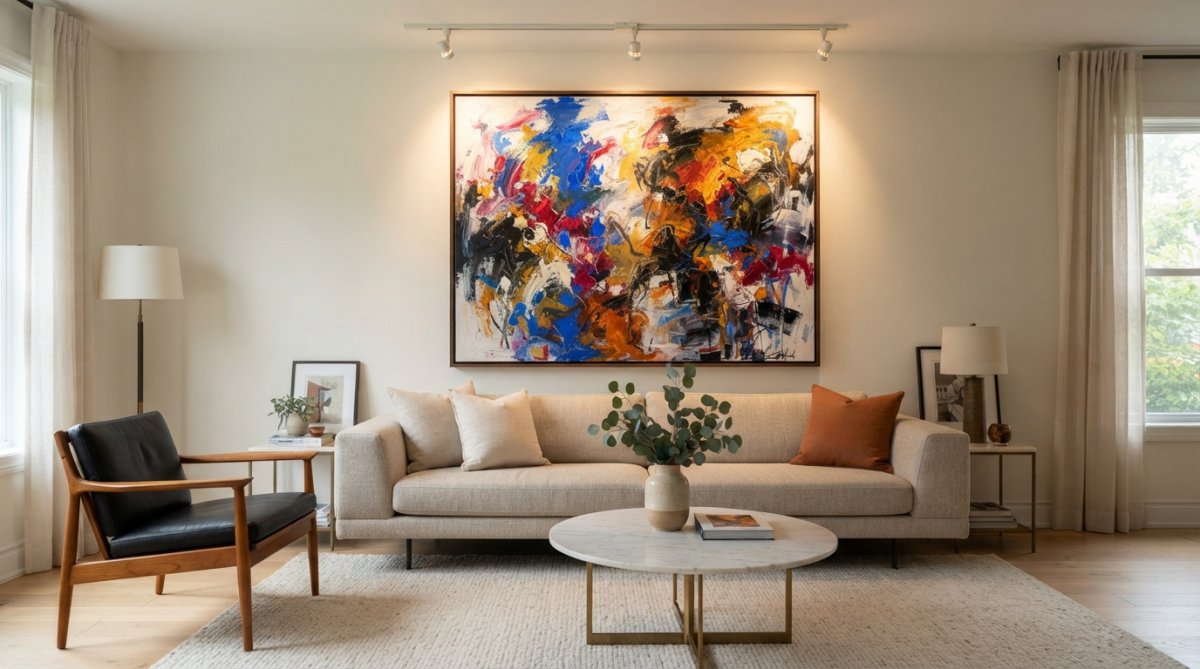
Position your abstract expressionism home decor above a sofa or console table at eye level (57 to 60 inches from the floor when seated) to establish it as the primary focal point without competing with windows or architectural features.
How to Style Abstract Art in Any Interior
Abstract art's greatest strength lies in its design versatility across minimalist and maximalist interiors. Successful styling requires understanding how different compositional styles create psychological impact in different room contexts.
Matching Compositional Energy to Room Function
Paintings with horizontal brushstrokes and calm color fields (blues, greens, earth tones) create stability, ideal for bedrooms and offices. Paintings with diagonal marks, high saturation, and dense activity energize viewers, suiting living rooms and kitchens.
When selecting abstract work, assess whether your eye moves smoothly across the canvas (calming) or jumps between focal points (energizing), and match this rhythm to the room's purpose.
Color Harmony and Palette Integration
The key to successful styling involves understanding compositional balance within your room's existing design. If your furniture arrangement emphasizes clean lines and neutral tones, select abstract work featuring geometric abstraction or monochromatic palettes with subtle texture and depth. For spaces with bold, patterned furnishings, choose paintings with complementary color fields that echo your existing palette without competing for visual attention.
Warm wall colors pair beautifully with abstract compositions featuring gestural brushwork in contrasting hues. Cool wall colors allow paintings with organic forms and color intensity to become dominant visual anchors. The artwork should enhance your existing palette, not fight against it. A practical approach: photograph your room's wall color and furniture in natural light, then hold paint chips or printed images of potential paintings against the photo to assess color harmony before purchasing.
Negative Space and Visual Breathing Room
Negative space becomes your ally. Don't surround your abstract painting with competing wall art or decorative objects. Allow the work breathing room; this restraint amplifies its visual impact. The trend toward "fewer pieces, but stronger" individual artworks reflects this principle: one powerful abstract expressionist piece creates more impact than a gallery wall of smaller works. This approach also reduces visual clutter, which research in environmental psychology suggests lowers cognitive load and stress in domestic spaces.
Consider the artwork's relationship to your room's color scheme and the psychological effect you want to create. A painting with warm, energetic brushwork in an otherwise cool, minimal room creates a focal point that draws the eye and stimulates conversation. The same painting in a warm, eclectic room might feel redundant. The goal is intentional contrast or harmony, not accidental visual competition.
Budget-Conscious Curation Across Multiple Spaces
Many homeowners assume abstract expressionism requires significant investment across multiple rooms. Strategic curation allows you to create cohesive abstract-forward design without premium pricing. Purchase one investment-quality original or high-end print for your primary living space, then source complementary affordable prints for secondary spaces. This tiered approach maintains visual consistency while distributing cost across your home.
When building an abstract collection on a budget, identify a unifying element: a shared color palette, a consistent artist's style, or a particular compositional approach (all gestural, all geometric, all organic). This coherence makes disparate price points feel intentional rather than random. An original abstract expressionist painting paired with giclée prints that share its color language or compositional energy creates a curated collection that feels sophisticated and deliberate.
Color Theory, Palette Selection, and Visual Harmony
Color theory underpins effective abstract expressionism home decor selection. Understanding how colors interact, through complementary relationships, analogous harmonies, and color temperature, ensures your painting enhances rather than clashes with your interior.
Complementary color relationships create maximum visual contrast and energy. A painting dominated by warm oranges and reds vibrates against cool blue walls, creating spatial dynamics that energize the room. Analogous color schemes, where your painting's palette sits adjacent on the color wheel to your room's dominant tones, produce visual harmony and sophistication, moving beyond mere representational form into pure aesthetic resonance.
Monochromatic paintings offer sophisticated restraint. A work rendered entirely in shades of gray, blue, or earth tones provides visual interest through texture and compositional complexity rather than chromatic intensity. These pieces work exceptionally well in spaces already featuring bold color or pattern, allowing the painting's gestural brushwork to command attention without introducing competing hues.
Value contrast, the difference between light and dark areas, matters as much as color itself. A painting with strong value contrast reads clearly from across the room and anchors the space visually. Works with subtle value shifts create intimacy and require closer viewing, making them ideal for intimate spaces like bedrooms or home offices.
Balancing Chaos and Control: Compositional Principles
The tension between chaos and control defines abstract expressionism's visual power. These paintings appear spontaneous yet possess underlying compositional structure that prevents them from feeling random or unfinished.
Compositional balance in abstract work operates differently than in representational art. Rather than distributing recognizable objects symmetrically, abstract expressionism achieves balance through visual weight distribution. A concentrated area of intense color on one side of the canvas might be balanced by a larger area of subtle gestural marks on the opposite side. This asymmetrical balance creates dynamic tension that engages the viewer's eye.
The focal point in abstract expressionism often emerges through color intensity, value contrast, or density of gestural marks. Your eye naturally moves toward the brightest hue, the darkest value, or the most densely worked area.
Technical Framing, Lighting, and Psychological Impact
How you frame and light your abstract expressionist painting significantly influences its psychological impact and perceived value. Proper framing protects the artwork while establishing visual boundaries that enhance the composition.
Frequently Asked Questions
What is abstract expressionism in simple terms?
Abstract expressionism is an artistic movement that prioritizes emotional expression and gestural brushwork over representational imagery. In home decor, it uses bold colors, dynamic forms, and visible physical gestures to create visual and emotional impact. The style emphasizes the artist's process and emotional state rather than depicting recognizable objects, making each piece a unique expression of feeling and movement.
How do I know if abstract expressionism will work in my living room?
Abstract expressionism adapts across diverse interior styles, from minimalist to bold. The key is selecting pieces with color palettes and compositional balance that complement your existing décor. Consider the room's natural light, wall color, and furniture arrangement. Large-scale abstract art works best as a focal point, anchoring the space visually. If you're uncertain about fit, look for pieces with emotional resonance that speaks to you personally, that connection often translates into successful placement.
Can I use abstract art in a traditional or classic home?
Yes. Abstract expressionism challenges predictability in classic interiors by introducing non-objective imagery that creates visual interest without competing with traditional elements. The key is using pieces with restrained color fields or monochromatic approaches that maintain spatial harmony with your existing aesthetic. Pairing one statement abstract piece with classic furniture creates aesthetic contrast while preserving the room's overall character and sophistication.
What makes original abstract expressionism worth the investment?
Original abstract expressionism pieces carry artistic authenticity, emotional depth, and lasting value. Each work reflects the artist's unique gestural technique, compositional choices, and use of color intensity. Unlike reproductions, originals develop character over time and create genuine emotional resonance in a space. When purchasing from artists committed to both artistic integrity and social impact, such as those supporting meaningful causes, you're investing in a piece that transforms your environment while supporting a greater cause.