 how-to
How to Frame Abstract Canvas Art Properly
Table of Contents
- Decide Whether to Frame Your Abstract Canvas
- How to Measure a Canvas for Framing
- Choosing the Best Frame for Abstract Art
- Prepare Your Canvas and Work Surface
- Position and Secure Your Canvas in the Frame
- DIY Canvas Framing: Step-by-Step Installation
- Install Hanging Hardware and Display Your Framed Canvas
- Common Mistakes to Avoid When Framing Abstract Canvas
- Frequently Asked Questions
Last Updated: October 8, 2026
Decide Whether to Frame Your Abstract Canvas
The first step in learning how to frame abstract canvas art properly is deciding whether framing is right for your piece. Some artists leave work unframed to showcase raw edges and texture; others rely on frames to complete the visual impact.
Consider your space and the canvas. A stretched canvas with finished edges might look complete alone, while an unstretched canvas or one with visible staples typically benefits from framing. A minimalist space might call for a simple floater frame; a traditional room might need a classic frame with matting.
At Susan Fielder Art, we've found the right frame doesn't just protect your artwork, it creates visual balance and draws the eye where you want it to go.
Ask yourself these questions before you frame:
- Does your canvas have finished edges or raw sides?
- Will the frame complement your room's aesthetic?
- Do you want the frame to blend in or stand out?
- Is protecting the canvas edges a priority?
How to Measure a Canvas for Framing
Accurate measurements are the foundation of proper framing. Get this wrong and your canvas won't fit, leaving gaps or forcing a poor fit that damages the artwork.
For a stretched canvas, measure width and height at the front face, from the outermost edge to the opposite edge. Don't include stretcher bar depth in those measurements.
Record three measurements: width, height, and depth (front of canvas to back). Depth matters because floater frames must accommodate canvas thickness.
For unstretched canvas, measure the fabric dimensions, excluding rolled edges. If you'll stretch it later, account for extra material.
Here's a practical measuring process:
- Use a metal ruler or measuring tape for accuracy
- Measure in inches (the standard for framing)
- Take measurements at three points (top, middle, bottom for width; left, middle, right for height)
- Record the largest measurement if there are slight variations
- Double-check each measurement before ordering a frame
Choosing the Best Frame for Abstract Art
Selecting the best frame for abstract art means understanding your options. Two styles dominate: floater frames and traditional frames, each suited to different canvas types.
Floater Frame for Canvas: Spacing and Depth
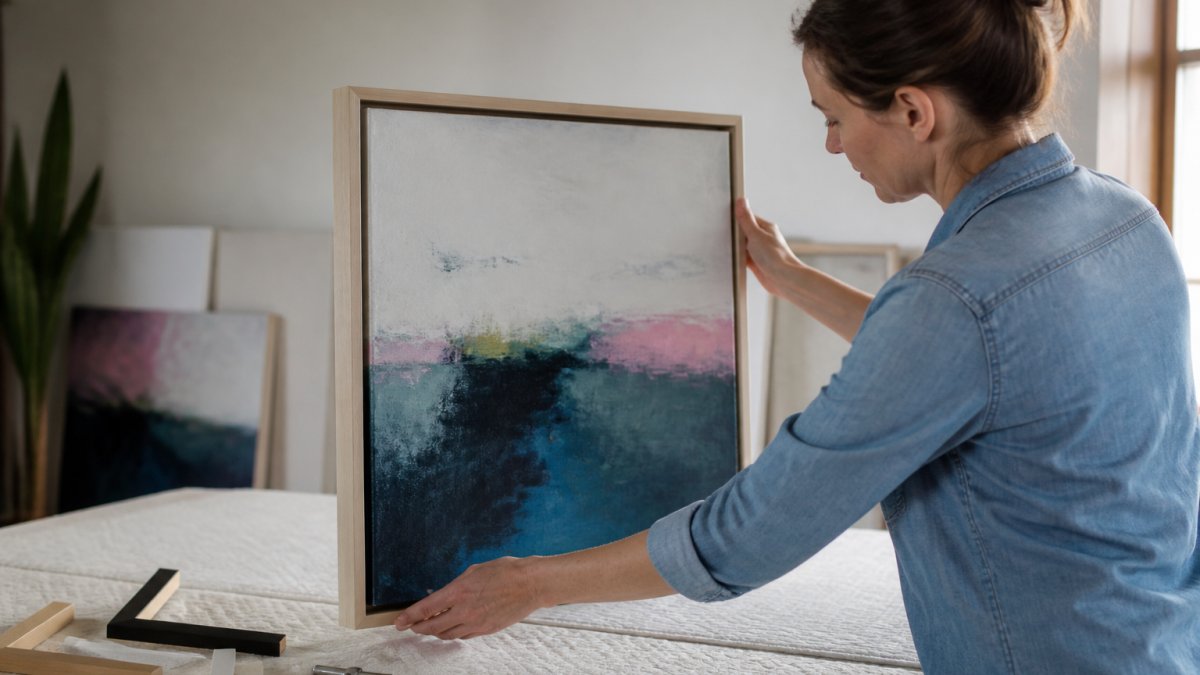
A floater frame for canvas holds stretched canvas without matting or glazing. It sits slightly away from the canvas edges, and this "floating" effect showcases canvas depth for a modern, gallery-quality look.
Floater frames work best with stretched canvas. Interior dimensions must match your canvas width and height exactly; the canvas sits inside the opening on spacers or a ledge, and the gap highlights the artwork.
When choosing a floater frame for canvas, consider these factors:
- Frame depth: Must accommodate your canvas thickness (typically 1.5 to 2 inches for standard stretchers)
- Material: Wood, metal, or composite options each affect the overall look
- Color: Should complement or contrast intentionally with your abstract art
- Finish: Matte, glossy, or textured surfaces change how light interacts with the frame
Floater frames come in standard sizes. If your canvas is 16x20 inches, you'll order a 16x20 floater frame. The frame opening matches your canvas dimensions precisely.
Traditional Frames and Mat Board Options
Traditional frames work with matting and backing boards, suiting unstretched canvas, fine art prints, or stretched canvas you want to display with matting.
A mat board (or matte board) is the cardstock layer between artwork and frame. It keeps the canvas off the glass, prevents moisture buildup, and adds visual breathing room.
Mat board comes in various colors and textures. White, cream, and gray let your abstract art take center stage; colored mats can complement specific tones.
When using a traditional frame with mat board:
- The mat opening should be slightly smaller than your canvas to create a border
- Typical mat borders range from 1.5 to 3 inches on all sides
- Acid-free mat board prevents yellowing and protects your artwork
- Backing board goes behind your canvas for additional support and protection
The Smithsonian Institution's conservation guidelines for artwork framing recommend using archival-quality materials when framing valuable pieces. This ensures your abstract canvas stays vibrant and protected for decades.
Prepare Your Canvas and Work Surface
Before framing your abstract canvas, prepare both the canvas and your work area. A clean surface prevents damage and ensures proper assembly.
Clean your canvas gently with a soft, dry cloth to remove dust. A slightly damp cloth works on edges and back if needed, but avoid excess moisture and let it dry completely.
Inspect the canvas for any issues:
- Check for loose threads or fibers
- Look for dents or damage that needs addressing before framing
- Verify the canvas is fully dry if it's a recent painting
- Ensure stretcher bars are square and properly constructed
Prepare your work surface next. You'll need:
- A clean, flat table or workspace
- Soft cloth or padding to protect the canvas face
- Good lighting to see what you're doing
- All frame components organized and within reach
- A level to ensure proper alignment
Lay a clean cloth or soft padding on your work surface and place the canvas face-down to protect the artwork from scratches while securing it.
Position and Secure Your Canvas in the Frame
Positioning and securing your canvas determines whether your framed abstract canvas looks gallery-quality or amateur.
For a floater frame, center the canvas in the opening so it's equidistant from all frame edges. Check that the gaps on all sides appear even.
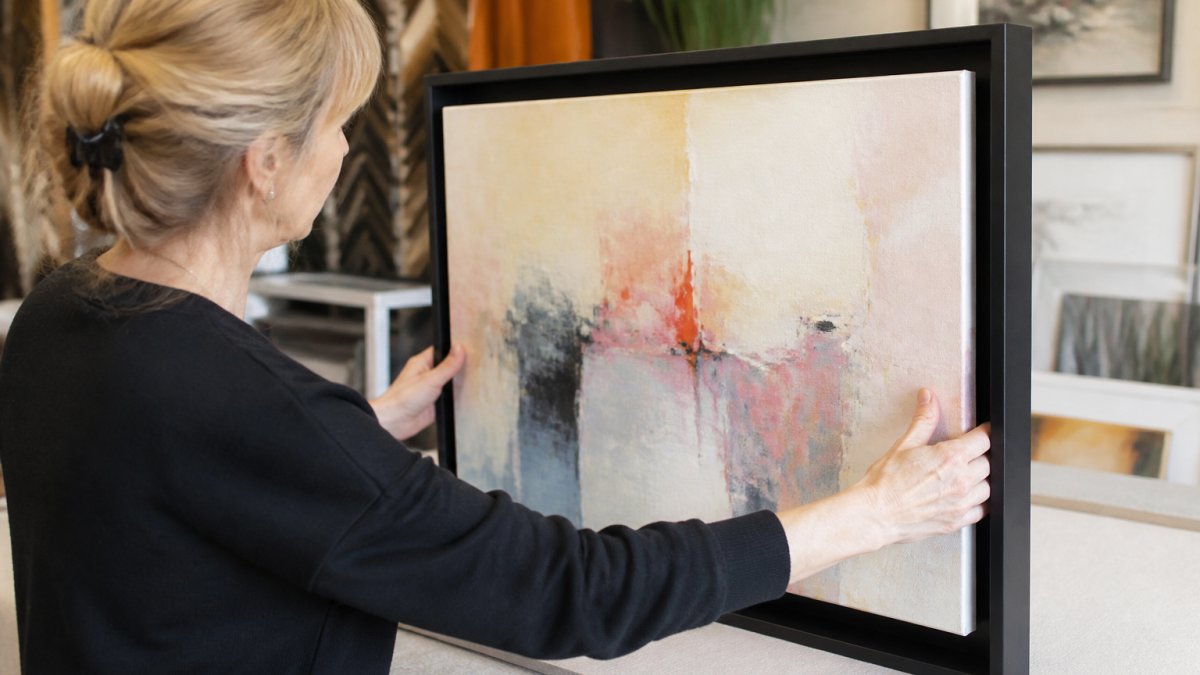
Once positioned correctly, secure the canvas using the method appropriate for your frame type:
For floater frames:
- Use the frame's built-in supports or spacers
- Some floater frames have adjustable ledges; position these to support the canvas
- Never use nails or screws that penetrate the canvas
- Check that the canvas doesn't shift when you gently press it
For traditional frames with matting:
- Center the canvas behind the mat opening
- Use acid-free tape or archival adhesive to secure the canvas to the backing board
- Never use regular tape, which yellows and damages artwork over time
- Ensure the canvas lies flat against the backing
Test security by gently tilting the frame; the canvas should not move or shift. If it does, adjust your securing method.
For textured or irregular surfaces, small foam spacers can level uneven canvas backs. Place them where they won't be visible from the front.
DIY Canvas Framing: Step-by-Step Installation
If you're framing your abstract canvas yourself, follow this systematic approach.
Step 1: Gather all materials and tools
- Your canvas (clean and ready)
- Frame components (frame, spacers, backing board, mat if using)
- Hardware (D-rings, wire, or hanging brackets)
- Adhesive (acid-free tape or archival glue)
- Tools (level, measuring tape, soft cloth)
Step 2: Assemble the frame Follow the frame manufacturer's instructions. Most frames come in pieces that slot together.
Step 3: Install spacers or supports For floater frames, position spacers according to your canvas depth.
Step 4: Position the canvas Place the canvas in the frame opening. Center it carefully.
Step 5: Secure the canvas Use your chosen method: frame supports, archival tape, or adhesive. Work methodically.
Step 6: Add backing board Slide the backing board into place behind the canvas.
Step 7: Install the frame back Close the frame according to its design.
Step 8: Verify everything is secure Gently test the canvas position. Nothing should move or rattle.
Install Hanging Hardware and Display Your Framed Canvas
The final steps involve hanging hardware and getting your framed abstract canvas on the wall. Proper installation keeps it secure and beautifully displayed.
Choose hanging hardware based on your frame weight. Light frames can use simple D-rings and wire. Heavier frames need sturdy hardware rated for the weight.
Install D-rings on the back of the frame:
- Position them about one-third down from the top
- They should be equidistant from the frame edges
- Secure them firmly with screws (not nails)
- Use washers under screw heads to prevent pulling through
Attach hanging wire between the D-rings. The wire should form a slight arc when the frame hangs. This distributes weight evenly and prevents tilting.
For wall installation, locate studs if possible. Use wall anchors if studs aren't available. The hanging hook or nail should be rated for your frame's weight.
Here's the installation sequence:
- Mark the wall where you want the frame centered
- Install the hanging hook at the correct height
- Hang the frame by its wire
- Check that it's level using a level tool
- Adjust if needed until perfectly straight
- Step back and assess the visual balance
Consider the canvas's relationship to surrounding elements. Eye level is typically the frame's center at approximately 57-60 inches from the floor, creating natural visual flow.
Common Mistakes to Avoid When Framing Abstract Canvas
Knowing what not to do prevents costly errors and protects your artwork.
Mistake 2: Inaccurate measurements Measure multiple times.
Mistake 3: Using non-archival materials Regular tape yellows and damages artwork. Non-acid mat board deteriorates.
Mistake 4: Positioning the canvas off-center An off-center canvas looks amateur.
Mistake 5: Over-tightening securing hardware Excessive tightness can warp canvas or bend stretcher bars.
Mistake 6: Neglecting to protect textured surfaces Abstract canvases with heavy texture need careful handling.
Mistake 7: Hanging without proper support Inadequate hanging hardware causes frames to tilt or fall.
Mistake 8: Ignoring humidity and environment Canvas reacts to humidity changes.
When you frame abstract canvas properly, you protect your investment and showcase the artwork beautifully.
We believe that framing is the final brushstroke in presenting your abstract canvas.
Framing your abstract canvas doesn't have to be intimidating. When you're ready to invest in original abstract artwork that deserves beautiful framing, Susan Fielder Art's curated collection offers emotionally resonant pieces designed to inspire.
Frequently Asked Questions
Should abstract canvas art be framed?
Framing abstract canvas art is entirely optional but offers real benefits. A frame protects the canvas edges from dust and damage, enhances visual balance in your room, and creates a finished, gallery-like appearance. Stretched canvas can stand alone on a shelf or lean against a wall, but framing elevates the presentation and helps the piece integrate with your décor. Consider framing if you want to protect your investment, create a cohesive wall display, or give the artwork a more polished look.
What type of frame is best for abstract canvas art?
Floater frames are ideal for abstract canvas because they surround all four sides while allowing the canvas edges to remain visible, which complements abstract work. Traditional frames with mat board also work well, especially for unstretched canvas. Choose frame materials and colors that complement your abstract art's palette and your room's aesthetic. For textured or irregular abstract surfaces, floater frames provide better support than mat-based options.
How do you measure a canvas for a frame?
Measure the width and height of your stretched canvas at its widest points using a ruler or measuring tape. For a floater frame, add the canvas depth (typically 1.5 to 2.5 inches) to your measurements. Measure from the front face of the canvas to ensure accurate frame sizing. If using a mat board, measure just the visible front surface. Write down all measurements in inches and double-check before ordering your frame. Most framers can guide you through sizing if you provide these measurements.
Can you frame canvas art yourself?
Yes, DIY canvas framing is possible with basic tools: a frame kit or pre-made frame, spacers, backing board, and hanging hardware. Floater frames are easier for beginners because they require less assembly. Ensure your work surface is clean and soft to protect the canvas. Carefully position the canvas, use spacers to maintain even gaps, and secure the backing board. If you're uncomfortable with the process, professional framers can handle it, though this adds cost. Start with a simple floater frame if attempting DIY for the first time.