 how-to
How to Frame Abstract Canvas Paintings: 2026 Guide
Table of Contents
- Why Floater Frames Are the Standard for Abstract Canvas Art
- Floating Frame vs Traditional Frame: Which Works for Canvas?
- DIY Canvas Framing Tools and Materials You'll Need
- How to Measure Your Stretched Canvas for a Custom Frame
- Step-by-Step: How to Frame Abstract Canvas Paintings at Home
- Best Frame Styles for Abstract Art: Color, Profile, and Finish
- Weight, Mounting, and Archival Care for Framed Canvas
- Where to Find Abstract Canvas Art Worth Framing
- Frequently Asked Questions
Last Updated: September 15, 2026
Why Floater Frames Are the Standard for Abstract Canvas Art
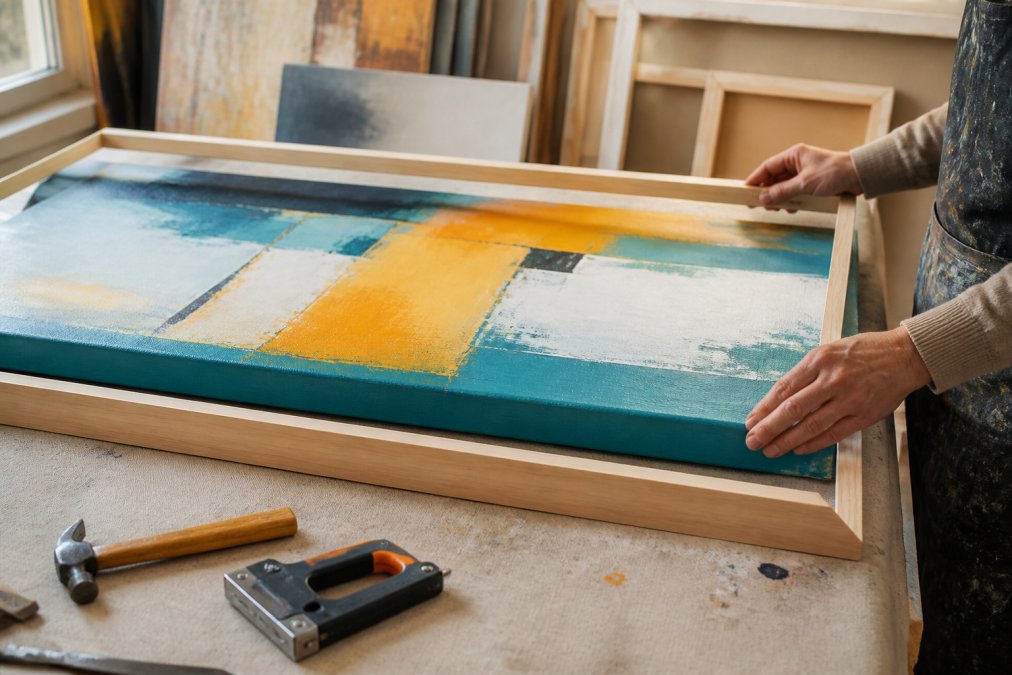
Floater frames are the default for abstract canvas art because they display the full perimeter of the painting without covering a single brushstroke. The canvas sits inside the frame with a small gap, so the artwork appears to float.
That gap matters: abstract work lives and dies by its edges, the paint wrapping the sides, the texture at the corners. A traditional frame with a lip hides 1/4 to 1/2 inch of that surface on every side. A floater frame hides nothing.
Market data backs up the shift. The abstract segment is projected to account for 30.49% of the wall art market in 2026, while the canvas segment is projected to hold a 45.11% share, according to Fortune Business Insights' Wall Art Market Report. When nearly half of all wall art sold is canvas, the frame that protects canvas best wins by default.
Floating Frame vs Traditional Frame: Which Works for Canvas?
A floater frame is the better choice for canvas in almost every case. A traditional frame is built for paper, panel, or board, where a rabbet lip holds a flat, rigid surface in place. Canvas is neither flat nor rigid.
Here's the practical difference:
| Feature | Floater Frame | Traditional Frame |
|---|---|---|
| Edge visibility | Full canvas visible | 1/4-1/2 inch covered per side |
| Depth requirement | Needs 1/8-1/4 inch clearance | Sits flush against lip |
| Best for | Stretched canvas, gallery wrap | Paper, panel, board |
| Glass | Never used | Often required |
| Texture display | Unobstructed | Partially hidden |
The glass question trips up a lot of first-timers. Experts advise against using glass on canvas paintings because it flattens the texture and traps moisture against the surface, per Montcarta's canvas framing guidance. Canvas needs to breathe. A floater frame leaves it exposed on the front, which is exactly what you want.
One more data point worth knowing: decorative frames make abstract paintings seem less valuable to viewers than simple frames do, according to ResearchGate's study on frame decorativeness and abstract art reception. Ornate molding competes with the painting. A slim floater profile lets the work speak.
DIY Canvas Framing Tools and Materials You'll Need
Framing a canvas yourself requires fewer tools than most people expect, and the kit costs less than one custom framing job.
Essential tools:
- Tape measure and pencil
- Phillips-head screwdriver
- Power drill with 1/16-inch bit
- Staple gun (for canvas stretching, not frame assembly)
- Wire cutters
Materials:
- Floater frame sized to your canvas depth
- D-rings (two per frame)
- Picture hanging wire rated 2x the artwork weight
- Screw eyes or frame brackets (usually included)
- Felt pads or bumpers
Total time: 30-45 minutes for a standard rectangular canvas.
Difficulty: Beginner. No woodworking required if you buy a pre-mitered floater frame.
The one item people forget is a frame deep enough for the canvas. A stretched canvas typically runs 3/4 to 1-1/2 inches deep, and the rabbet must clear that depth with room to spare. Measure before you buy.
How to Measure Your Stretched Canvas for a Custom Frame
Measure the back of the canvas, not the front. The front measurement includes the wrapped edges, which can add up to 1/8 inch per side, the difference between a frame that seats cleanly and one that arrives too tight.
The measurement process for a standard rectangle:
- Lay the canvas face-down on a clean, flat surface.
- Measure the width across the back from outer edge to outer edge.
- Measure the height the same way.
- Measure the canvas depth from the back of the stretcher bar to the front face of the canvas.
- Record all three numbers in inches, to the nearest 1/16 inch.
For a floater frame, order the frame's inner dimensions to match your canvas; the manufacturer handles the gap. For a custom frame, give the canvas measurements and specify "floater." For a ready-made frame, compare your measurements to the listed rabbet dimensions, not the outer dimensions on the box.
Measuring non-standard shapes. This is where most framing mistakes happen: round, oval, hexagonal, and organic canvases can't be captured with width and height alone.
- Round and oval canvases: Measure the diameter at the widest point, then again at 90 degrees to confirm it's round. Hand-stretched rounds are frequently off by 1/8 inch or more; record both numbers for the framer.
- Irregular and organic shapes: Trace the canvas outline onto large paper, mark the top edge, and mail or scan the template to the frame shop. A traced template is the only reliable way to cut a custom frame for a non-polygon shape.
- Multi-panel work (diptychs, triptychs, grids): Measure each panel individually. Panels from the same series are often within 1/16 inch but not identical, and a frame cut to the average leaves one panel rattling. Order per panel, not per set.
- Deep or shallow canvases: Gallery-wrapped canvas typically runs 3/4 to 1-1/2 inches deep, but deep-cradle canvases can run 2 inches or more and thin panels under 1/2 inch. Measure depth at the corner, where stretcher bars overlap and the profile is thickest, a side rail's middle can read thinner and give a false clearance number.
A note on warped or bowed canvases. Older canvases sometimes bow along one edge. Lay a straightedge across each side and note any gap. A frame shop can sometimes accommodate a slight bow with a deeper rabbet, but a canvas bowed more than about 1/4 inch usually needs re-stretching.
Step-by-Step: How to Frame Abstract Canvas Paintings at Home
Framing a canvas at home takes about 30 minutes with a pre-mitered floater frame. The process is reversible, requires no adhesives on the artwork, and can be done on a kitchen table. What separates a frame that survives a decade from one that sags in six months is the hardware and attachment points.
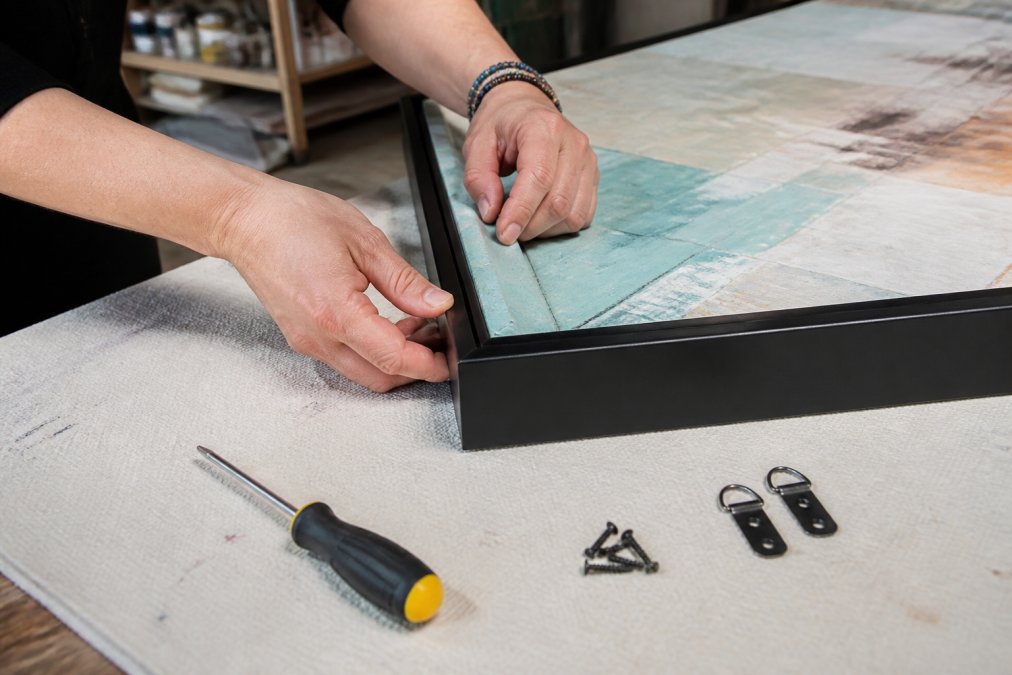
Step 1: Prep your workspace. Lay a soft towel or clean cardboard on a flat surface; you'll flip the canvas face-down and don't want the painted surface touching anything abrasive. Let a canvas that just came off a cold truck acclimate a few hours before you screw into the stretcher bars.
Step 2: Assemble the frame. Most floater frames arrive as four pre-mitered pieces.
Best Frame Styles for Abstract Art: Color, Profile, and Finish
Frame color by painting palette:
| Painting Dominant Tones | Recommended Frame | Why It Works |
|---|---|---|
| Warm (reds, oranges, ochres) | Natural oak or walnut | Echoes warmth without matching it |
| Cool (blues, grays, greens) | Matte black or charcoal | Grounds cool tones, adds definition |
| Neutral (whites, creams, beiges) | White or light ash | Blends into wall, keeps focus on texture |
| Bold multicolor | Thin gold or brass | Adds a quiet accent without fighting |
Weight, Mounting, and Archival Care for Framed Canvas
Where to Find Abstract Canvas Art Worth Framing
Frequently Asked Questions
Should abstract canvas paintings be framed with glass?
No. Glass traps moisture against the canvas surface and flattens the texture that makes abstract work feel dimensional. Experts advise against glass on canvas because it hides brushstrokes and can damage the painted surface over time. A floater frame leaves the canvas exposed while adding a finished edge, so the texture stays visible and the piece stays protected without a glass barrier.
What is the difference between a floater frame and a traditional frame?
A traditional frame overlaps the front edge of the artwork, covering the outer inch or so of the canvas. A floater frame sits behind the canvas with a small gap around the perimeter, so the full painted surface stays visible. For abstract canvas framing, the floater style is preferred because it shows the complete composition and adds depth without hiding wrapped edges or brushwork.
Can I frame a canvas painting myself at home?
Yes. Most stretched canvases can be framed at home with a pre-built floater frame, a screwdriver, and mounting hardware. Measure the canvas depth and width first, order a frame with a rabbet slightly deeper than the canvas, then attach the canvas from the back using screws through the frame's inner lip. No glass, matting, or professional tools are required for a clean result.
How do I measure a canvas for a custom frame?
Measure the width and height across the back of the stretcher bars, not the front face, since canvas wraps around the edges. Then measure the canvas depth from the back of the stretcher to the front of the painted surface. Order a floater frame sized to the back dimensions with a rabbet depth at least 1/8 inch deeper than your canvas so it sits flush without pressing the paint.
Framing abstract canvas art is a 30-minute job that changes how a room feels. The right floater frame shows every brushstroke, protects the surface, and lets the painting do the work it was made to do. Browse the original abstract canvases at Susan Fielder Art, pick a piece that speaks to you, and frame it to match. Every purchase supports pancreatic cancer research, so the art on your wall carries meaning long after the frame is hung.