 how-to
Styling Abstract Art Above a Sofa: 2026 Guide
Table of Contents
- The 2026 Shift: Why One Statement Piece Beats a Gallery Wall
- How High to Hang Art Above Sofa: The 6-8 Inch Rule
- How to Find the Best Size Art for Above Couch
- Choosing Abstract Art That Complements Your Living Room
- Gallery Wall Layout Tips for Abstract Art Lovers
- Beyond the Canvas: Texture, Lighting, and Rentals
- Conclusion
- Frequently Asked Questions
Last Updated: September 9, 2026
The 2026 Shift: Why One Statement Piece Beats a Gallery Wall
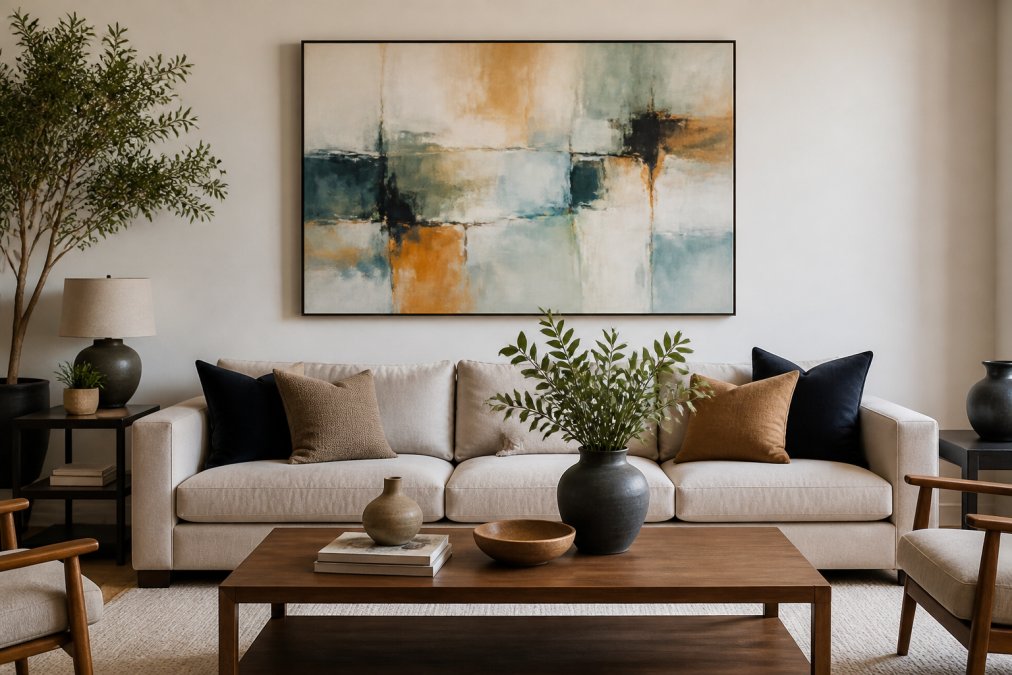
Interior design for 2026 has moved decisively away from clustered gallery walls toward a single, large horizontal painting as the primary focal point above the sofa Ridyart 2026 trend guide. Styling abstract art above a sofa now centers on choosing one bold, emotionally resonant piece rather than arranging many small frames. This guide from Susan Fielder Art walks through placement, scale, and style so your living room feels intentional and grounded.
The shift makes practical sense. A statement piece simplifies visual balance, reduces clutter, and lets the artwork's texture and color do the talking. For homeowners and renters alike, one oversized abstract canvas offers a cleaner, more modern look than coordinating five or six smaller frames.
How High to Hang Art Above Sofa: The 6-8 Inch Rule
The bottom of your art frame should sit 6 to 8 inches above the top of the sofa back. This placement rule, cited by Buy Wall Art's 2026 placement guide, creates a visual connection between the furniture and the artwork while keeping the piece at comfortable eye level for seated viewing.
Hanging too high leaves a floating gap that disconnects the art from the sofa; hanging too low makes the piece feel crowded and can interfere with headroom. The 6-8 inch gap also aligns with the mounting height most designers use for proper scale and proportion.
For rooms with tall ceilings, push toward the upper end of this range; in compact spaces, err slightly lower to anchor the seating area. The goal is aesthetic cohesion, not rigid math.
How to Find the Best Size Art for Above Couch
The best size art for above couch placement spans two-thirds to three-quarters of the sofa's total width, according to standard sizing guidelines from About Wall Art's sizing recommendations. For a 90-inch sofa, that means a piece roughly 60 to 68 inches wide. This proportion keeps the artwork visually balanced against the furniture without overwhelming the negative space around it.
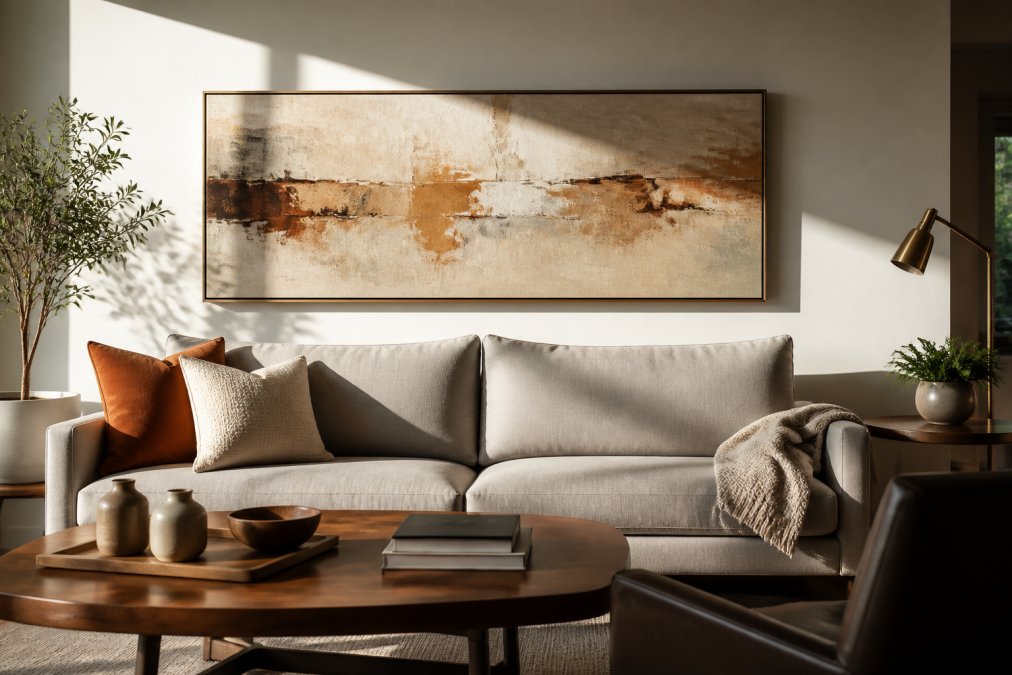
Height matters too. Large horizontal abstract pieces positioned at eye level or slightly above are the most effective way to define a living room focal point Big Artify 2026 interior design insights. Aim for a canvas height between 30 and 40 inches for most standard sofas, adjusting for your specific ceiling height and room dimensions.
| Measurement | Recommended Range | Why It Works |
|---|---|---|
| Art width vs. sofa width | 66% to 75% | Keeps scale proportional to furniture |
| Gap above sofa back | 6 to 8 inches | Connects art to seating, clears heads |
| Typical canvas height | 30 to 40 inches | Fills wall without dominating the room |
A common mistake is choosing a piece that looks substantial in the store or online but feels small once mounted. When in doubt, size up. Oversized abstract wall art has become a near-essential element for modern living rooms precisely because it commands the wall without requiring additional decor Extra Large Wall Art's 2026 market analysis.
Choosing Abstract Art That Complements Your Living Room
Selecting abstract art is not about matching a paint swatch. It is about understanding how color, form, and finish interact with your room's existing light, furniture lines, and intended mood.
Color Coordination: The 60-30-10 Rule Applied to Art
Interior designers commonly use the 60-30-10 rule for color distribution in a room: 60% dominant wall color, 30% secondary (upholstery, rugs), and 10% accent. Abstract art should function as an extension of the 10% accent layer, not as a wildcard.
Identify the single strongest accent color already present in your room, whether a throw pillow, area rug, or ceramic vase, and select an abstract piece that contains that exact hue, even in a small passage. The art does not need to match the sofa; it needs to echo an accent that already exists.
For 2026, neutral and earthy tones dominate living room palettes, with warm caramel, terracotta, and sage green appearing frequently in upholstery and wall colors. If your sofa is a warm caramel leather, pairing it with warm neutral abstract art in a modern black frame creates a cohesive, gallery-ready look. If your room leans cool, gray walls, blue-gray sofa, seek abstracts with cool undertones (taupe, slate, muted teal) to avoid a jarring temperature clash.
The Psychology of Form: Organic vs. Geometric
Abstract art is not random; its forms trigger measurable emotional responses that shape how a room feels.
- Organic, curvilinear forms, flowing arcs, soft blobs, sweeping brushstrokes, are associated with calm, relaxation, and approachability. These forms echo natural shapes found in landscapes and the human body. If your living room is the evening wind-down space, prioritize abstracts dominated by curves and soft edges.
- Geometric, angular forms, sharp triangles, hard-edged rectangles, intersecting lines, project energy, structure, and intellectual focus. These forms are associated with alertness and conversation. If your living room doubles as a home office or entertaining space where you want lively dialogue, geometric abstracts support that energy.
- Biophilic patterns, forms that suggest leaves, water ripples, or organic growth without depicting them literally, bridge both categories. They bring a natural, grounding quality that suits most living rooms, especially those with plants or natural-fiber textures.
Match the art's energy to the room's primary function: a family room for movie nights benefits from organic forms, while a formal living room for hosting can handle geometric work.
Finish and Sheen: The Overlooked Variable
The physical finish of the canvas, matte, satin, or gloss, changes how the piece reads at different times of day. Matte absorbs light, reducing glare and muting colors; gloss reflects light, intensifying saturation but creating glare when sunlight hits at an angle.
For a sofa opposite a window, matte or satin is safer; gloss will glare during afternoon hours. For a wall with no direct sunlight, gloss or metallic-accent finishes add life by catching ambient light.
Gallery Wall Layout Tips for Abstract Art Lovers
While single statement pieces lead the 2026 trend, gallery walls remain a valid choice when executed with discipline. Mixing multiple art styles works if you maintain a unifying element such as consistent color, frame, or size Artfully Walls 2024 design guidance. Without that thread, the arrangement reads as chaos.
For a cohesive gallery wall above your sofa, follow these layout guidelines:
- Establish a center point at the 6-8 inch height, then build outward symmetrically or asymmetrically from there.
- Keep spacing between frames consistent at 2 to 3 inches for a tight, intentional look.
- Limit the arrangement to three to five pieces in a horizontal orientation to echo the sofa's width.
- Use the same framing style across all pieces to create visual balance without matching artwork.
An asymmetrical arrangement works best when one anchor piece is significantly larger than the others. Layering art with a shelf below adds flexibility, allowing you to swap pieces seasonally without patching new holes.
Avoid mixing more than two frame colors in a single gallery wall. Too many framing styles fragment the composition and pull the eye in competing directions, undermining the scale and proportion you worked to establish.
Beyond the Canvas: Texture, Lighting, and Rentals
Most placement guides stop at measurements, but abstract art presents unique challenges, and opportunities, that generic wall decor does not. This section covers how the piece's surface interacts with light, how to illuminate it deliberately, and how to mount it without permanent damage.
Texture: Matching the Medium to Your Light and Distance
The surface of your abstract piece is a physical filter for light. A flat canvas print reflects light evenly, while a heavily textured piece, such as impasto with thick acrylic ridges or mixed-media with embedded fibers, creates micro-shadows that shift as daylight moves.
Consider your primary viewing distance. From 8 to 10 feet away, fine texture becomes invisible; only bold, sculptural impasto or collage elements register. If your sofa sits closer than 6 feet, subtle canvas weave or light gel strokes add interest without competing with upholstery texture.
Pair a smooth, matte sofa (like linen weave or brushed cotton) with a heavily textured canvas for contrast. Conversely, if your sofa is already textured boucle or velvet, a flat, smooth-surface abstract print prevents the wall from feeling busy.
Lighting: Engineering the Focal Point After Sunset
Abstract art, especially pieces with metallic accents, high-gloss sections, or deep texture, demands deliberate lighting. Ambient ceiling light flattens the piece and washes out its color; a dedicated art light fixes this, and the fixture choice changes how the piece reads.
- Picture lights (battery or hardwired): Mounted to the frame or wall above the canvas, these cast a warm, even pool of light. For a canvas up to 48 inches wide, a single 12- to 16-inch picture light centered above the piece is sufficient. For wider pieces, you will need two lights spaced at the one-third and two-thirds marks to avoid a dark center.
- Track lighting or adjustable recessed cans: These allow you to aim a beam at a steep angle (about 30 degrees from vertical) across the canvas surface. This raking light emphasizes texture by casting shadows from each ridge, ideal for impasto or mixed-media work. For flat prints, a steeper angle is unnecessary and can create glare.
- Color temperature matters. Warm LED bulbs in the 2700K range render earthy ochres, terracottas, and deep browns faithfully, making them the default for neutral-toned abstracts. Cooler daylight bulbs (4000K and above) sharpen the contrast in bold, high-chroma geometric pieces but can make warm palettes look muddy. Most practitioners recommend testing a bulb before committing, as the same artwork can appear dramatically different under the two temperatures.
A simple rule: if the art is the room's focal point, it should be the brightest surface in the room after dark. Dim the overhead lights and let the art light carry the space.
Rental-Friendly Mounting: Real Options for Large Canvases
Renters and frequent movers often assume a large, heavy canvas is off-limits. That is not true. The key is knowing the weight limits and failure modes of each non-damaging system.
- Heavy-duty adhesive strips (e.g., Command picture hanging strips): These are rated for weight per pair, but the rating assumes a smooth, painted wall and a rigid frame. For a 30- by 40-inch canvas in a standard aluminum or wood frame, four to six pairs of the largest strips (rated for up to 16 pounds per pair) distributed along the top and bottom rails will hold securely. The critical mechanism is surface area: strips fail when the frame flexes, so a canvas with a solid backing board (not just stretched canvas) is essential. Test the bond by pressing firmly for 30 seconds per strip and waiting an hour before hanging.
- Tension rods behind the sofa: A heavy-duty tension rod (rated for 20+ pounds) wedged between the wall and the sofa back can support a lightweight canvas (under 10 pounds) using wire or D-rings. This works only if the sofa sits flush against the wall and the rod has enough friction to hold. It is a viable zero-damage option for smaller pieces, but it will not support a large statement canvas.
- Picture rails and molding hooks: If your rental has original crown molding or a picture rail, use decorative molding hooks that hang over the rail, no nails required. This is the oldest non-damaging system and supports substantial weight, but it positions art higher than the 6-8 inch rule, so account for that when selecting piece size.
For frequent movers, consider the art's versatility beyond this room: a horizontal statement piece sized for a 90-inch sofa can become a focal point above a console table, bed, or desk in your next home.
Conclusion
Styling abstract art above a sofa comes down to three decisions: the right height, the right width, and a piece that speaks to how you want the room to feel. Start with the 6-8 inch rule, size your canvas to two-thirds or more of the sofa width, and let color and texture do the emotional work. At Susan Fielder Art, every original abstract painting carries a narrative of healing and resilience, and 10% of proceeds supports pancreatic cancer research. Shop the collection to find a one-of-a-kind piece that transforms your living space with meaning.
Frequently Asked Questions
How high should abstract art be hung above a sofa?
The bottom of your abstract art frame should sit 6 to 8 inches above the top of your sofa's back cushions. This standard creates a visual connection between the furniture and the artwork while preventing the piece from feeling disconnected or floating too high up the wall. For rooms with very tall ceilings, you can extend this to 10 inches, but the 6-8 inch range remains the safest choice for achieving a cohesive and professionally styled look.
What is the 2/3 rule for hanging art over a couch?
The 2/3 rule is a sizing guideline, not a placement one. It states that your artwork should span at least two-thirds (roughly 66%) of your sofa's width. For example, a 72-inch wide sofa calls for art that is at least 48 inches wide. For 2026, designers often recommend pushing this to three-quarters of the sofa's width for a more dramatic, statement-making look that anchors the entire living room.
Should abstract art match the color of my sofa?
Matching is not required, but coordinating is smart. Instead of matching your sofa exactly, pull a secondary accent color from your rug, throw pillows, or other decor, and look for an abstract piece that includes that hue. This creates aesthetic cohesion without making the art blend into the furniture. If you want a bold contrast, consider a textured piece in a neutral tone to complement a colorful sofa.
How do I create a gallery wall with abstract art above a sofa?
Treat the entire arrangement as one single unit when measuring. The overall footprint should follow the 2/3 width rule, and the center of the entire composition should sit at eye level. Keep the spacing between frames consistent at 2-3 inches for a unified look. To avoid a chaotic feel, use a unifying element such as matching black frames or a consistent color palette across the different abstract prints.