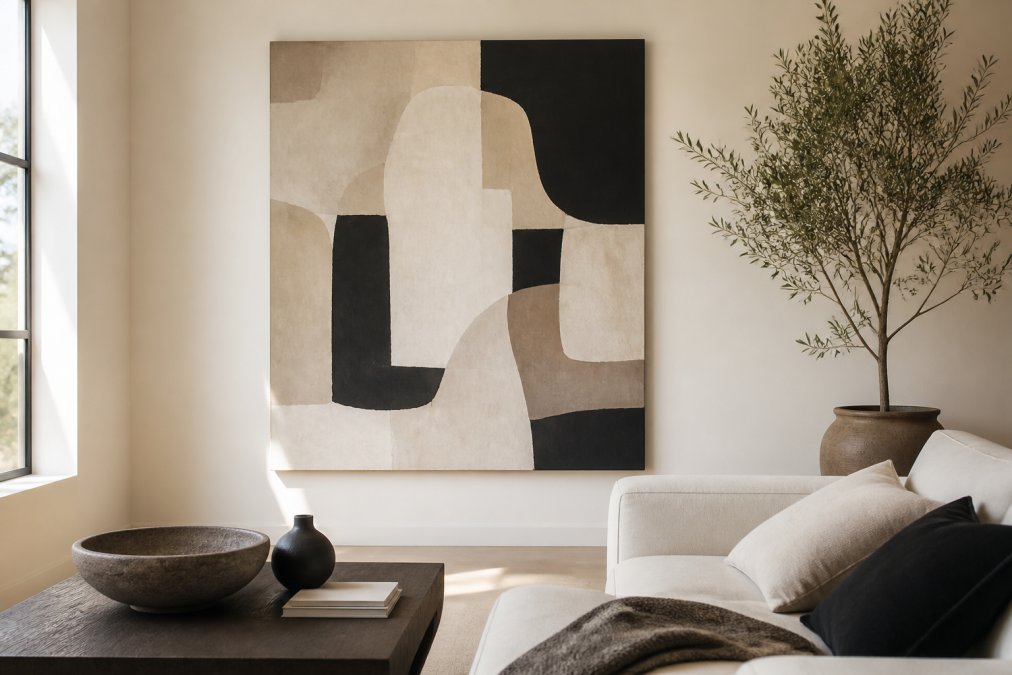
 ultimate-guide
Minimalist Abstract Art for Modern Homes Guide
Table of Contents
- Why Minimalist Abstract Art Dominates Modern Homes in 2026
- Choosing Art for Minimalist Interiors: Palette, Form, and Texture
- Large Scale Abstract Paintings for Modern Homes: Sizing and Placement
- How to Style Abstract Wall Art in Living Rooms and Open Spaces
- The Psychology of Minimalist Abstract Art and Emotional Connection
- Authenticity, Provenance, and What to Know Before You Buy
- Conclusion: Bring Meaningful Minimalist Abstract Art Home
- Frequently Asked Questions
Last Updated: September 12, 2026
Why Minimalist Abstract Art Dominates Modern Homes in 2026
Minimalist abstract art for modern homes has moved from trend to default. According to Desenio's 2026 home decor analysis, consumer demand for abstract pieces now runs 2.5 times higher than for any other style in American homes. At Susan Fielder Art, we see that shift in every order: buyers want fewer pieces, larger scale, and work with real texture instead of flat prints.
The reason is not aesthetic fashion alone. Over 70% of new residential design projects analyzed in late 2025 and early 2026 incorporated original modern abstract art as the emotional core of the space, per Iris Lee Gallery's 2026 trend report. Minimalism stripped rooms down. Abstract art gives them something to feel.
Below, we break down palette, form, scale, placement, and provenance, so you can choose a piece that still works when the trend cycle moves on.
Choosing Art for Minimalist Interiors: Palette, Form, and Texture
Choosing art for minimalist interiors comes down to three decisions: color palette, form, and surface texture. Get those right and almost any piece will settle into a quiet room.
Color Palettes That Work in Modern Interiors
Neutral tones dominate for a reason. The "quiet luxury" and warm minimalism trend favors earthy, understated palettes: bone, sand, clay, muted olive, and soft charcoal. These colors let a room breathe and keep the art from competing with your furniture.
That does not mean colorless. A single saturated accent, a rust stroke or a deep indigo field, gives the eye a focal point without breaking calm. What most guides miss is that the wall color sets the ceiling on contrast. Warm whites absorb cool grays; cool whites make warm neutrals look muddy.
Geometric vs. Organic Forms and Negative Space
Geometric composition reads architectural and deliberate. Organic forms read softer and more human. Neither is better; the choice depends on what your room already has. A space full of hard right angles benefits from organic curves. A space with soft textiles can carry a crisp geometric piece.
Negative space is where minimalist art earns its name. The empty area is not leftover canvas; it is the visual balance that lets the painted marks land. A common mistake is treating negative space as unfinished work and buying a busier piece to compensate.
Large Scale Abstract Paintings for Modern Homes: Sizing and Placement
Large scale abstract paintings for modern homes should cover roughly 60 to 75 percent of the wall width above the furniture they anchor. One oversized statement piece per wall now outperforms gallery walls in modern minimalist interiors, based on My Photo Station's 2026 wall art guide.
Sizing rules that hold up in practice:
- Sofa wall: art width between two-thirds and three-quarters of the sofa width
- Bed wall: one piece centered, hung 15-20 cm above the headboard
- Hallway or narrow wall: a vertical piece, never a wide horizontal one
- Open-plan spaces: one large piece per zone to define each area
Hanging Height, Lighting, and Framed vs. Gallery-Wrapped
Center the artwork at eye level, roughly 145 cm from the floor to the middle of the piece. In rooms where people sit, drop it slightly so the art meets the seated eyeline.
Lighting changes everything. Textured canvas needs raking light from the side to show depth; flat prints look best under even, diffuse light. Avoid direct sunlight on any original work, since UV exposure fades pigments over time.
Gallery-wrapped canvas shows the painted edge and needs no frame, which suits a clean-lined minimalist interior. Framed work adds a defined border and reads more formal. Both are valid; the room decides.
How to Style Abstract Wall Art in Living Rooms and Open Spaces
Styling abstract wall art is about restraint. Let the piece be the focal point and keep everything around it quiet. Two or three supporting objects, not ten.
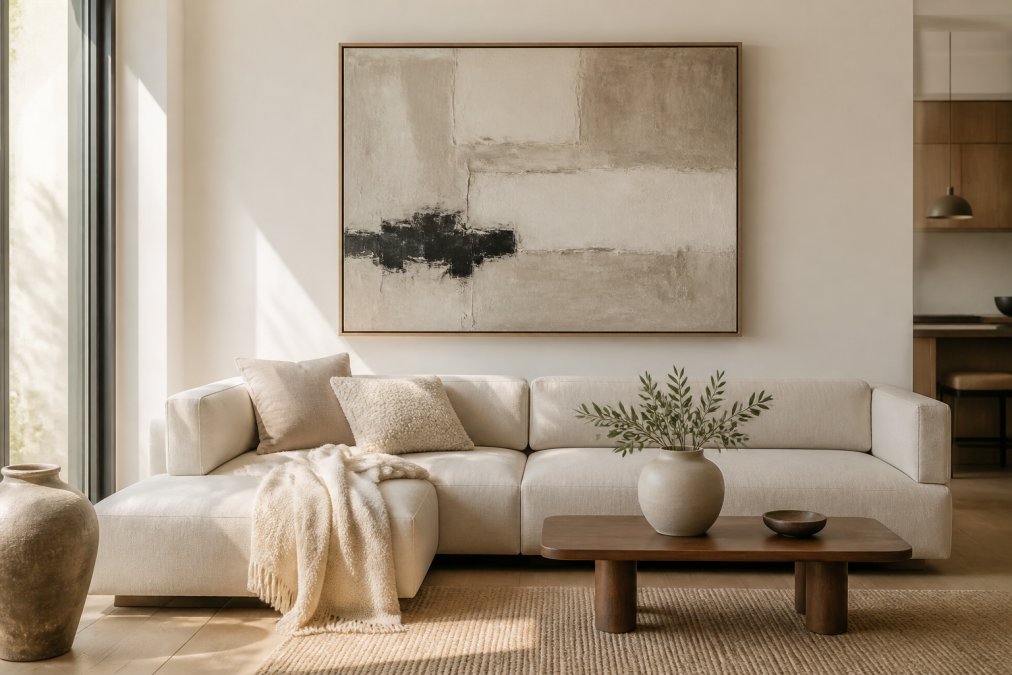
In open-plan layouts, art does the work that walls used to do. A single large canvas above the dining table separates that zone from the kitchen without a physical divider. Keep the palette consistent across zones so the whole floor reads as one composition.
The Psychology of Minimalist Abstract Art and Emotional Connection
Minimalist abstract art works psychologically because it gives the eye less to process and the mind more room to respond. That is the part most buying guides skip. A representational painting tells you what to see. An abstract piece asks what you feel, and that ambiguity is the point.
Why less visual information produces more calm
Cognitive load is the mechanism. Every edge, object, and color shift in a painting is something your visual system has to resolve. A busy figurative scene can contain dozens of those decision points; a minimalist abstract piece often contains three or four. Interior designers and art consultants commonly describe the effect as the wall "stopping the noise", the eye lands, rests, and stops scanning.
That is also why scale matters more in minimalism than in any other style. A small, quiet piece on a large wall reads as an afterthought. A large, quiet piece gives the eye enough surface to settle into without demanding anything back. The calm comes from the combination of low information density and generous size, not from the palette alone.
The sterility trap
This is why generic minimalism carries a real risk. RidyArt's 2026 trend analysis warns that flat, mass-produced pieces leave a space feeling sterile rather than calm. The difference between calm and sterile is almost always texture and intent. A flat digital print has no surface for light to move across, so the wall reads as a graphic rather than an object. Hand-applied paint, palette knife ridges, or visible brushwork give the eye a second layer of information, subtle enough not to compete with the room, present enough to feel human.
A useful test before you buy: stand three feet from the piece and ask whether the surface changes as you move. If it does not, you are looking at a reproduction of minimalism, not minimalism.
Emotional resonance and long-term satisfaction
For buyers drawn to a piece for reasons beyond color, that resonance often carries a story. Work tied to healing and resilience tends to hold its meaning longer than work chosen purely to match a sofa. A common pattern among collectors is that the pieces they keep for a decade are the ones they can explain in one sentence, a memory, a place, a person, a cause. Pieces chosen only for palette tend to get rotated out at the next repaint.
Authenticity, Provenance, and What to Know Before You Buy
Authenticity questions are the ones buyers ask us most, and they are fair. An original painting should arrive with documentation: the artist's name, the title, the year, the medium, and a signature or certificate of authenticity. But documentation alone does not tell you whether you are buying an original or a print dressed up as one. Here is how to tell the difference before you pay.
Original, limited edition, or open-edition print
These three categories are not interchangeable, and the price gap between them is real.
- Original: one physical painting, made by hand, exists once. The surface has texture you can see at an angle. The artist signs the front or back.
- Limited edition: a fixed number of reproductions, usually signed and numbered (for example, 12/50). Once the run sells out, no more are made from that image.
- Open-edition print: unlimited reproductions, often unsigned, often printed on demand. This is what most "abstract wall art" listings on large marketplaces actually are.
If a listing does not state which of the three it is, assume it is an open-edition print until the seller confirms otherwise in writing.
How to verify an original handmade piece
A short verification workflow catches most problems:
- Ask for a close-up detail photo at an angle. Real paint casts tiny shadows and shows ridges, drips, or brush marks. A flat print shows none.
- Ask for the back of the canvas. Originals usually carry a signature, date, title, or studio stamp on the reverse. Prints rarely do.
- Check the artist's body of work. A real artist has a consistent portfolio, a studio presence, and a history, not a single listing on a print-on-demand storefront.
- Confirm the medium in writing. "Acrylic on canvas," "oil on linen," and "giclée on paper" are three different products at three different price points.
- Read the return and shipping terms. Originals are usually shipped insured and crated; prints ship rolled in a tube.
Provenance and the paper trail
Provenance is the documented history of a piece, who made it, when, and how it reached you. For a living artist's work sold directly, provenance is simple: the certificate of authenticity, the invoice, and the artist's signature together form the chain. Keep all three. If you ever resell, insure, or donate the piece, that paperwork is what establishes its value.
A certificate of authenticity should include the artist's name, the title, the year, the medium, the dimensions, and a signature. If a seller offers a "certificate" that is a generic template with no artist signature, it is not a certificate of authenticity, it is a receipt.
What to ask about price and cause
On price: original handcrafted work costs more than a canvas print because you are paying for the artist's time, the materials, and the fact that no second copy exists. That is the honest reason, and any seller who cannot explain the gap is worth a second look.
Where a piece supports a cause, ask what percentage is donated and to whom. Susan Fielder Art, for example, donates 10% of all proceeds to pancreatic cancer research, and every purchase is made through a verified secure checkout registered with the Art Storefronts Organization.
Conclusion: Bring Meaningful Minimalist Abstract Art Home
The hard part is not finding a minimalist piece. It is finding one that still moves you in year three, after the room has been repainted and the furniture swapped. That is the test a print rarely passes and an original usually does.
Susan Fielder Art builds its collection around that idea: emotionally charged original paintings, one-of-a-kind work that transforms a space, and a purchase that supports pancreatic cancer research through the Impactful iPlaid series and a 10% donation of all proceeds. If you want wall decor with a story behind it, browse the collection and find the piece that speaks to your room.
Get started with Susan Fielder Art and bring home art that carries meaning, not just color.
Frequently Asked Questions
What is minimalist abstract art?
Minimalist abstract art strips a composition down to its essential forms, colors, and lines. It uses negative space, limited palettes, and simple geometric or organic shapes instead of recognizable subjects. The result is a calm, open visual that fits modern interiors without competing with the room. In 2026, this style often features textured canvas, handcrafted details, and neutral tones that add depth to a space while keeping it understated.
How do I choose the right size minimalist abstract art for a modern living room?
Start with the wall, not the art. For a sofa or console, a piece should span about two-thirds to three-quarters of the furniture width. In modern homes, one large-scale piece is preferred over a gallery wall. Measure your wall, mark the intended area with painter's tape, and live with the outline for a day. If the art feels too small, go bigger. Oversized minimalist abstract art often anchors a room better than several smaller works.
How does minimalist art impact the mood of a modern home?
Minimalist abstract art creates a sense of calm and spatial harmony. Neutral tones and negative space reduce visual noise, helping a room feel larger and more intentional. The quiet luxury and warm minimalism trend for 2026 favors soft organic compositions that provide emotional resonance without overstimulation. A single textured canvas can serve as a focal point while letting the rest of the room breathe, which is why over 70% of new residential design projects now include original modern abstract art.
How can abstract art reflect personal narratives and resilience?
Abstract art communicates through color, texture, and movement rather than literal imagery. Artists often pour personal stories of healing and resilience into layered brushwork and bold gestures. When you choose a piece that resonates emotionally, it becomes a daily reminder of your own journey. Look for original paintings with visible handcrafted texture and a documented story behind the work. Galleries like Susan Fielder Art share the narrative behind each piece, so you know the meaning before it hangs on your wall.