 how-to
How to Choose Abstract Art for a Small Apartment
Last Updated: October 30, 2026
Quick Summary
To choose abstract art for a small apartment, measure your wall and furniture first, then pick a piece covering about 60 to 75 percent of the furniture's width. Keep color contrast and visual density low so the room still feels calm.
- Measure wall width, furniture width and height, and the distance from furniture top to ceiling.
- Choose an artwork covering about 60 to 75 percent of the width of the furniture below it.
- Hang the center of the artwork about 15 to 30 centimeters above the top of the furniture.
- Reserve high-contrast art for one piece per room and keep other walls lower contrast.
- Choose one statement piece over a gallery wall if your room already has lots of furniture or patterns.
Table of Contents
- Measure Your Walls and Furniture Before You Shop
- Pick an Artwork Size That Fits Your Wall and Sofa
- Choose an Abstract Art Color Palette for Your Home
- Decide Between One Statement Piece and a Gallery Wall
- How to Hang Abstract Art Above a Sofa
- Renter-Friendly Ways to Hang and Move Your Art
- Frequently Asked Questions
Choosing abstract art for a small apartment is harder than it looks, because the wrong piece can make a tight room feel cramped in seconds. This practical guide helps you pick a piece that fits your walls, your furniture and your life. Start with measurements, then choose size, color and placement. Each step builds on the last.
Measure Your Walls and Furniture Before You Shop
Before you fall in love with a painting online, measure the space it will live in. Write down the wall width, the height of your sofa or bed, and the distance from the top of that furniture to the ceiling. These three numbers will do more to guide your choice than any trend report.
Most small apartments have one wall that works as the focal point. Start there. Measure from corner to corner, and note any outlets, windows or doors that will break up the space. Those details decide what fits.
- Wall width, corner to corner
- Furniture width and height
- Distance from furniture top to ceiling
- Outlets, windows and doors on the wall
- Natural light sources and where shadows fall
Watch out: Measuring only the wall and skipping the furniture is the most common mistake. A painting that looks perfect on an empty wall can overwhelm the sofa beneath it.
Pick an Artwork Size That Fits Your Wall and Sofa
Size is where most small-apartment buyers go wrong. A good starting point is to choose a piece that covers about 60 to 75 percent of the width of the furniture below it. That range keeps the art in proportion without swallowing the room.
Tall, narrow wall spaces often call for a vertical piece, which draws the eye upward and makes ceilings feel higher. Wide, low walls usually suit a horizontal piece. Matching the orientation to the wall shape matters as much as the size itself. Find out how to pair abstract art with your furniture in how to match abstract art with furniture.
Hang the center of the artwork about 15 to 30 centimeters above the top of the furniture. This keeps the piece connected to the room rather than floating on its own. Since small apartments leave little room for error, mark the spot with painter's tape before you commit to a nail.
Choose an Abstract Art Color Palette for Your Home
Color is the fastest way to change how a small room feels, but in a compact space the goal is not just the right hue, it is the right amount of visual activity. For more on palettes that suit modern interiors, see abstract art color palettes for modern interiors.
Start with the room's dominant color. Look at the largest surfaces first, wall paint, rug, sofa, and bedding, and identify the one color that already occupies the most visual area.
Match contrast to room size. High-contrast art, black and white, deep navy against cream, saturated red against gray, reads as energetic and pulls the eye from across the room.
Watch visual density, not just color count. Visual density is how much is happening on the canvas: thick impasto, busy line work, many small shapes, and high texture all raise it. In a small room, a densely painted canvas competes with furniture, rugs, and patterns for attention.
Use the three-color rule as a ceiling, not a target. Pulling in more than about three strong colors from the artwork into the surrounding room usually makes a compact space feel chaotic. Instead, let the art introduce one accent color and echo it in no more than two small objects, a throw pillow, a ceramic vase, a lampshade. That single thread of repetition is what makes a room look intentional rather than decorated.
Test the palette before you buy. Take a photo of the wall where the piece will hang, then view the artwork image on your phone at the same size it will appear on the wall. Squint at both.
Our guidance on palettes for modern interiors is a useful next read if you want to go deeper on this step.
The article's palette guidance comes down to a few concrete choices a reader can compare at a glance.
| Decision | Recommended approach | Why it matters |
|---|---|---|
| Dominant color | Repeat it or contrast with it | Pick one strategy, not both |
| High-contrast art | One piece per room | Reads as energetic, can exhaust if repeated |
| Low-contrast art | Tonal blues, warm neutrals, soft grays | Recedes and makes tight rooms feel larger |
| Visual density | More negative space with busy rooms | Dense canvases compete with furniture and rugs |
| Strong colors | Three or fewer pulled into the room | More than three usually feels chaotic |
| Accent echo | Repeat in no more than two small objects | Makes the room look intentional |
Decide Between One Statement Piece and a Gallery Wall
In a small apartment, one strong statement piece often beats a crowded gallery wall. Learn more about styling minimalist abstract art at home. A single abstract painting gives the room a clear focal point and leaves negative space around it, which helps the room feel calm rather than cluttered.
A gallery wall can still work, but it needs a plan. Keep the frames consistent, leave even gaps between pieces, and limit the arrangement to the wall that has the most room. Without those rules, a gallery wall in a small space can quickly look busy.
Here is a quick way to decide:
- Choose one statement piece if your room already has a lot of furniture or patterns
- Choose a gallery wall if you have one open wall and a simple, neutral room
- Choose a gallery wall only if you can lay the layout out on the floor first
How to Hang Abstract Art Above a Sofa
Hanging art above a sofa is one of the most common setups in small apartments, and it is easy to get slightly wrong. Center the piece on the sofa, not on the wall, if the sofa is off-center. For detailed steps on hanging large abstract pieces, read our pro guide. Keep the bottom edge of the frame a comfortable distance above the sofa back so it does not feel crowded.
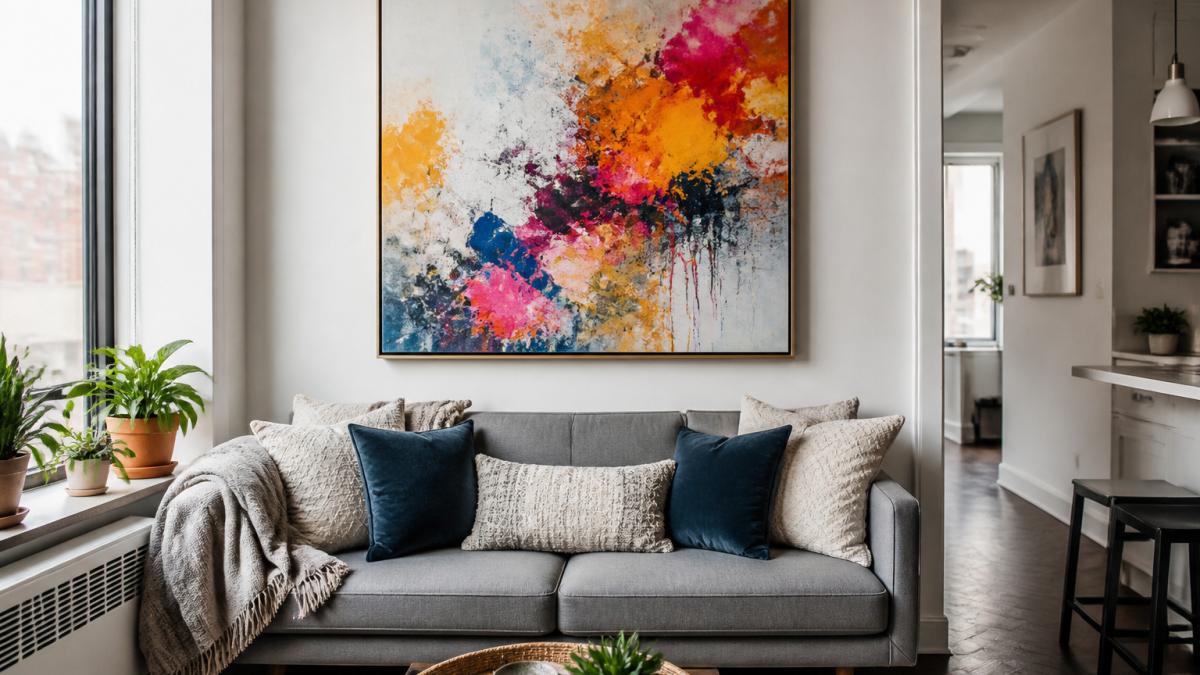
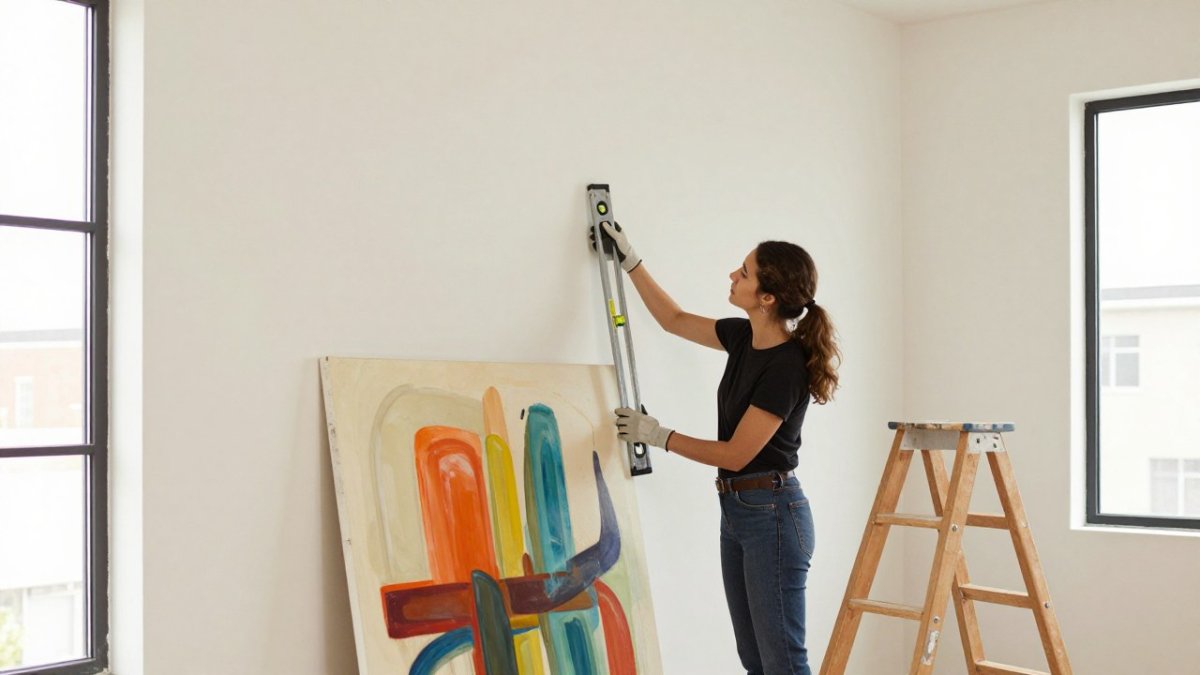
Use a level, and check the placement from the seat where you will sit most often. Art that looks right when you stand can feel too high when you relax on the couch. Adjust for your eye level, not just the measurements.
Renter-Friendly Ways to Hang and Move Your Art
Renters face a constraint most art-buying guides ignore: every hole is a future security-deposit conversation. Compare nail-free hanging methods that avoid wall damage before you choose. The good news is that damage-free hanging has improved enough that you can safely display real artwork without a single nail, as long as you match the method to the weight and the wall.
Know your weight before you choose a method. Weigh the framed piece, not just the canvas. A small unframed canvas may be under 2 pounds; the same canvas in a glass-and-wood frame can easily reach 8 to 12 pounds. Most removable adhesive strips are rated in pairs, and the package rating assumes a clean, flat, painted surface, not textured plaster, brick, or fresh paint that has not fully cured.
Match the method to the wall and the weight:
- Removable adhesive strips, best for lightweight canvases and small framed prints under roughly 10 pounds on smooth, painted drywall. Follow the package cure time before hanging, and remove them slowly by stretching the tab, not pulling outward.
- Picture rails and rail hooks, ideal for renters in older buildings that already have a molding rail near the ceiling. Hooks hang from the rail on cords, so you can reposition art without new holes and adjust height as furniture changes.
- Tension rods, useful in narrow hallways and above doorways where you want to lean or suspend a lightweight piece without wall contact. Check the rod's weight rating and the wall span; rods can slip on smooth surfaces.
- Leaning, the lowest-risk option of all. A framed piece can lean on a console, a bookshelf, or the floor against the wall. Use museum putty or a small adhesive dot under the bottom corners to keep it from sliding, and keep leaning art out of high-traffic paths.
- Traditional anchors, for heavy statement pieces, a hollow-wall anchor or a stud-mounted screw is still the safest choice. If you go this route, patch and paint before move-out; small spackle repairs are usually cheaper than a deposit deduction.
Plan for the move, not just the hang. Keep the original box and corner protectors if you have the storage space. Wrap glass with paper, not bubble wrap directly against the surface, and tape an X across the glass to hold it if it cracks.
Measure the path before you buy. Narrow apartment hallways, tight stairwells, and small elevators are where large art gets damaged or returned. Before ordering, measure your door width, hallway width at the narrowest point, and elevator depth. Check with Susan Fielder Art for current shipping and return details before checkout.
Best for: renters who want to change their art every year or two, or who move frequently. Skip if: you plan to stay put and want a permanent, heavy statement piece. A traditional wall anchor will hold it more securely.
Frequently Asked Questions
What size artwork works best in a small apartment?
For most small apartments, pick a piece that covers roughly 60 to 75 percent of the width of the sofa or the wall it hangs on. Undersized art looks lost, while oversized art can overwhelm a compact room. Measure the wall before you shop, then compare the dimensions to your furniture. A single medium-to-large abstract piece often makes a small room feel more open than several small pieces scattered across the walls.
How high should you hang a painting above a sofa?
Hang the artwork so its bottom edge sits about 15 to 30 centimeters above the top of the sofa back. Keep the piece centered over the sofa and aim its middle at about eye level for a seated viewer. This placement ties the art to the furniture and keeps it from feeling disconnected. In low-ceilinged apartments, stay closer to the 15-centimeter end of that range.
Should abstract art match the colors in a small apartment?
Artwork does not need to match your furniture exactly. Pull one or two colors from your rooms, such as a cushion or rug tone, and let the painting either echo them or provide a deliberate contrast. Calming palettes suit small spaces that already feel busy, while a single vibrant color can become the room's focal point. Avoid adding more than three dominant colors to one wall, which can make the space feel crowded.
Is one large painting better than a gallery wall in a small space?
In most small apartments, one large abstract piece is simpler and keeps visual clutter low. A gallery wall works well when you have a narrow hallway or a plain wall that needs texture, but it takes careful planning and more wall space. If you choose a gallery wall, keep the frames consistent in color and keep spacing tight so the arrangement reads as one unit.
Ready to find a piece for your space? Shop Susan Fielder Art's curated collection of emotionally charged abstract paintings, and book a consultation if you want help choosing a size or color for your apartment. Every purchase also supports pancreatic cancer research, with 10 percent of all proceeds donated to the cause.