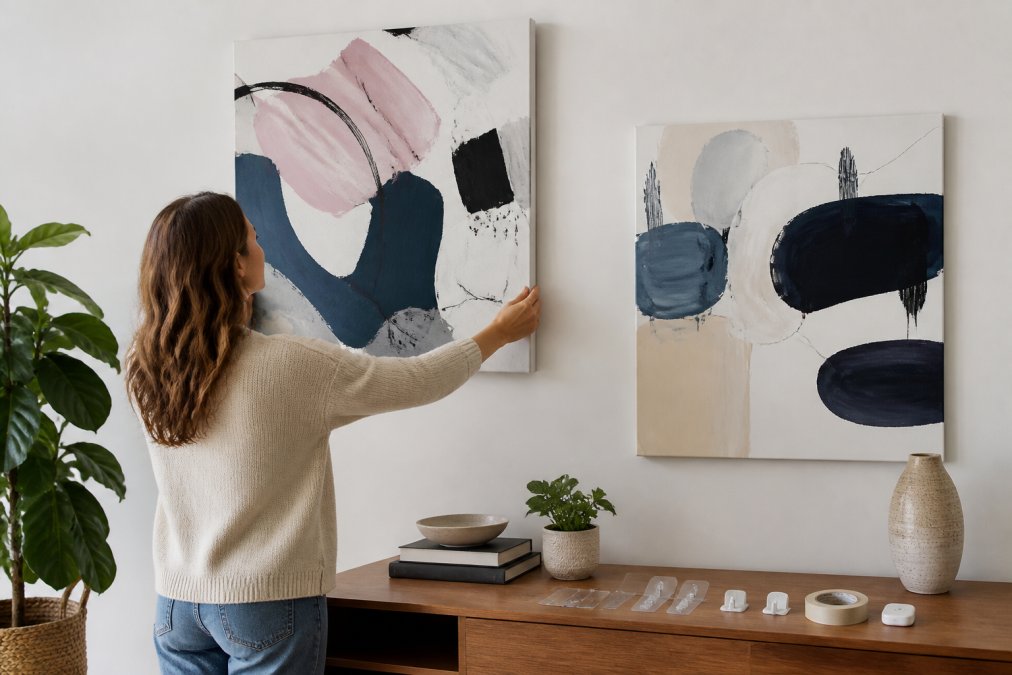
 how-to
How to Hang Abstract Paintings Without Nails: 7 Safe Methods
Table of Contents
- Why Nail-Free Hanging Works for Abstract Art
- Adhesive Strips for Heavy Art: What Actually Holds
- Best Picture Hanging Methods for Renters
- How to Arrange Abstract Art on a Wall Without Nails
- How to Hang Abstract Paintings Without Nails on Textured Walls
- Safe Removal: Taking Art Down Without Peeling Paint
- Conclusion
- Frequently Asked Questions
Last Updated: September 22, 2026
Why Nail-Free Hanging Works for Abstract Art
You don't need nails to hang abstract art. Modern adhesive strips, picture rails, and leaning displays can hold everything from a small canvas to a large statement piece, and they leave walls intact when you move out.
At Susan Fielder Art, we hear this question constantly from renters and first-time buyers. Nobody wants to patch holes after buying a piece they love. A YouGov survey on American wall art habits found that about one in five people have no artwork on their walls at all, often because hanging feels like a hassle.
It doesn't have to be.
Adhesive Strips for Heavy Art: What Actually Holds
Adhesive strips are the fastest damage-free option, but they have a real ceiling, and the ceiling depends on the strip, the wall, and how the frame is built. Most brands rate their strips for lightweight pieces under 5 pounds on smooth, painted walls, according to Emans Gallery's 2026 hanging guide. That number assumes ideal conditions: sealed drywall, no texture, room temperature, and a frame with a flat back.
Weight-to-Method Guide
Most guides stop at "use strips for light art." Here is the breakdown that actually matters when you are standing in front of a canvas:
| Piece Weight | Best No-Nail Method | Notes |
|---|---|---|
| Under 2 lb (small print, thin canvas) | Single adhesive strip pair | Smooth drywall only |
| 2-5 lb (medium canvas, light frame) | Two strip pairs, one per side | Cure 1 hour before loading |
| 5-10 lb (large canvas, framed print) | Four strip pairs plus bottom-corner stabilizers | Test pull after 24 hours |
| 10-20 lb (heavy framed abstract) | Picture rail into studs, or wall ledge | Adhesive strips alone are unreliable |
| Over 20 lb | Picture rail into studs, or professional mount | Do not trust adhesive |
Hardware Compatibility: D-Rings, Sawtooth, and Wire
Adhesive hooks and strips do not work the same way with every frame. The hardware on the back of the canvas decides whether a strip can even grip:
- Sawtooth hangers sit flush against the wall and pair well with adhesive strips because the load stays close to the surface.
- D-rings with a taut wire create a gap between the frame and the wall, which lets the piece swing and can peel strips over time. If you use D-rings with strips, shorten the wire so the frame sits nearly flush.
- Picture wire alone is the worst match for adhesive strips, the wire flexes, the frame rocks, and the strip fatigues. Pair wire with a picture rail instead.
Surface Prep That Actually Decides the Hold
Surface prep decides whether strips hold or fail. A few rules that matter more than the brand you buy:
- Wipe the wall with isopropyl alcohol and let it dry fully
- Skip walls with texture, peeling paint, or heavy dust
- Wait 24 hours after painting before applying strips
- Press each strip for 30 seconds, then wait an hour before loading
- Avoid exterior walls in humid climates, moisture migrates through drywall and weakens adhesive
Best Picture Hanging Methods for Renters
Renters need methods that come down clean. The three best options are picture rails, wall ledges, and clip systems, and each one works without touching the wall's structural integrity.
Picture Rails, Ledges, and Clip Systems
Here's how the three compare for common rental situations:
| Method | Best For | Wall Damage | Weight Capacity |
|---|---|---|---|
| Picture rail | Heavy framed pieces | Minimal (rail screws) | High |
| Wall ledge | Medium canvases, leaning art | Minimal | Medium |
| Clip system | Unframed abstract work | None | Light |
A common mistake is mounting a picture rail without checking for studs. Anchors alone won't hold a heavy rail over time.
How to Arrange Abstract Art on a Wall Without Nails
Arrangement matters as much as the hanging method. Abstract art has no "correct" orientation, so the layout carries the visual weight.
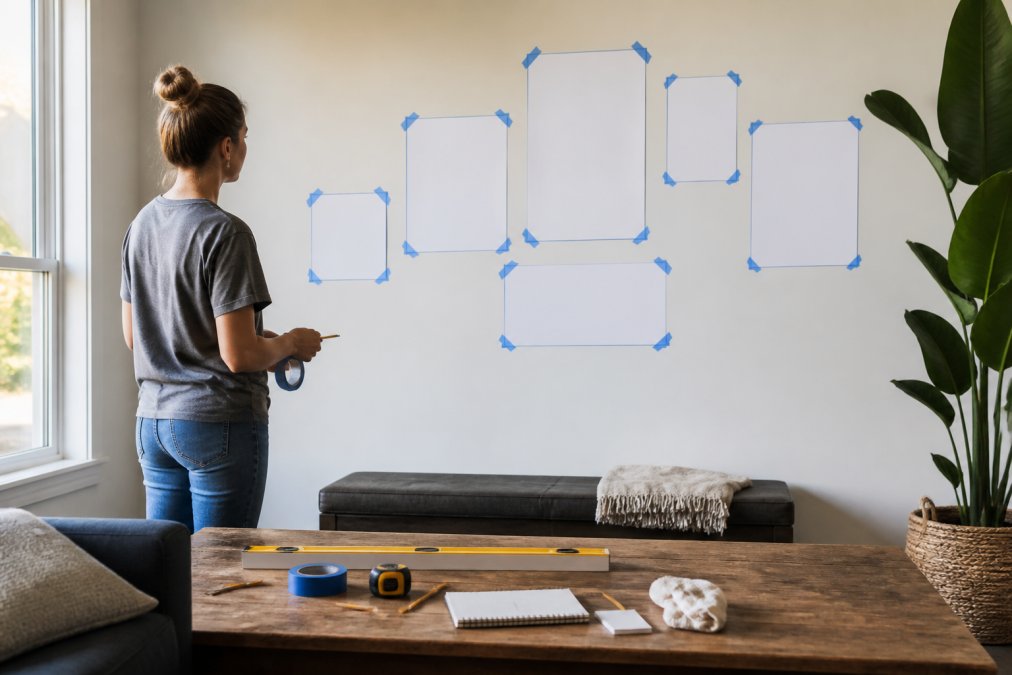
Painter's Tape Layout and the 2/3 Rule
The 2/3 rule keeps arrangements from floating too high or sinking too low. Hang art so the center of the piece sits at roughly two-thirds the height of your wall, or about eye level for most adults.
How to Hang Abstract Paintings Without Nails on Textured Walls
Textured walls break most adhesive methods. Strips need a smooth, sealed surface to bond, and texture creates air gaps that weaken the hold. But "textured" is not one condition, orange peel, knockdown, brick, concrete, and wood paneling each fail adhesives for different reasons, and each has a different no-nail workaround. This is the section most guides skip, and it is the one that decides whether your art stays up.
Texture-by-Texture Compatibility
| Wall Texture | Adhesive Strips | Best No-Nail Method |
|---|---|---|
| Smooth drywall (level 4-5 finish) | Yes | Adhesive strips or hooks |
| Orange peel (light) | Marginal, test first | Adhesive putty for light pieces; rail for heavy |
| Knockdown / heavy texture | No | Picture rail into studs, or wall ledge |
| Painted brick | No | Picture rail into mortar joints, or leaning display |
| Exposed concrete | No | Wall ledge, easel, or floor leaning |
| Wood paneling | No | Picture rail screwed into paneling studs, or ledge |
Why Texture Kills Adhesive
Adhesive strips need continuous contact across their full surface. On orange peel, the peaks touch but the valleys do not, so the effective bonding area drops, often by half or more. On brick and concrete, the surface is also porous, which pulls the adhesive's tack away from the wall. On paneling, the grooves create the same air-gap problem plus a slick finish that many adhesives cannot bite.
No-Nail Methods That Work on Texture
If your wall is textured, skip adhesive strips entirely. These are the methods that hold:
- Picture rails mounted into studs. The rail carries the load; the wall only holds the rail. Use a stud finder and lag screws rated for the rail's weight plus the art.
- Wall ledges. Art rests on the ledge and leans back. Works on any texture because the ledge, not the wall, carries the weight.
- Leaning displays. Floor leaning or mantel leaning avoids the wall entirely. Best for large abstract canvases that can stand on their own bottom edge.
- Easels. A floor or table easel displays a canvas without touching the wall at all, the safest option for brick and concrete.
Safe Removal: Taking Art Down Without Peeling Paint
Removal is where most damage happens. Pull too fast and you take paint with you.
Conclusion
Hanging abstract art without nails comes down to matching method to weight and wall type. Get that right and you can display bold, original work anywhere, even in a rental.
Frequently Asked Questions
What is the best way to hang artwork without nails?
For pieces under 5 pounds on smooth painted walls, adhesive strips are the most reliable option, according to 2026 guidance from Emans Gallery. Heavier abstract paintings do better on picture rails, wall ledges, or clip systems that distribute weight across a bracket. Leaning larger canvases on a mantel or console is another zero-damage approach favored by interior designers for oversized abstract work.
Can I use adhesive strips for heavy abstract paintings?
Adhesive strips generally hold artwork weighing under 5 pounds on smooth, painted surfaces, per Emans Gallery's 2026 expert tips. Larger or heavier abstract canvases may need structural alternatives like picture rails or leaning techniques, since adhesive load capacity drops on textured or freshly painted walls. Check the strip's rated weight capacity and stay well under it for safety.
How do you hang art on textured walls without nails?
Adhesive strips bond poorly to textured surfaces like brick, stucco, or heavy knockdown drywall. For these walls, use a picture rail or wall ledge mounted with tension rods or brackets, or lean the artwork on furniture. If you must use adhesive, press firmly for 30 seconds and let it cure for an hour before hanging, but expect reduced weight capacity.
How can I create a gallery wall without using nails?
Lay out the arrangement on the floor first, then transfer it to the wall using painter's tape and paper frame templates. Apply the 2/3 rule: art should span about two-thirds the width of the furniture below it. Use adhesive strips rated for each frame's weight, or a clip system rail for a uniform look. Test one strip overnight before committing the full layout.
Choosing art you love is the easy part. Hanging it without wrecking your walls is where most people get stuck, and it doesn't need to be. Susan Fielder Art offers emotionally charged, original abstract paintings, 10% of all proceeds go to pancreatic cancer research, and every piece ships from a verified secure website registered with the Art Storefronts Organization. Get started with Susan Fielder Art and bring home a piece that speaks to your space and your story.