 how-to
Framing Large Abstract Canvas Prints: A Step-by-Step Guide
Last Updated: November 4, 2026
Quick Summary
Framing large canvas starts with measuring canvas width, height and depth, then matching frame type to depth: shallow canvases under an inch fit standard frames, while deeper gallery-wrapped canvases need a floater frame or no frame. For canvases over 40 inches wide, use thicker stock and reinforced corners.
- Measure canvas width, height, depth and wall width before buying any frame.
- A floater frame leaves a reveal gap of about a quarter inch around the canvas.
- Wood glue needs at least 24 hours at room temperature for a full-strength bond.
- Space offset clips every 6 to 8 inches along each side to prevent bowing.
- Hang art with the center 57 inches from the floor, per 4over4 guidance.
Table of Contents
- Measuring Your Canvas and Choosing the Right Frame Depth
- Why a Floater Frame for Canvas Suits Large Abstract Art
- How to Frame Canvas Art With a Wooden Frame
- How to Frame a Canvas Without a Frame
- How to Frame a Canvas Painting With Glass
- Hanging Hardware, Wall Anchors, and Weight Distribution for Extra-Large Canvases
- Shop Original Abstract Art Ready for Your Frame
- Frequently Asked Questions
Measuring Your Canvas and Choosing the Right Frame Depth
Framing large canvas starts with two numbers: the depth of your stretcher bars and the width of your wall. Get those right and every later decision gets easier. At Susan Fielder Art, we see more framing problems caused by skipped measurements than by bad craftsmanship.
Framed canvas is the best-selling wall art format of 2026, and natural wood is the most popular frame color, according to Buy Wall Art's 2026 market analysis. That popularity matters when you shop for materials.
Measure three things before you buy anything:
- Canvas width and height, edge to edge, across the front face
- Canvas depth, the thickness of the stretcher bars, usually from under an inch to about two inches
- Wall width, so you can plan coverage
For scale, In Print Designs' 2026 wall decor guidance recommends a canvas 110 to 130 cm wide above a 180 cm sofa. That is roughly 43 to 51 inches over a 71-inch sofa.
Why Canvas Depth Determines Your Frame Style
Canvas depth decides which frame type will physically fit. A shallow canvas under an inch deep sits well in a standard frame. A deep gallery-wrapped canvas needs a floater frame or no frame at all.
Here is the trade-off in plain terms:
| Canvas Depth | Best Frame Type | Why |
|---|---|---|
| Under 1 inch | Standard or wooden frame | Sits close to the wall |
| 1 to 1.5 inches | Floater frame | Room for the reveal gap |
| 1.5 to 2 inches | Floater frame or unframed | Depth becomes the feature |
A common mistake is buying a frame before measuring depth. If the frame's rabbet is shallower than the canvas, the canvas will not sit flush. Watch out: forcing it in cracks the stretcher bars at the corners.
Why a Floater Frame for Canvas Suits Large Abstract Art
A floater frame holds the canvas inside the frame with a small gap around the edges, so the artwork appears to float. That gap is the whole point.
Montcarta's 2026 framing trends report names floating frames as the better choice for abstract canvas because they add depth without covering the painted edges. For a piece wider than 40 inches, that added depth stops the work from reading as a flat poster on the wall.
How the Reveal Gap Adds Depth Without Hiding Edges
The reveal gap is the visible space between the canvas side and the inside edge of the frame. A typical gap runs about a quarter inch. That small shadow line does real work:
- It separates the art from the frame visually
- It lets the canvas depth show as part of the design
- It hides minor unevenness in the canvas edges
If you want the longer case for this style, our guide on the 7 benefits of using a floater frame for abstract art walks through it in detail.
How to Frame Canvas Art With a Wooden Frame
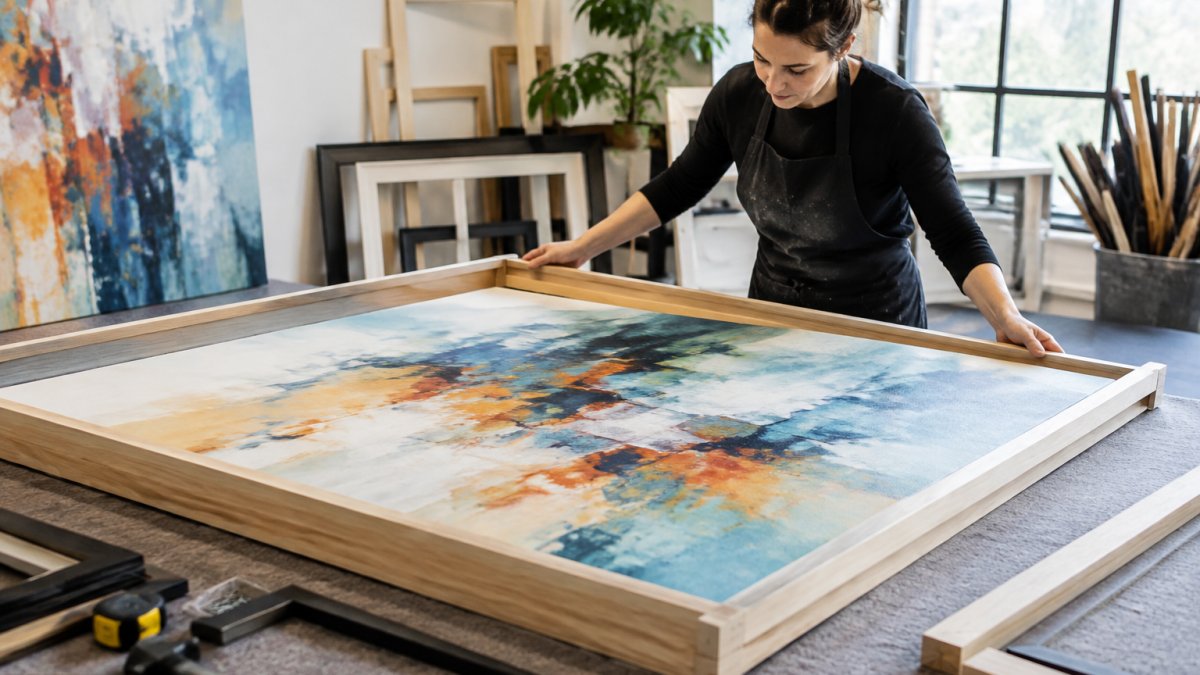
To frame canvas art with a wooden frame, build a box frame sized to the canvas, then set the canvas inside and hold it with offset clips. The steps below suit a canvas up to about 48 inches wide.
Tools and materials:
- Wood strips in pine or oak, at least 1 inch thick (use 1.25 to 1.5 inch stock for canvases over 40 inches wide)
- Miter saw
- Wood glue and corner clamps
- Framing points or offset clips
- D-rings and hanging wire
- Sandpaper and finish
- A carpenter's square and a tape measure long enough to span both diagonals
Steps:
- Measure the canvas and add the frame lip to each side. The lip is the amount of frame that overlaps the front face of the canvas, usually a quarter inch to three-eighths of an inch. Add that figure to both the width and the height before you cut.
- Cut four strips with 45-degree mitered corners. Cut the two long sides first, then the two short sides, and dry-fit them before gluing.
- Glue and clamp the corners, then check for squareness with a diagonal measurement. The two diagonals should match within one-sixteenth of an inch. If they do not, adjust the clamps before the glue sets.
- Let the glue cure fully before sanding. Most wood glues need at least 24 hours at room temperature for a full-strength bond.
- Sand the joints smooth and apply your finish.
- Set the canvas in and secure it with offset clips or framing points. Space the clips every 6 to 8 inches along each side so the canvas cannot bow away from the frame.

The woman is American.
Sizing Stock and Reinforcing Corners for Large Frames
A frame that works at 24 inches will flex and pull out of square at 60 inches. The fix is thicker stock and a mechanical reinforcement at each corner.
| Canvas Width | Minimum Stock Thickness | Corner Reinforcement |
|---|---|---|
| Up to 24 inches | 1 inch | Glue only |
| 24 to 40 inches | 1 inch | Glue plus one spline per corner |
| 40 to 60 inches | 1.25 inches | Glue plus spline or metal corner brace |
| Over 60 inches | 1.5 inches | Glue plus brace plus a cross-brace behind the canvas |
Del Ray Artisans' 2025 presentation guidelines require frames to have screw eyes and wire for secure hanging. Unfinished canvas edges are not acceptable for display.
For a fuller walkthrough of measuring, cutting, and finishing, see our guide on how to frame abstract canvas art properly.
How to Frame a Canvas Without a Frame
You can frame a canvas without a frame by using a gallery wrap, where the painted image continues around the sides and the piece hangs bare. Many abstract painters design for this.
A gallery wrap works when:
- The edges are painted, not raw canvas
- The stretcher bars are thick enough to look intentional
- The piece sits in a room where the bare edge fits the style
The catch is durability. Bare edges collect dust and scuff easily, and a deep canvas can look unfinished next to framed work on the same wall. If your edges are raw, frame it or paint them first.
How to Frame a Canvas Painting With Glass
Framing a canvas painting with glass is possible, but it usually works against the art. Glass sits in front of the surface, and on a textured abstract piece it flattens the depth you paid for. It also traps moisture.
Here is when glass makes sense and when it does not:
- Use glass only for flat works on paper or board mounted inside a frame
- Skip glass for stretched canvas with texture or heavy paint
- Never press glass against the canvas surface
If you want protection on a canvas, use a frame with a spacer and no glass, or a sealed backing board. For a large abstract piece, the frame does the protecting.
Hanging Hardware, Wall Anchors, and Weight Distribution for Extra-Large Canvases
Large canvases fail at the wall, not at the frame. Our guide on how to hang oversized wall art securely covers detailed, secure hanging methods for oversized art once the frame is built. A piece over 40 inches wide can weigh well past 20 pounds once framed, and a single nail will not hold it. Spread the load across two points and anchor into studs or use proper wall anchors.
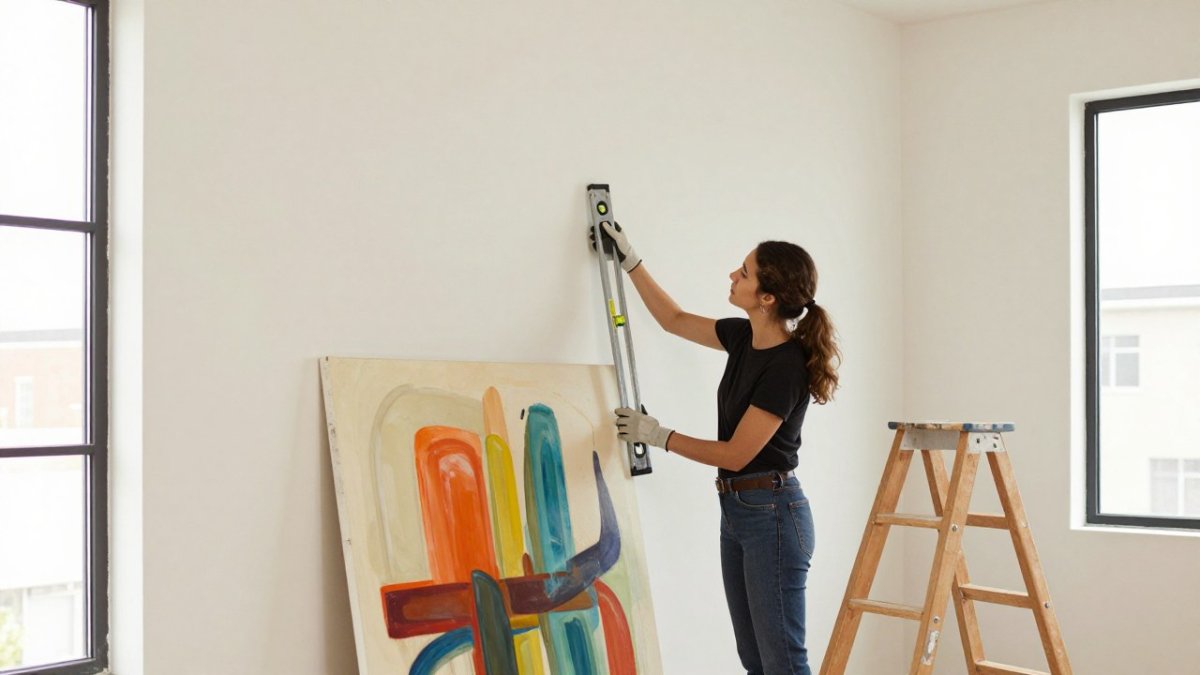
Standard hanging height is 57 inches from the floor to the center of the piece, per 4over4's 2025 installation guidance. For weight distribution:
- Use two D-rings, one on each side, set at the same height
- Run wire between them with a slight slack, not tight. A wire pulled tight puts the load on the D-rings instead of spreading it across the hanger.
- Hit studs where possible; use rated wall anchors where you cannot
- Add a bottom spacer or bumper so the frame sits level against the wall
Matching Anchors to Load
The anchor you choose should be rated for at least twice the weight of the framed piece. A common pattern is to size the anchor to the load, not to the wall material alone.
| Framed Weight | Anchor Type | Notes |
|---|---|---|
| Up to 20 pounds | Two 50-pound-rated self-drilling drywall anchors | Fine for standard drywall |
| 20 to 50 pounds | Toggle bolts or heavy-duty strap toggles | Spread load behind the drywall face |
| Over 50 pounds | Lag bolts into studs, or a French cleat rated for the load | Do not rely on drywall anchors alone |
A French cleat is the most reliable option for a canvas over 48 inches wide, because it distributes the load along the full width of the frame instead of at two points. Most practitioners find a cleat also makes it easier to level a large piece, since you can slide it side to side before it seats.
Watch out: a wire hung from two D-rings on a heavy canvas will pull the rings inward over time and let the frame tilt forward at the top, which puts the full load on the wire rather than the wall.
Troubleshooting Warped Frames and Environmental Protection
Warped frames usually come from moisture and uneven weight. Wood strips absorb humidity and swell, and a frame hung from one point pulls out of square over time.
To correct a frame that has already pulled out of square, take it down, lay it face down on a flat surface, and measure both diagonals.
For environmental protection, an unglazed canvas has no barrier against UV light or dust.
If edges have already been damaged, our article on how to repair damaged canvas painting edges walks through the fix. For routine care, our guide on how to clean and maintain abstract canvas paintings covers dusting and safe cleaning.
Shop Original Abstract Art Ready for Your Frame
Choosing a frame is the last step. Finding a piece that deserves one comes first.
If you are deciding between a floater frame and a bare gallery wrap, start with the artwork and let its edges guide you.
Ready to find the piece? Browse our original abstract paintings and choose the one that fits your wall, then frame it with confidence.
Get started with Susan Fielder Art and bring a meaningful, original work into your space.
Frequently Asked Questions
How do you frame a large canvas print without damaging the artwork?
Use a floater frame sized to your canvas depth so the painted edges stay visible and untouched. Attach the canvas with offset clips screwed into the frame's inner lip, not through the stretcher bars. Keep the reveal gap even on all four sides, and never clamp directly onto the painted surface. This approach lets you frame a canvas print securely while preserving the artwork's integrity.
Does abstract canvas art look better framed or unframed?
It depends on the piece. Gallery-wrapped canvases with finished edges can hang unframed to emphasize texture and depth, which suits many abstract works. A floater frame for canvas adds a finished, professional look and protects edges during moves. For large abstract pieces in high-traffic rooms, a frame often provides structural support and a cleaner visual boundary.
How do you hang a large framed canvas securely?
Use two D-rings and braided wire rated for the frame's weight, anchored into wall studs or heavy-duty wall anchors. For extra-large canvases, add a French cleat or two-point hanging system to distribute weight evenly. Verify the frame is square before hanging. Check anchors annually for loosening.
Can you frame a stretched canvas without glass?
Yes. Stretched canvas is typically framed without glass because the textured surface and painted edges are meant to be seen and the canvas needs airflow. Glass can trap moisture and cause mold over time. If you want glazing for an abstract piece, use acrylic or glass only with a floater frame designed to accommodate it, and keep a small gap for ventilation.