 how-to
7 Benefits of Using a Floater Frame for Abstract Art
Last Updated: October 31, 2026
Quick Summary
A floater frame holds a stretched canvas inside a slightly larger frame with a thin visible gap on every side, so the full canvas stays visible, including painted edges. It preserves depth and texture, gives abstract art a defined boundary without a heavy border, and creates a contemporary gallery-style presentation.
- A floater frame attaches from behind with small screws or brackets, so nothing presses on the painted surface.
- A common reveal range is 1/4 inch to 1/2 inch on each side, adjusted to canvas size.
- Many framers start with a reveal of roughly 1 to 2 percent of the canvas's shortest dimension.
- Dry-fit the canvas before drilling, since a reveal can look even on three sides and off on the fourth.
- Skip a floater frame when canvas edges are raw or stapled, or the work is on paper or panel.
Table of Contents
- Why a Floater Frame Changes How Abstract Art Reads on a Wall
- What Is a Floater Frame and How Does It Hold a Stretched Canvas?
- Seven Benefits of Using a Floater Frame for Abstract Art
- Floater Frame vs Regular Frame: Which Suits Canvas Artwork?
- How to Choose a Floater Frame for Your Painting
- Floater Frame Gap Size: Picking the Right Reveal
- Measuring, Mounting, and Hanging Your Floater Frame
- When a Floater Frame Is Not the Right Choice
- Frequently Asked Questions
Why a Floater Frame Changes How Abstract Art Reads on a Wall
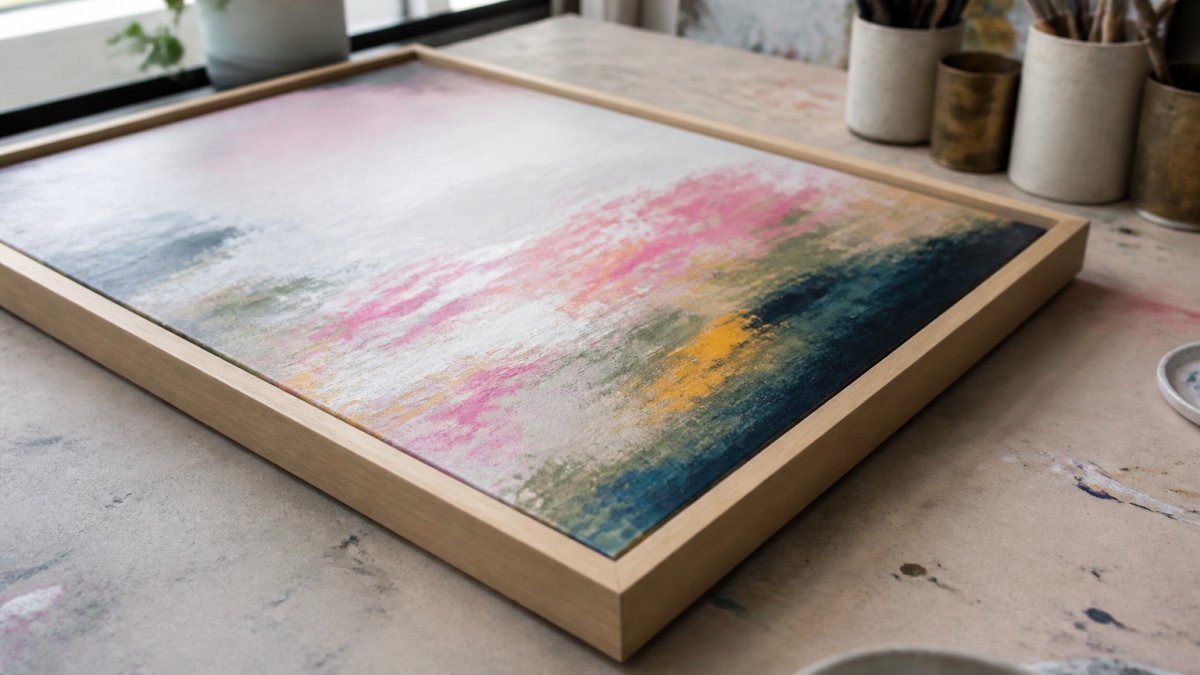
A floater frame holds a stretched canvas inside a slightly larger frame, leaving a thin visible gap around the artwork.
Abstract painters often carry color and gesture right to the edge, painting the sides on purpose.
Abstract art also lives on texture and depth, thick paint, visible brushwork, layered washes. A frame that sits tight against the canvas flattens all of that visually.
What Is a Floater Frame and How Does It Hold a Stretched Canvas?
Here's how the mounting works:
- The canvas drops into the frame's inner opening
- Small screws or brackets attach the stretcher bars to the frame from the back
- The canvas sits slightly recessed, not flush with the frame face
Nothing presses on the painted surface. Nothing covers the edges. The frame supports the canvas from behind and below, which is why floater frames suit stretched canvas so well.
If you want the full step-by-step process for canvas framing, our guide on how to frame abstract canvas paintings walks through it from start to finish.
Seven Benefits of Using a Floater Frame for Abstract Art
The benefits of using a floater frame for abstract art come down to one idea: the frame serves the painting instead of competing with it.
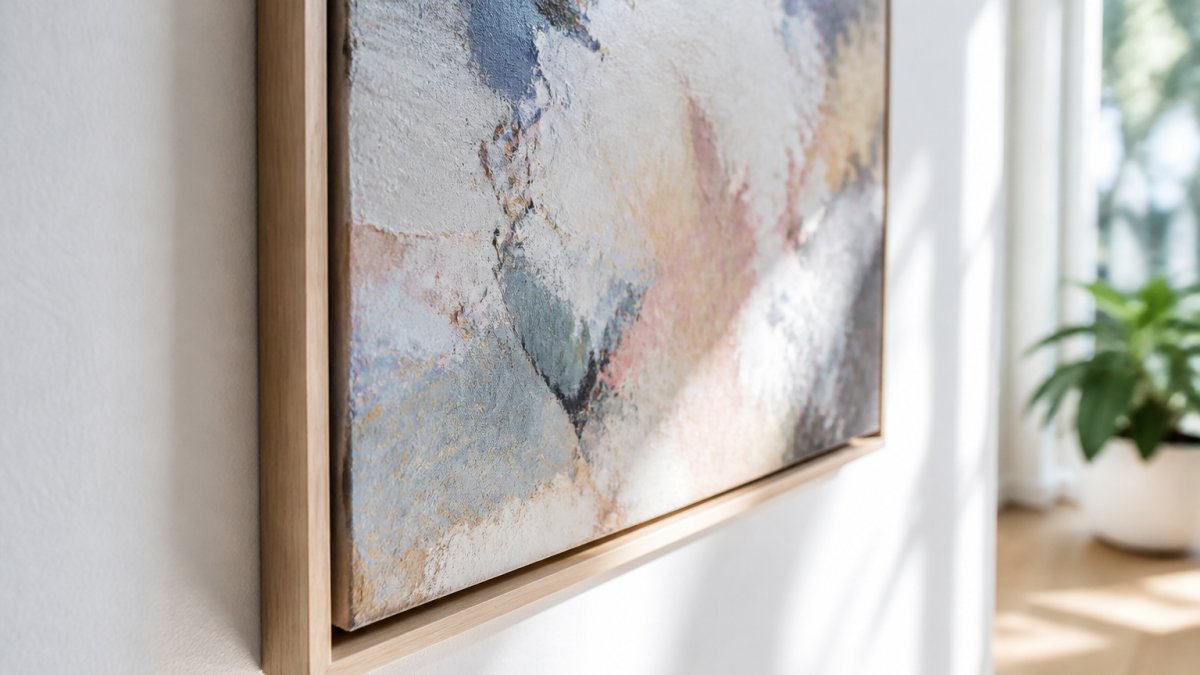
The Full Canvas Stays Visible, Including Painted Edges
Abstract artists paint the sides of a canvas for a reason. A gallery wrap carries the composition around the edge. A floater frame leaves those edges uncovered, so the wraparound design stays part of the piece. With a standard frame, that work disappears behind the lip.
Depth and Texture Read as Part of the Composition
Heavy impasto and layered brushwork cast small shadows. A floater frame sets the canvas forward, so raking light can catch that texture instead of flattening it.
A Defined Boundary Without a Heavy Border
Abstract art often needs an edge to contain it, especially on a large white wall. A floater frame gives the composition a clean, defined boundary without a thick, decorative border, a gallery-style presentation where the painting looks finished, not boxed in.
- A contemporary look that suits modern and abstract work better than ornate traditional frames
- Less visual competition between frame and paint, so the composition leads
- Protection for the canvas edge while keeping it visible
Floater Frame vs Regular Frame: Which Suits Canvas Artwork?
A regular frame suits works on paper, prints, and panels. A floater frame suits stretched canvas, especially when the edges are painted and the surface has visible texture.
| Factor | Floater Frame | Regular Frame |
|---|---|---|
| Canvas edges | Fully visible | Covered by the lip |
| Best for | Stretched canvas, abstract art | Prints, works on paper, panels |
| Texture and depth | Preserved and highlighted | Can look flattened |
| Presentation style | Gallery-style, contemporary | Traditional, enclosed |
| Frame profile | Wider outer face, deeper rabbet | Narrower, sits over the art |
| Relative cost | Higher | Lower |
For a deeper look at getting canvas framing right, read our guide on how to frame abstract canvas art properly.
How to Choose a Floater Frame for Your Painting
Start with the canvas, not the frame. Measure the stretched canvas first, then pick a frame whose inner opening leaves the reveal you want.
- Measure the canvas at its widest point, edge to edge, including any sag in the stretcher
- Measure the canvas depth so the frame rabbet is deep enough to hold it
- Choose the reveal width before you choose the finish
- Match the frame profile to the scale of the work; a thin profile can vanish on a very large canvas
- Pick a finish that complements or contrasts with the dominant paint colors, not one that matches them exactly
- Confirm the frame material suits the weight of the piece
On finish: a warm wood tone against cool blue paint creates contrast that sharpens both.
For guidance on framing original work more broadly, see our guide to framing original fine art.
Floater Frame Gap Size: Picking the Right Reveal
The reveal is the visible gap between the canvas edge and the inner edge of the frame. It determines whether a floater frame looks intentional or like a sizing mistake.
A common working range is 1/4 inch to 1/2 inch on each side, but the right number depends on canvas size, frame face width, and how much painted edge you want the viewer to see. Treat the reveal as a proportion problem, not a fixed number.
A simple proportion rule
Many framers work from a ratio rather than an absolute measurement. One common starting point is a reveal equal to roughly 1 to 2 percent of the canvas's shortest dimension, then rounded to a standard fraction.
- 12 x 12 inch canvas: 1 to 2 percent is about 1/8 to 1/4 inch. A 1/4 inch reveal reads as deliberate; 1/8 inch can look like a tight fit.
- 24 x 30 inch canvas: 1 to 2 percent of 24 inches is about 1/4 to 1/2 inch. A 3/8 inch reveal is a common middle ground.
- 36 x 48 inch canvas: 1 to 2 percent of 36 inches is about 3/8 to 3/4 inch. A 1/2 inch reveal holds up without looking loose.
These are starting points, not rules. The goal is a gap wide enough to cast a consistent shadow line and narrow enough that the canvas still reads as held by the frame.
Match the reveal to the frame face width
The reveal and the frame's visible face width should feel related. A thin 3/4 inch face with a 3/4 inch reveal looks unbalanced, the gap competes with the frame. A common pattern is a reveal roughly one-third to one-half the width of the frame face:
- 1 inch face: 1/4 to 3/8 inch reveal
- 1-1/2 inch face: 3/8 to 1/2 inch reveal
- 2 inch face: 1/2 to 3/4 inch reveal
If you are choosing between two reveals, go with the narrower one on small work and the wider one on large work. The eye reads a wide gap on a small canvas as a bad fit, and a narrow gap on a large canvas as an accident.
How reveal interacts with abstract composition
- Color-field and hard-edge work: a consistent, moderate reveal (about 3/8 inch on a mid-size canvas) reinforces the clean geometry of the composition. An uneven gap is immediately visible against a flat field of color.
- Gestural and expressive work: a slightly wider reveal gives the energetic edges room and keeps the frame from feeling like it is cropping the gesture.
- Heavily textured or impasto work: a wider reveal (1/2 inch or more on a large canvas) lets raking light create a shadow line that emphasizes the paint depth rather than flattening it.
Check the reveal before you commit
Before ordering or assembling, do a dry fit. Set the canvas into the frame without fasteners and sight down each side. The gap should look the same on all four sides. If one side is wider, the canvas is out of square or the frame's inner opening is off, fix that before you drill anything.
If you are ordering a custom frame, give the framer the canvas dimensions and your target reveal, and ask them to confirm the inner opening size in writing. The inner opening should equal the canvas dimension plus twice the reveal.
Measuring, Mounting, and Hanging Your Floater Frame
This is where most floater frame installations go wrong, not because the steps are hard, but because the measuring is rushed.
Step 1: Measure the canvas correctly
Measure the stretched canvas, not the frame, at the widest point on each side. Stretcher bars can bow, and a canvas that is 30 inches across the top and 29-7/8 inches across the bottom will show an uneven reveal.
- Width and height: measure edge to edge at the widest point, including any sag in the stretcher.
- Depth: measure the thickness of the stretcher bar, typically 3/4 inch to 1-1/2 inches for standard and gallery-depth canvas. The frame's rabbet must be at least this deep, with a little clearance.
- Square: measure both diagonals. If they differ by more than about 1/8 inch, the canvas is out of square and the reveal will be uneven.
Step 2: Confirm the frame's inner opening and rabbet depth
The frame's inner opening should equal your canvas dimension plus twice your chosen reveal. For a 24 x 30 inch canvas with a 3/8 inch reveal, the inner opening should be 24-3/4 x 30-3/4 inches.
Check the rabbet depth against your canvas depth. A 1-1/2 inch gallery-depth canvas needs a frame with a rabbet deeper than 1-1/2 inches, or the canvas will sit proud of the frame face instead of recessed.
Step 3: Dry-fit and set the reveal
Set the canvas into the frame without fasteners. Sight down each side and check that the gap is consistent on all four sides. Adjust the canvas position until the reveal is even, then note where the stretcher bars meet the frame's back flange. This is where your screws will go.
Step 4: Attach the canvas from the back
Floater frames attach from behind. Drive the supplied screws through the frame's back flange into the stretcher bars, not into the canvas itself. Use two screws per side for small canvases and three or more per side for large ones, spaced evenly.
- Pilot-drill first if the stretcher wood is hard or the screws are large. A cracked stretcher bar is difficult to repair and can loosen the canvas tension.
- Do not overtighten. Snug is enough. Overtightening pulls the stretcher out of square and distorts the reveal.
- Check the reveal again after the first side is attached, before you fasten the remaining sides.
Step 5: Add hanging hardware rated for the load
Most floater frames arrive with hardware for attaching the canvas, but the wall side is on you. Use two D-rings or a French cleat rated well above the weight of the framed piece. For a large canvas, a French cleat spreads the load across the wall far better than a single hook or a pair of D-rings.
- Small to mid-size pieces: two D-rings and two wall hooks, each rated for at least the full weight of the framed piece.
- Large pieces: a French cleat sized to at least two-thirds the width of the frame.
- Always anchor into studs where possible. If studs are not available, use wall anchors rated for several times the load.
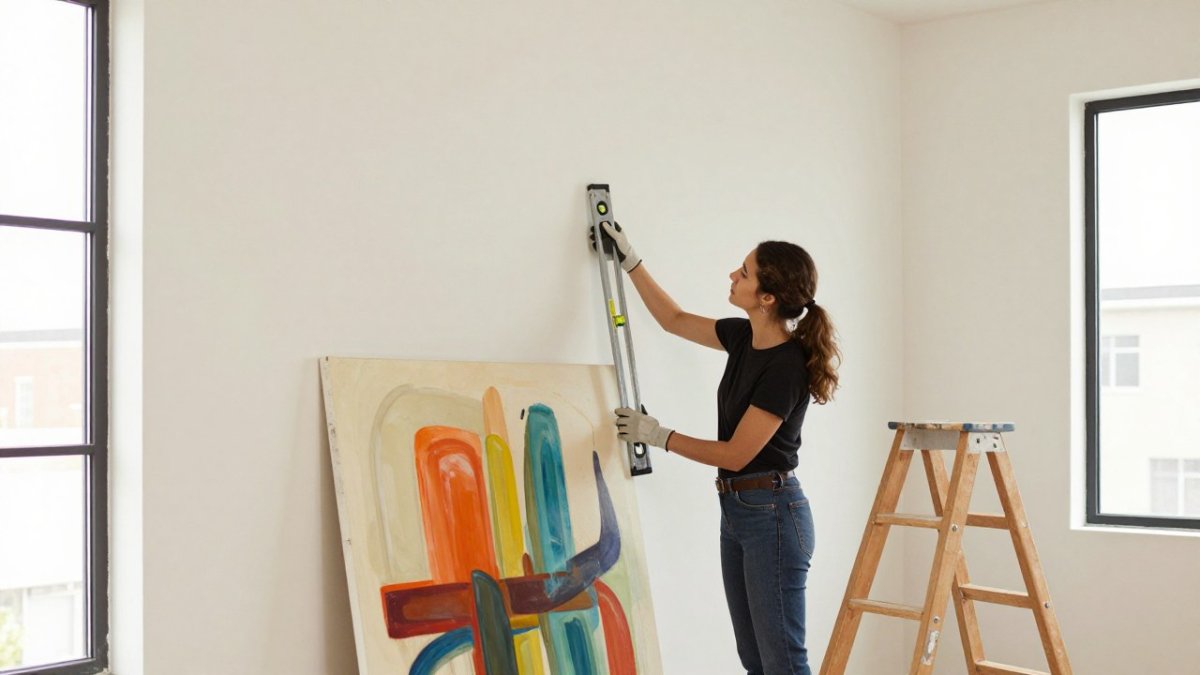
Step 6: Find the height and hang level
A common approach is to center the artwork at eye level, roughly 57 to 60 inches from the floor to the center of the piece.
Mark both hanging points, check with a level, and mount into studs or proper anchors.
For large pieces, our pro guide on hanging large abstract art covers anchor types and wall planning in detail.
Watch out: hanging a heavy framed canvas from a single nail or a drywall anchor rated below the load is the most common failure we see.
When a Floater Frame Is Not the Right Choice
- The canvas edges are raw or stapled. There's nothing worth showing, and a standard frame hides the mess.
- The work is on paper or panel. These need glass and a mat, not a floater.
- The piece will travel often. Floater frames add bulk and hardware that complicate packing.
If you're reconsidering framing altogether, our guide on cleaning and maintaining abstract canvas paintings covers keeping an unframed canvas in good condition.
On care: dust a framed canvas with a soft, dry brush and keep it out of direct sun.
Choosing a frame is really a decision about how much of the painting you want the viewer to see.
Frequently Asked Questions
What is a floater frame for art?
A floater frame is a frame built with an inner opening slightly larger than the canvas, so the artwork sits inside the frame instead of behind a lip. The canvas is attached from behind, which leaves a narrow reveal, usually a few millimeters to about a centimeter, all the way around. Because nothing overlaps the front, the entire painted surface and the canvas edges stay visible, and the piece appears to hover inside the frame rather than being boxed in.
Do floater frames work with stretched canvas?
Yes, they are made for it. A floater frame is sized to the outside dimensions of a stretched canvas and to its depth, so the stretcher bars sit inside the frame's rabbet and the canvas face stays flush or slightly recessed. Gallery-wrapped canvases with painted edges are the best match, since those edges remain on view. Measure the canvas width, height, and depth before ordering, and confirm the frame's inner depth is at least as deep as the stretcher bars.
How much space should be between a canvas and a floater frame?
Most floater frames use a reveal of about 1/4 inch, and anything from 1/8 inch to 1/2 inch is common. A narrow gap reads as a crisp hairline shadow and keeps attention on the painting; a wider reveal gives the work more breathing room and suits large, bold abstract pieces. The gap must be even on all four sides, so the frame has to be ordered to the exact canvas dimensions rather than a standard size.
Can you hang a canvas without a floater frame?
You can. A gallery-wrapped canvas can go straight on the wall with a sawtooth hanger or D-rings, and many abstract pieces look finished that way. A floater frame adds a defined boundary, protects the canvas edges from knocks, and gives the work a gallery-style presentation that holds its own against furniture and wall color. If the canvas has staples or unfinished edges showing, framing is the simpler fix than repainting the sides.