 how-to
How to Frame Original Fine Art: A 2026 Guide
Table of Contents
- Before You Frame: What You'll Need and Why It Matters
- How to Choose a Frame for a Painting
- Art Framing Materials: Conservation-Grade vs. Standard
- Measuring Artwork and Frame Dimensions: A Step-by-Step Walkthrough
- Safe Mounting Without Damaging an Original
- How to Display Unframed Artwork
- How to Hang Framed Art
- When to DIY vs. Hire a Professional Framer
- Frequently Asked Questions
Last Updated: October 12, 2026
Before You Frame: What You'll Need and Why It Matters
Knowing how to frame original fine art is the process of protecting a one-of-a-kind work while presenting it at its best, and it starts before you buy a single supply.
At Susan Fielder Art, we ship original abstract paintings to homes across the country, so we hear the same question often: how do I frame this without ruining it?
Here is the good news. A careful home framer can do this well with the right materials and a little patience.
Gather these before you start:
- A tape measure and a pencil
- Clean cotton gloves
- Acid-free backing board and mounting supplies
How to Choose a Frame for a Painting
Choosing a frame for a painting means matching the frame to the artwork's mood, scale, and color rather than to your furniture. The frame should support the piece, not compete with it.
Start by looking at the painting itself, not your wall. What colors repeat inside the piece? What is the overall feeling, calm or energetic? The answers point you toward a frame family before you ever measure.
Matching Frame Style to the Artwork
A frame style is the overall look and shape of the molding, such as a slim gallery float, a wide flat profile, or a deep shadow box. For contemporary abstract work, simple profiles usually win.
For traditional or older pieces, a period-appropriate frame can be part of the work's meaning. The RISD Museum's guidance on framing art advises that an original frame on an original work should never be separated, and it recommends researching the artist and frame before deciding.
Frame Color, Finish, and Profile
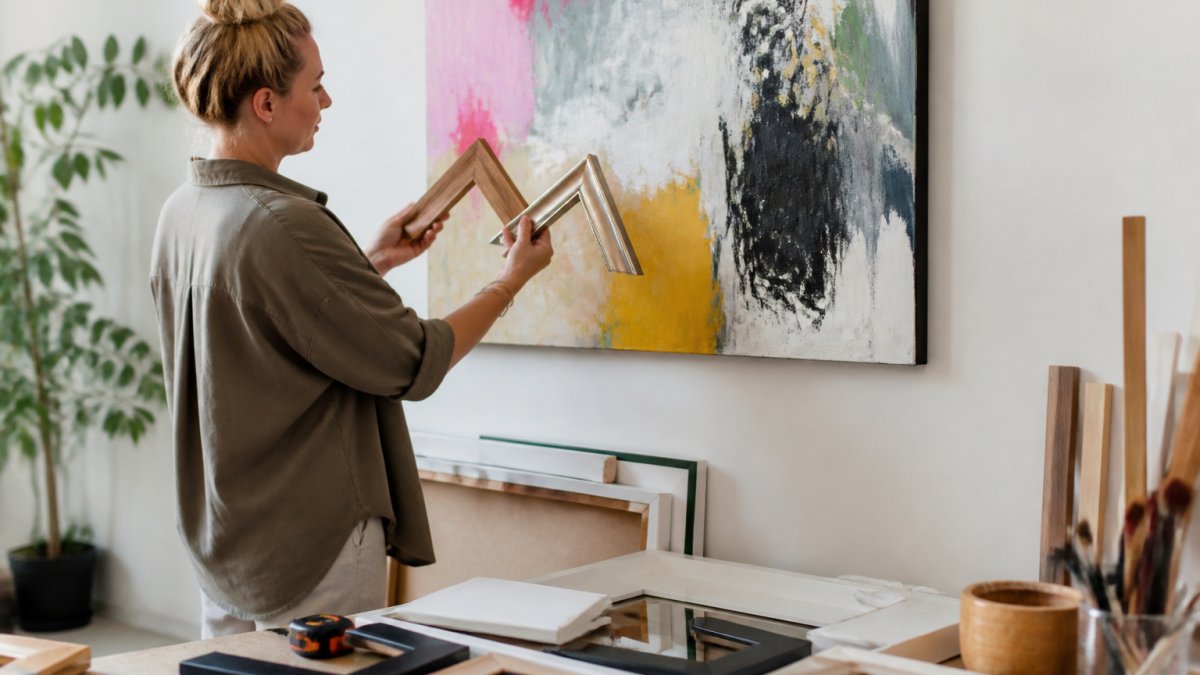
Frame color should echo a color already in the painting. Pull a secondary tone from the canvas and let the frame repeat it. That trick makes the whole piece feel intentional.
Finish matters too. Matte finishes absorb light and suit soft, quiet work. Glossy finishes reflect light and add energy. Profile, meaning the shape and depth of the molding, controls how much the frame stands off the wall.
Quick matching rules:
- Warm painting, warm frame: gold, natural wood, or bronze
- Cool painting, cool frame: silver, black, or gray
- Bold painting, quiet frame: thin and neutral
Art Framing Materials: Conservation-Grade vs. Standard
Art framing materials fall into two groups: conservation-grade and standard. Conservation-grade materials are acid-free and designed to protect the artwork for decades. Standard materials are cheaper and fine for a print you may swap out, but risky for an original.
The difference comes down to acid. Cheap mat board and backing contain acid that migrates into paper and canvas over time, causing yellowing and brittle edges. Acid-free and buffered boards stop that transfer.
Conservation-grade includes:
- Acid-free, buffered mat board
- Archival mounting hinges or corner pockets
- Inert backing board
Standard includes:
- Basic paper mat board
- Spray adhesive or dry mounting
- Standard cardboard backing
Glazing, Reflection, and Environmental Trade-Offs
Glazing is the glass or acrylic sheet that sits in front of the art. It blocks dust, UV light, and fingerprints.
Museum glass cuts glare and filters UV, but it costs more. Acrylic is lighter and safer for large pieces, though it scratches more easily.
Think about the room. A bright, sunlit wall needs UV-filtering glazing to slow fading. A dim hallway can get by with less.
Measuring Artwork and Frame Dimensions: A Step-by-Step Walkthrough
Measuring artwork and frame dimensions correctly is the step that prevents a costly misfit. Measure the art first, then the mat opening, then the frame, and write every number down. Guessing here wastes money and time, and on an original you cannot simply reorder a replacement print.
The four numbers that matter
Every framing order comes down to four measurements. Confuse them and the piece will not fit.
- Art size, the actual width and height of the artwork, edge to edge.
- Mat opening, the visible window the mat creates over the art.
- Frame size, the outer dimension of the frame, which is what hangs on the wall.
- Rabbet depth, the inner lip of the frame that holds the art stack (glazing + mat + art + backing).
Step-by-step measurement
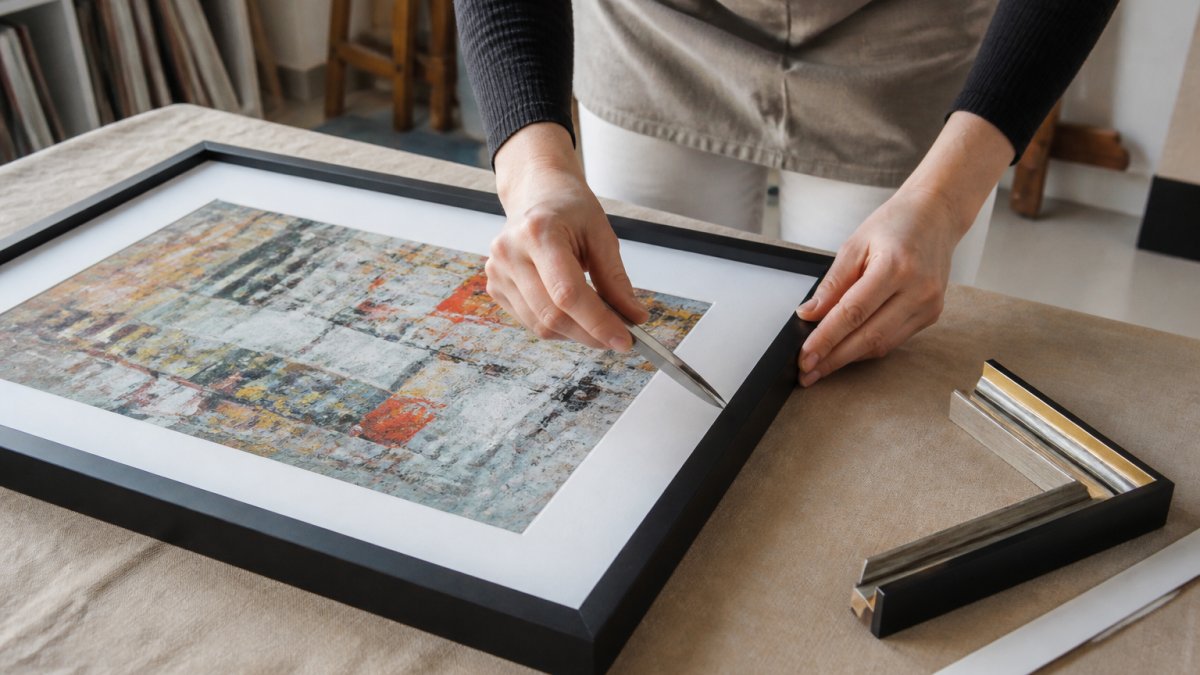
- Lay the artwork flat on a clean, padded surface. Wear cotton gloves.
- Measure the width edge to edge at the top, middle, and bottom. Record all three.
- Measure the height the same way on both sides. Record both.
- Use the largest measurement in each direction. Paper and canvas are rarely perfectly square, and the frame must clear the widest point.
- Decide your mat border width. A common border is 2 to 4 inches on each side for a medium work; larger pieces often take 3 to 5 inches.
- Calculate the mat opening. The opening should overlap the art by about 1/8 inch on each side so the mat holds the edges down. That means the opening is roughly 1/4 inch smaller than the art in each direction.
- Calculate the frame size. Frame size = art size + (2 × mat border) + a small allowance for the frame's rabbet overlap (usually 1/8 to 1/4 inch per side).
Worked example
Say you have an original painting on paper that measures 11 × 14 inches.
- Art size: 11 × 14 in
- Mat border: 3 in on each side
- Mat opening: 10 3/4 × 13 3/4 in (1/8 in overlap per side)
If you skip the mat, the frame rabbet should match the art size plus about 1/8 inch per side for clearance. Never order a frame opening exactly the art size, humidity changes will make the paper swell and buckle.
Rabbet depth: the number most people forget
Rabbet depth is how deep the frame's inner lip is. It must be deep enough to hold the entire stack: glazing, mat, artwork, and backing board. A typical stack runs 1/4 to 3/8 inch thick. If the rabbet is too shallow, the backing will not seat and the frame will not close. If it is too deep, the art will rattle.
| Measurement | What to Measure | Why It Matters |
|---|---|---|
| Art width | Edge to edge, widest point | Sets the mat opening |
| Art height | Top to bottom, tallest point | Sets the mat opening |
| Mat border | Width of mat on each side | Adds to overall size |
| Mat opening | Art size minus ~1/4 in | Holds art without covering image |
| Frame rabbet width | Inner lip width | Determines frame size |
| Rabbet depth | Inner lip depth | Must clear glazing + mat + art + backing |
| Overall size | Frame outer edge | Confirms wall fit |
Safe Mounting Without Damaging an Original
Safe mounting means holding the artwork in place without glue, tape, or anything that touches the painted surface. The goal is to secure the piece while letting it expand and contract with temperature and humidity.
The safest methods use the edges or the back, never the front. Hinges made from acid-free paper and wheat starch paste attach to the back of the art and the backing board, letting the piece hang freely.
Never do these:
- Spray adhesive on an original
- Dry mounting an original painting
- Tape touching the painted surface
How to Display Unframed Artwork
Displaying unframed artwork is a valid choice, especially for canvas that is already stretched and finished on the sides.
Before you hang a piece unframed, check the edges. Are the sides painted or finished? Is the canvas stapled on the back rather than the sides?
Ways to display unframed art:
- Hang a gallery-wrapped canvas directly
- Lean a piece on a shelf or mantel
- Clip a work to a rail for a rotating display
Keep unframed art out of direct sun and away from damp rooms. Without glazing, the surface has no barrier against dust, so dust gently with a soft dry cloth.
How to Hang Framed Art
Hanging framed art well comes down to height, hardware, and level. The center of the artwork should sit at eye level, which is usually around 57 to 60 inches from the floor.
Use hardware rated for the weight. A small frame needs one hook. A large, heavy piece needs two hooks or a French cleat spread across the back. Two points of support stop the frame from drifting out of level.
Hanging checklist:
- Mark the center height on the wall with a pencil
- Measure the hanging wire or cleat position on the frame
- Install hardware rated above the frame's weight
When to DIY vs. Hire a Professional Framer
Learning how to frame original fine art yourself works well for standard sizes, simple profiles, and pieces you feel confident handling.
If the art is a one-of-a-kind piece you love, and the size is unusual or the surface is delicate, a pro removes the risk.
Choose DIY when:
- The size is standard and a ready-made frame fits
- The work is sturdy and easy to handle
- You want to save money and enjoy the process
Choose a pro when:
- The piece is large, heavy, or fragile
- The value is high and you want it insured in place
- The shape is irregular or the surface is textured
At Susan Fielder Art, every original we sell is a one-of-a-kind piece tied to a story of healing and resilience, and 10% of all proceeds go to pancreatic cancer research.
Frequently Asked Questions
What is the 70/30 rule in art?
The 70/30 rule is a composition guideline suggesting that roughly 70% of a frame's visual weight should come from its dominant material or color, while 30% comes from accent details. Applied to framing, it means the frame should complement the artwork without competing. A neutral wood frame with a subtle gold inner lip is a common example. The goal is visual balance: the frame supports the piece rather than overshadowing it.
How do you frame original fine art without damaging it?
Use conservation-grade materials and reversible mounting techniques. Avoid spray adhesive, double-sided tape, or dry mounting on original works, as these bond permanently to the surface. Instead, use archival hinging tape applied to the back of the artwork with a Japanese paper hinge, or corner pockets made from Mylar. Add an acid-free backing board and UV-filtering glazing. The RISD Museum advises that an original frame on an original work should never be separated, so research the artist and frame before making changes.
Should original artwork be framed with glass?
It depends on the medium. Works on paper (watercolors, prints, photographs) need glazing to protect against dust, moisture, and UV light. Oil and acrylic paintings on canvas generally do not require glass because the paint surface needs to breathe and glazing can trap moisture. If you frame a canvas, use a floater frame that leaves a small gap between the canvas edge and the frame, and skip the glass.
How do I measure artwork for a frame?
Measure the artwork's width and height at the widest and tallest points, including any irregular edges. For a matted piece, add the mat border width to both dimensions. For a frame, add the frame profile width on all sides plus a small allowance (about 2-3 mm) for expansion. Always write down the dimensions before ordering. A measuring tape alone can be imprecise, so use a metal ruler for smaller works.
Framing an original is a decision about trust: trust that the materials you choose will protect the work for years. If you would rather not take that on alone, Susan Fielder Art can point you toward the right care for your piece. Our originals arrive ready to display, backed by a verified secure checkout and registered with the Art Storefronts Organization. Browse our collection and find a painting that transforms your space while supporting a cause that matters.