 how-to
How to Host an Art Auction for Cancer Fundraising
Table of Contents
- Plan Your Art Auction for Cancer Fundraising
- How to Ask Artists to Donate Artwork
- Select an Auction Format That Works for Your Event
- Silent Art Auction Rules and Bidding Sheets
- Price Artwork and Set Opening Bids
- Art Auction Event Planning Checklist
- Online Art Auction Fundraising Strategy
- Maximize Cancer Fundraising Impact and Donor Recognition
- Frequently Asked Questions
Last Updated: October 10, 2026
Plan Your Art Auction for Cancer Fundraising
Hosting an art auction cancer fundraising event transforms artwork into fuel for research and patient support. Every dollar raised moves the needle on treatment advances and survivor care.

Art auctions connect donors with a cause while celebrating artists who give their work freely. The best auctions start with a solid plan.
Set Your Fundraising Goal and Timeline
Start by defining what success looks like. According to Giving USA's 2025 State of Nonprofit Auctions, auction donors gave an average gift of $529, with 49% of those donors making an additional gift afterward.
Set a realistic goal based on audience size and donor capacity. Small community events might target $5,000; larger, well-promoted auctions could reach $25,000 or more.
Timeline matters. Plan your art auction for cancer fundraising at least 3-4 months in advance. This gives you time to:
- Recruit artists and collect donated artwork
- Build your bidder list
- Secure a venue
- Create marketing materials
Choose Your Venue and Event Date
Pick a venue with good lighting, wall space for displays, and room for bidders to move comfortably. Community centers, galleries, nonprofit offices, and restaurants all work.
Book your date early. Avoid major holidays and competing local events. Weekends typically draw larger crowds than weekdays.
How to Ask Artists to Donate Artwork
Artists are the backbone of any art auction for cancer fundraising. How you approach them matters.
Identify and Reach Out to Local Artists
Start with artists you know personally, then expand to local art schools, galleries, social media communities, and your city's arts council.
Include your nonprofit's mission, how funds are used, the auction date and format, what happens to unsold artwork, and recognition the artist will receive.
Create Clear Donation Agreements
Put everything in writing. A donation agreement protects both you and the artist. It should cover:
- Artwork details: Title, medium, dimensions, retail value estimate
- Ownership transfer: Confirm the artwork becomes the nonprofit's property
- Unsold artwork: Will you return it or donate it elsewhere?
- Artist recognition: How will they be credited in the catalog and at the event?
Keep the agreement simple and friendly, most artists appreciate clarity because it removes confusion later.
Select an Auction Format That Works for Your Event
The format you choose shapes the entire experience. Each has strengths and trade-offs.
Live Auction vs. Silent Auction vs. Hybrid
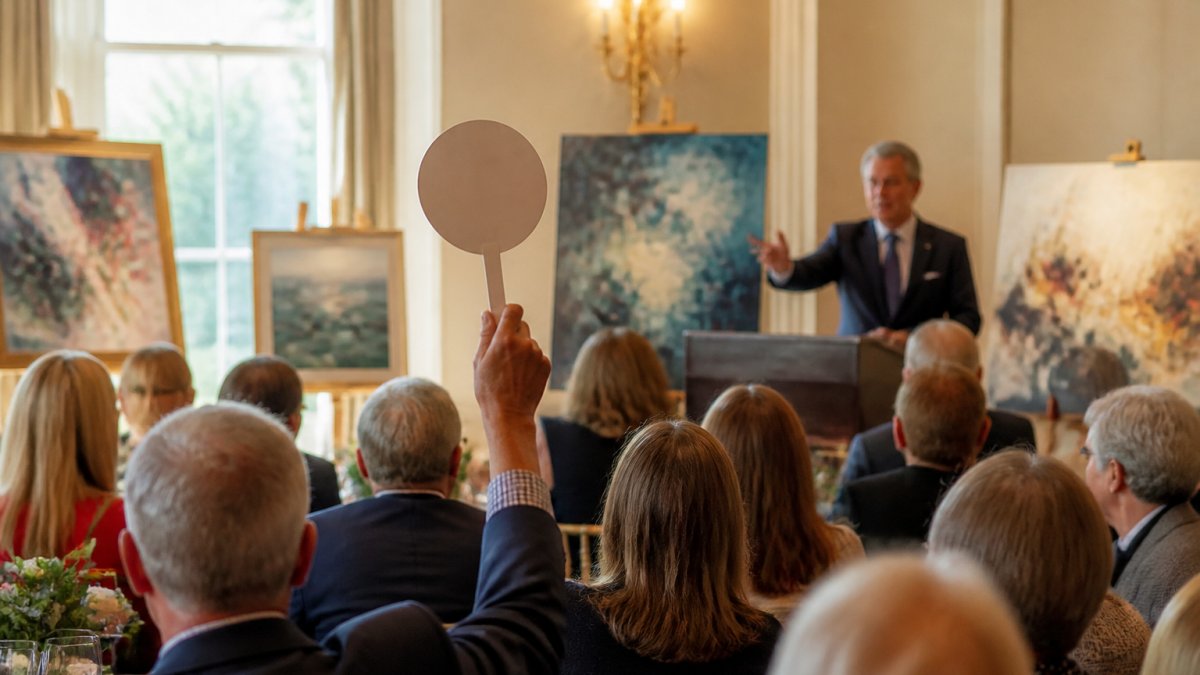
Live Auction: A professional auctioneer guides bidding with high energy and competitive pricing.
Silent Auction: Bidders write offers on sheets with no auctioneer needed. Lower-pressure and inclusive. Trade-off: prices tend to be more conservative.
Hybrid Auction: Silent auction runs all evening; high-value pieces go live at the end.
Silent Art Auction Rules and Bidding Sheets
Silent auctions need clear rules or they descend into confusion. Set expectations upfront so bidders know how to participate.
Set Up Bidding Sheets and Track Bids
Create a simple bidding sheet for each artwork. Include:
- Artwork title and artist name
- Starting bid amount
- Bid increment (usually $10-$25 depending on estimated value)
- Blank lines for bidders to write their name and bid amount
Place sheets on tables or clipboards next to artwork with pens readily available. Assign a volunteer to monitor bidding every 15-30 minutes, verify legibility, watch for errors, and ensure the highest bidder is clear when the auction closes.
Establish Reserve Prices and Bid Increments
A reserve price is the minimum you'll accept; set it realistically to avoid unsold artwork or leaving money on the table. Bid increments are the minimum jump between bids, $10 for a $100 opening bid, $50 for a $1,000 piece. Document these rules on bidding sheets.
| Element | Purpose | Example |
|---|---|---|
| Opening bid | Starting point for bidding | $50 |
| Bid increment | Minimum jump between bids | $10 |
| Reserve price | Minimum acceptable final bid | $75 |
| Closing time | When bidding ends | 8:00 PM |
Price Artwork and Set Opening Bids
Ask each artist for a fair market value estimate. Opening bids typically start at 30-50% of estimated value, for a $400 piece, open at $120-$200 to invite participation and build momentum.
Art Auction Event Planning Checklist
Display and Describe Artwork Effectively
Display each piece at eye level with good lighting. Avoid cluttered backgrounds that compete for attention.
Create printed description cards for each artwork including title, artist name, medium, dimensions, and a brief artist statement. Make them easy to read from a few feet away.
Promote Your Auction and Attract Bidders
Start promoting early through email, social media (share artwork images), local newspapers, posters, and word of mouth. Emphasize the cause, frame it as "Support cancer research through art." People bid higher when they feel connected to the mission.
Online Art Auction Fundraising Strategy
If a live or hybrid event isn't feasible, online auctions work. They reach broader audiences and remove geographic limits.
Choose an Auction Platform
Several platforms support nonprofit auctions:
- Specialized nonprofit auction software (32Auctions, BiddingForGood, Auctionata)
- General marketplace platforms (eBay for nonprofits)
- Your own website with auction functionality
Look for platforms with reasonable fees (10-15% standard), secure payment processing, mobile bidding, automated email reminders, and donor reporting.
Process Payments and Deliver Artwork
Decide upfront on shipping costs (buyer usually covers), return policy (typically no returns), delivery timeline (within 2 weeks standard), and payment methods. Provide high-quality photos from multiple angles with dimensions and condition notes.
Maximize Cancer Fundraising Impact and Donor Recognition
Your art auction for cancer fundraising raises money, but it also builds community and awareness. The work doesn't end when the gavel falls. Post-event stewardship determines whether bidders, artists, and volunteers return for your next event.
Post-Event Thank-You Workflow
Create a structured thank-you sequence within one week of the event:
Day 1-2 after the event:
- Send a brief thank-you email to all bidders (winners and non-winners). Include a photo from the event and a sentence about the total amount raised.
- Email artists with a summary of results: how many pieces sold, total proceeds, and recognition they received.
- Thank volunteers and sponsors with a personal note or call.
Day 3-5:
- Mail or email formal donation receipts to all artists (required for their tax deduction).
- Send winning bidders a receipt and pickup/delivery instructions for their artwork.
- Post event photos and a brief recap on your website and social media, tagging artists and thanking major bidders by name (if they consent).
Week 2:
- Publish a detailed impact report (see below) and share it with all participants.
- Follow up with major bidders ($500+) with a personal phone call or handwritten note from a board member or executive director.
Impact Reporting and Transparency
Donors and artists want to know their contribution mattered. Publish a clear, honest report within 2-3 weeks:
What to include:
- Total gross revenue from the auction
- Itemized expenses (venue rental, auctioneer fee, marketing, catering, etc.)
- Net proceeds (gross revenue minus expenses)
- How the net proceeds will be used (e.g., "$8,500 will fund three months of patient navigation services at [Cancer Center Name]" or "$12,000 will support a research grant focused on [specific cancer type] treatment")
According to Association of Fundraising Professionals research, nonprofits that report back to donors see 35% higher retention rates. Transparency builds trust and encourages repeat giving.
Donor Retention and Cultivation
Bidders at your art auction are high-capacity donors. They've already shown they'll spend money for your cause. Cultivate them:
- Add all bidders to your donor database and monthly newsletter.
- Invite major bidders to a private thank-you reception or behind-the-scenes tour of your cancer center or research facility.
- Feature their names in your annual report or donor honor roll (with permission).
- Invite them to your next art auction 6-9 months in advance, before you begin recruiting artists.
Artist Retention and Community Building
Artists are your most valuable partners. Keeping them engaged ensures a strong pipeline for future auctions:
- Send each artist a thank-you package: a printed catalog, photos of their work at the event, and a summary of how much their donation contributed to the total.
- Invite artists to a post-event celebration or studio visit.
- Feature artists in your newsletter or social media throughout the year, sharing their work and their connection to your mission.
- Ask artists if they'd like to be on a "recurring donor" list for future auctions (some artists will commit to donating annually).
Budget and Net-Proceeds Planning
Before your next auction, conduct a financial review to determine if the format is sustainable:
Typical expense categories:
- Venue rental: $500-$2,500 (depending on location and size)
- Auctioneer fee: $300-$1,500 (or volunteer, $0)
- Marketing and printing: $200-$800
- Catering and beverages: $300-$1,500
- Auction platform or software: $0-$500
Total typical range: $1,500-$7,600 for a community-scale event.
If your gross revenue was $10,000 and expenses were $3,000, your net proceeds are $7,000. That's a 70% net margin, excellent. If gross revenue was $8,000 and expenses were $4,000, your net is $4,000 (50% margin), still solid, but consider whether a different format (online auction, smaller venue) could reduce costs.
Document this analysis and share it with your board. It justifies the effort and informs planning for the next event.
Creating a Catalog and Keepsake
Consider producing a printed or digital catalog of the event. It serves multiple purposes:
- For bidders: A keepsake that documents their purchase and the artists they supported.
- For artists: Professional documentation of their work and its charitable impact.
- For your organization: A marketing tool and historical record.
A simple 20-30 page printed catalog costs $300-$800 to produce (depending on quantity and quality). A digital PDF version costs nothing to distribute via email and your website. Include:
- Cover with event title, date, and cancer mission
- Artist bios and photos
- Artwork images with titles, medium, and sale prices
- Acknowledgments of sponsors, volunteers, and major bidders
- Impact statement (how much was raised and how it will be used)
Most importantly, close the loop. Tell donors where their money went. Did it fund a specific research project? Support patient services? Share outcomes in a follow-up email 6-12 months after the event. This builds trust and encourages repeat giving.
Frequently Asked Questions
How much money can an art auction for cancer fundraising realistically raise?
According to recent nonprofit auction data, auction donors gave an average gift of $529, with 49% of auction donors making an additional gift beyond their winning bid. The total raised depends on the number of artworks, opening bid amounts, and your audience size. A well-organized charity art auction with 20-30 pieces and strong promotion can raise $5,000 to $15,000 or more. Success comes from quality artwork, engaged bidders, and clear communication about how proceeds support cancer research.
What is the difference between a silent art auction and a live auction for cancer fundraising?
In a silent auction, bidders write their offers on bidding sheets or a digital platform during a set time window, then the highest bidder wins each piece. Live auctions use an auctioneer who calls out items and facilitates real-time bidding, creating excitement and often higher prices. Silent auctions work well for smaller events or mixed-format fundraisers because they require less staffing. Live auctions generate energy and competitive bidding but need professional auctioneers. Many cancer fundraising events use a hybrid approach, combining silent bidding on smaller pieces with a live auction for high-value artwork.
How do I ask artists to donate artwork for a charity auction?
Contact local artists directly with a personal letter or email explaining your cancer fundraising mission and why their work matters to the cause. Be specific: mention the event date, venue, and expected audience. Offer to feature their name, bio, and artist statement in your auction catalog and program. Provide a simple donation agreement that clarifies ownership transfer, any tax deduction eligibility, and how their work will be displayed. Give artists at least 6-8 weeks' notice so they can prepare pieces. Recognize their generosity publicly throughout the event and in thank-you communications afterward.
What should I include in my art auction event planning checklist?
Start 3-4 months before your event. Secure a venue, recruit artists, and set your fundraising goal. Create an auction catalog with high-quality photos and artist statements. Set up a registration or ticketing system and plan promotion across social media, email, and local networks. Arrange for payment processing and checkout logistics. If using an online auction platform, test it thoroughly. Plan artwork display with proper lighting and signage. Brief volunteers on their roles. Confirm logistics with your auctioneer (if live) or finalize bidding sheet templates (if silent). Send reminder emails to registered bidders 1-2 weeks before the event. After the auction, process payments, arrange artwork delivery, and send thank-you letters to artists, donors, and bidders.