 how-to
How Do You Organize a Community Art Fundraiser?
Last Updated: October 29, 2026
Quick Summary
To organize a community art fundraiser, set a measurable fundraising goal and build a timeline that matches your event size, then solicit donated art from local artists and confirm permits, insurance, and raffle rules before selling tickets. Small events under 100 guests can be planned in 8 to 12 weeks, while galas and festivals need 4 to 6 months.
- Small community events with under 100 guests can be planned in 8 to 12 weeks.
- Build a list of 20 to 30 local artists and collectors when soliciting art donations.
- Ticket sales should cover fixed costs like venue, insurance, and permits.
- Promotion starts four to six weeks out across email, social media, and local press.
- Send thank-you notes within a week and share final numbers with donors.
Table of Contents
- Start With a Goal and a Timeline for Your Community Art Fundraiser
- How to Solicit Art Donations for Charity
- Your Nonprofit Event Planning Checklist
- Art Auction Fundraising Ideas That Fit Your Crowd
- Budgeting, Sponsorship, and Venue Selection
- Marketing, Publicity, and Community Outreach
- Volunteer Management and Event Execution
- Plan Your Community Art Fundraiser With Susan Fielder Art
- Frequently Asked Questions
Start With a Goal and a Timeline for Your Community Art Fundraiser
A community art fundraiser raises money for a cause by selling, auctioning, or showcasing art made by local creators. Pairing creative work with a clear purpose can make a big difference for a cause. First, decide what you want to raise and when.
Set a Fundraising Goal You Can Measure
Pick one number and write it down. Then break that number into smaller pieces you can track.
- Set a total goal, such as $5,000 or $10,000
- Split it into ticket sales, auction bids, and direct donations
- Set a stretch goal for extra revenue
A clear goal keeps your committee focused and helps you ask sponsors for support with confidence.
Build an Event Timeline That Matches Your Size
Small events move fast. Big ones take months.
For smaller community events with under 100 guests, a planning window of 8 to 12 weeks is considered workable, according to Zeffy's 2026 fundraising event guide. For major events like galas or festivals, planning should begin 4 to 6 months in advance.
| Event Size | Guests | Planning Window |
|---|---|---|
| Small community show | Under 100 | 8-12 weeks |
| Mid-size benefit | 100-250 | 3-4 months |
| Gala or festival | 250+ | 4-6 months |
Some organizers use four phases instead, goal setting, approvals, execution, follow-up. Pick one method and stick with it.
How to Solicit Art Donations for Charity
Start with artists you know, then widen your circle.
- Build a list of 20 to 30 local artists and collectors
- Write a one-page letter that names the cause and the event date
- Offer a tax-deductible receipt and clear credit in all marketing
- Ask for a specific piece or a specific value range
- Follow up once by phone, then once by email
Understand the value of what artists give. Our guide on how to determine market value of original art explains how to set fair starting bids and thank donors credibly.
Watch out: vague asks like "anything helps" get vague results. Name the piece size, the theme, and the deadline.
Your Nonprofit Event Planning Checklist
A nonprofit event planning checklist keeps a small team from missing details. Build yours around six buckets: money, art, place, people, rules, and access, the last two are where most community art fundraisers get into trouble.
- Confirm your budget and sponsorship totals
- Collect, photograph, and catalog every donated piece
- Book the venue and sign the contract
Permits, Licenses, and Raffle Rules
Permit requirements vary by location, so confirm everything with your local government offices and your state charity regulator before you sell a single ticket. Common items include:
- Temporary event or special event permit: often required for public gatherings, signage, or street use.
- Food service permit: required if you prepare or serve food; a licensed caterer may cover this under their own permit.
- Sales tax permit or exemption: artwork sales may be taxable even at a fundraiser; confirm your state's rules and whether your nonprofit exemption applies.
Insurance and Art Handling
Ask your venue what coverage they carry, then add a short-term special event liability policy if needed. For high-value donated art, ask your agent about a fine art floater or bailee coverage. Document every piece on intake with a photo, condition note, and estimated value, plus a signed donation form stating ownership and transfer terms.
Tax-Deductible Receipts Done Right
Donors want proof, and the IRS has specific rules for charitable acknowledgments. A compliant receipt should include:
- The organization's legal name and employer identification number (EIN)
- A statement that no goods or services were provided in exchange, or a good-faith estimate of the value of anything provided
- A description of the donated item
Tell artists up front so they can plan. Buyers and donors both want proof of authenticity, and our guide on how to verify abstract art authenticity online walks through the checks that hold up.
Accessibility and Inclusivity (the Gap Most Guides Miss)
Public art events should be accessible to the whole community. Build accessibility into the plan rather than retrofitting it:
- Physical access: step-free entry, accessible restrooms, and clear 36-inch-wide aisles between display walls.
- Display height: hang and place art so seated guests can view it; provide a lower viewing zone for key pieces.
- Communication: captions on any video, large-print bid sheets, and a quiet room or low-sensory hour for guests who need it.
Announce accessibility features in your marketing, it signals the event is for everyone and often brings in guests who would otherwise stay home.
Art Auction Fundraising Ideas That Fit Your Crowd
Match the format to your audience. A quiet gallery crowd bids differently than a festival crowd.
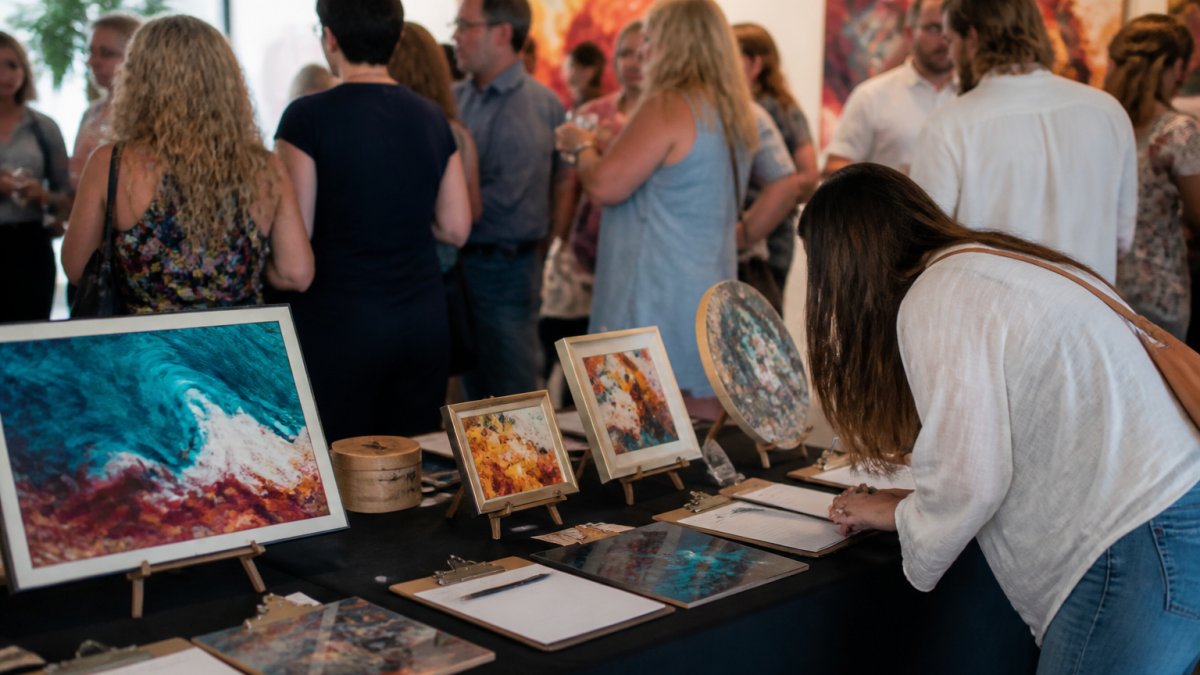
- Silent auction: bid sheets beside each piece, closes at a set time
- Live auction: an auctioneer drives bids on 5 to 8 top pieces
- Art-a-thon: artists create on site while guests donate to vote

The community canvas idea is growing. Zeffy's 2026 event trends report notes interactive installations where visitors donate to paint a communal piece. For a deeper walkthrough of auction formats, see our guide on how to host an art auction for cancer fundraising.
Budgeting, Sponsorship, and Venue Selection
Set your budget before you book anything. A community art fundraiser runs on a break-even-plus-margin model: project revenue from tickets, auction bids, donations, and sponsors, then cap expenses so the event nets your goal. Build a line-item spreadsheet, not a percentage guess. Rigorous financial planning ensures that every charity fundraiser event remains sustainable even when logistical complexities arise during the coordination of specialized local gatherings.
Build a Line-Item Budget
Start with revenue lines, then expense lines, then a contingency. A common pattern for a 150-guest community art fundraiser looks like this:
| Line Item | Type | Planning Assumption |
|---|---|---|
| Ticket sales | Revenue | Price per ticket × expected attendance |
| Silent auction proceeds | Revenue | Conservative estimate per piece × number of pieces |
| Live auction proceeds | Revenue | Top 5-8 pieces only |
| Direct donations | Revenue | Ask-at-door and online giving |
| Sponsorships | Revenue | Cash plus in-kind |
| Venue rental | Expense | Contracted flat fee |
| Event liability insurance | Expense | Short-term policy premium |
| Art handling and display | Expense | Rentals, easels, wall hardware |
| Marketing and printing | Expense | Bid sheets, signage, postage |
| Food and beverage | Expense | Per-person catering or donated |
| Permits and licenses | Expense | Temporary event, sales tax, food service |
| Payment processing | Expense | Percentage of card and online gifts |
| Contingency | Expense | 5-10% of total expenses |
Two line items often overlooked: payment processing fees (card readers and online platforms take a cut of every ticket and bid) and insuring the art while it is on site. Price both before you set ticket tiers.
Sponsorship Tiers That Actually Close
Sponsorship covers the gap between ticket revenue and total expenses. Local banks, credit unions, art supply stores, restaurants, and real estate offices are the most common community sponsors. Offer three tiers with named benefits rather than an open ask:
- Presenting sponsor (one only): name and logo on all signage, event program, and social posts; verbal recognition from the stage; first choice of auction preview time.
- Gallery sponsor (three to five): logo on signage and program; social media mention; reserved seating.
- Community sponsor (open): name in the program and on the thank-you page.
Ask for a specific amount tied to a specific cost line, for example, "Would you cover the $1,200 venue rental?" Specific asks close far more often than "any amount helps." Value in-kind sponsors (food, printing, AV) at fair market value and acknowledge them like cash sponsors.
Venue Selection Trade-Offs
Look for good lighting, wide wall space, easy load-in, and accessible entry. Compare the real trade-offs:
- Gallery or community center: lowest cost, best wall space, but limited capacity and sometimes restrictive load-in hours.
- Church hall or school gym: inexpensive and roomy, but you may need to bring your own lighting and wall panels.
- Hotel ballroom: turnkey AV and catering, but the highest rental cost and often a food-and-beverage minimum that eats your margin.
Ask every venue what liability coverage they carry and whether they require you to name them as an additional insured. Get load-in and load-out windows in writing, art handling takes longer than most venues expect.
Claim the Sustainability Angle
Choose recycled or FSC-certified paper for bid sheets and programs, rent display walls and easels instead of buying, source plant-based or local catering, and set up clearly labeled recycling and compost stations. Ask artists to use non-toxic or reclaimed materials where the work allows, and say so in your marketing, donors respond to it.
Marketing, Publicity, and Community Outreach
Promotion starts four to six weeks out and runs on a schedule across three channels: email, social media, and local press.
- Send three emails: save the date, ticket launch, final reminder
- Post weekly on social media with one consistent social media hashtag
- Pitch your local paper two weeks before the event
Community outreach matters most. Partner with schools, arts councils, and nearby businesses, each brings an audience you do not have. To reach collectors directly, our guide on how to curate a personal art collection in 2026 speaks to exactly the people you want in the room.
Volunteer Management and Event Execution
Volunteers make or break the night. Assign every person one clear job and one backup.
- Set-up crew: walls, lighting, signage
- Greeters: check-in and bidder numbers
- Art handlers: move and protect pieces
Run a 30-minute briefing before doors open, walking everyone through the layout and schedule. Keep one person free during the event to solve problems.
Watch out: checkout lines kill momentum at the end of the night. Staff two payment stations and pre-print receipts for winning bidders.
Plan Your Community Art Fundraiser With Susan Fielder Art
A community art fundraiser works when the goal is clear, the art is real, and the follow-up is honest.
If you want artwork that carries a story, Susan Fielder Art offers emotionally charged abstract originals, and 10% of all proceeds are donated to pancreatic cancer research.
Get started with Susan Fielder Art and turn your next event into a night people remember.
Frequently Asked Questions
How do you solicit art donations for a charity auction?
Start with artists you already know and ask in person or by email with a one-page brief: the cause, the event date, how the work will be displayed, and how credit and tax-deductible acknowledgment will work. Offer a clear deadline and pickup plan. Local artists and gallery owners often say yes when the ask is specific and the audience fits their work. Follow up once, thank every donor publicly, and send documentation after the event so they are willing to give again.
How far in advance should you plan a community art fundraiser?
Timing depends on scale. . Build in extra weeks for art donations, since artists need notice to create or release work. Some organizers skip rigid calendar deadlines and instead run four phases: goal setting, approvals, execution, and follow-up.
What legal considerations apply to a community art fundraiser?
Confirm any charitable solicitation registration, raffle, or auction rules with your local and state authorities before selling tickets. Secure general liability insurance for the venue, get written donation agreements from artists, and issue tax-deductible receipts that state whether goods or services were received. If alcohol is served, a separate license and licensed server are usually required. Confirm details with a local attorney or your state charity office.
How can original abstract art increase what your fundraiser raises?
Original work gives people a reason to bid beyond obligation. A single statement piece can anchor a silent auction table and pull attention to smaller lots nearby. Pair each artwork with the artist's story, since buyers pay more when they understand the narrative behind a piece. Susan Fielder Art offers emotionally charged abstract work tied to a cause, with 10% of proceeds donated to pancreatic cancer research.