 how-to
Using Abstract Paintings to Reduce Bedroom Stress
Table of Contents
- Why Abstract Paintings Can Help Reduce Bedroom Stress
- How to Choose Bedroom Wall Art That Actually Calms You
- Bedroom Art Color Psychology: Calming Colors, Soft Hues, and Muted Tones
- Where to Hang Art in a Bedroom: Placement, Size, and Viewing Distance
- Mindfulness and Abstract Art: A Relaxation Practice, Not a Treatment
- Lighting, Glare, and How to Tell If the Art Is Helping
- Small Budgets, Rentals, and Reversible Display Options
- Conclusion
- Frequently Asked Questions
Last Updated: October 17, 2026
Why Abstract Paintings Can Help Reduce Bedroom Stress
Hanging an abstract painting to reduce bedroom stress works best when the piece is muted, personally meaningful, and placed where you see it before sleep. A review indexed by PubMed Central found that eight of 11 studies linked active art-making, such as drawing or working with clay, to lower stress and anxiety (Creative Arts Interventions for Stress Management and Prevention). Still, the university-level interest is real: the University of Auckland reports evidence that looking at paintings can ease stress and anxiety (Can viewing art reduce stress?).
At Susan Fielder Art, we sell original abstract work, so we have a stake in this conversation. We also think most art-and-wellness advice overpromises. Below, we'll show you exactly how to pick, size, and hang a piece that suits your room and your nervous system, and where the honest limits sit.
How to Choose Bedroom Wall Art That Actually Calms You
The best bedroom wall art is the piece that lowers your shoulders when you walk in, not the one that matches a trend. Most buyers start with color and stop there. That is backwards. Start with you.
Start With Your Stress Triggers and Sensory Preferences
Ask what actually keeps you awake. A racing mind responds to different cues than a tense body.
- Busy mind? Choose calm, repeating shapes over sharp angles.
- Sensitive to clutter? Pick one large piece instead of a gallery wall.
- Drawn to nature? Lean toward organic, landscape-like abstracts.
Write your answers down before you shop. It keeps you from buying on impulse.
Judge Visual Complexity Before You Buy
Visual complexity is how much is happening in a painting at once: the number of colors, edges, and shapes competing for attention. High complexity energizes a hallway. Low complexity settles a bedroom.
Here is how we would score a piece before buying:
- Count the dominant colors. Three or fewer reads calmer.
- Check the edges. Soft, blended edges feel gentler than hard lines.
- Look at contrast. Strong black-on-white pops; muted tones recede.
Bedroom Art Color Psychology: Calming Colors, Soft Hues, and Muted Tones
Calming bedroom colors are the soft, low-saturation ones: beige, taupe, clay, warm gray, and dusty blues.
One caution: don't assume abstract equals calming. A review indexed by PubMed Central found two studies where people reported lower stress viewing nature artworks than abstract ones (Evidence for the effects of viewing visual artworks on stress outcomes). The takeaway isn't to avoid abstract art.
Build your palette around the room:
| Palette | Feels Like | Best For |
|---|---|---|
| Beige, taupe, warm gray | Grounded, quiet | Neutral bedrooms |
| Clay, blush, sand | Warm, soft | Cozy, textured rooms |
| Dusty blue, sage, mist | Cool, airy | Small or warm rooms |
| Charcoal with soft accents | Grounded, modern | Minimal spaces |
Where to Hang Art in a Bedroom: Placement, Size, and Viewing Distance
Hang bedroom art at eye level from where you sit or lie, centered over the bed, with the bottom edge 15 to 25 centimeters above the headboard.
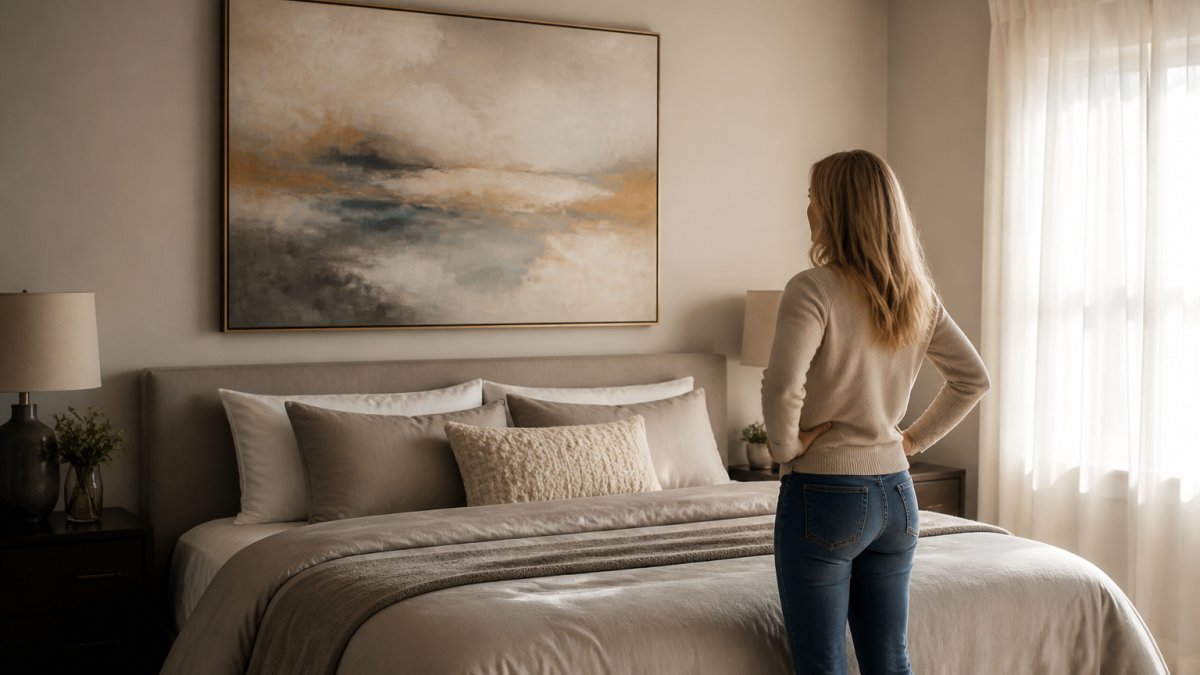
Size matters as much as height. A piece that is too small floats and feels unresolved. As a guide, art above a bed should span roughly two-thirds to three-quarters of the headboard width.
A Step-by-Step Placement Process
Most advice stops at "hang it at eye level." Here is the full sequence we use, from empty wall to final check.
- Measure the headboard width. Write it down. If you have no headboard, measure the mattress width and add 6 to 12 inches.
- Set the target width. Multiply the headboard width by 0.66 and by 0.75. Your art (or art grouping) should fall between those two numbers.
- Find seated eye level. Sit on the bed with your back against the pillows. Have someone mark the wall at your eye height. This is your centerline, not the ceiling line.
- Mark the bottom edge. Measure 15 to 25 centimeters above the top of the headboard and draw a light pencil line. The bottom of the frame sits on or just above this line.
- Tape the footprint. Use painter's tape to outline the frame on the wall. Live with it for a day. If the tape looks too high or too small from the pillow, adjust before you make a hole.
- Check viewing distance. From your pillow, you should see the entire piece without turning your head. If you have to move your eyes past the frame edges, the piece is too wide or hung too close.
- Hang, then verify from the bed. Sit or lie down and look. The most common correction is lowering the piece 2 to 4 inches.
Viewing Distance and Glare
Viewing distance is not just about size. It is about how much of your visual field the piece fills from the bed. A common pattern is that a painting hung 8 to 12 feet from the pillow should span roughly one-third to one-half of your horizontal view to feel immersive without dominating.
Lighting decides whether the piece soothes or glares. Place art where it catches soft, indirect light, and keep it away from direct sun that washes out muted tones and creates reflections. In a bedroom, a warm lamp angled across the piece often reads better than overhead light. Watch for three glare sources:
- Ceiling fixtures that throw a hot spot on glossy canvas or glass.
- Windows opposite the art that create a mirror effect at night when interior lights are on.
- Bedside lamps aimed straight at the surface rather than across it.
A matte canvas or textured surface reduces glare compared with glass-covered prints. If you must hang opposite a window, angle a floor lamp across the wall instead of lighting the piece head-on.
Above the Bed and the Cocoon Effect
The cocoon effect is the sense of security you get when art and bedding frame you in a soft, enclosed space. A wide, low-contrast painting above the bed reinforces it. So does matching the art's tones to your linens. This is where a bedroom becomes a personal space rather than a display.
Mindfulness and Abstract Art: A Relaxation Practice, Not a Treatment
Mindfulness and abstract art pair well when you treat the painting as a focal point for a short breathing pause, not as medicine.
The distinction matters. The stress reductions in the art research came from active making, not from viewing bedroom decor. Thomas Jefferson University researchers explored immersive art and well-being, with one report noting 63% of patients reported an outcome, though the details are thin (When Art Brings Calm).
What the Evidence Actually Supports
A review indexed by PubMed Central found that eight of 11 studies linked active art-making, such as drawing or working with clay, to lower stress and anxiety (Creative Arts Interventions for Stress Management and Prevention). A separate review found two studies where people reported lower stress viewing nature artworks than abstract ones (Evidence for the effects of viewing visual artworks on stress outcomes).
There is also a real difference between viewing art and clinical art therapy. Art therapy is delivered by a credentialed professional and is a form of treatment. Looking at a painting in your bedroom is a relaxation cue.
A Simple Way to Notice Whether It Is Helping
You do not need a clinical scale to check whether the art is doing its job. Use a short, non-clinical check-in over two to four weeks:
- Before bed: rate your tension from 1 to 5 in your head before you look at the piece.
- After two minutes: rate it again. Notice any change without judging it.
- Weekly: ask whether you looked at the piece at all, and whether your wind-down routine felt easier.
This is observation, not diagnosis. If the answers are mostly no, the piece may be too busy, too small, or in the wrong spot. Move it before you replace it. A different wall and better light can change everything.
Lighting, Glare, and How to Tell If the Art Is Helping
Lighting decides whether your painting soothes or glares. Place art where it catches soft, indirect light, and keep it away from direct sun that washes out muted tones and creates reflections.
Then watch for signals over a few weeks:
- Do you notice the piece when you get into bed?
- Does looking at it slow your breathing?
- Does it feel like part of the room, or a thing on the wall?
If the answers are mostly no, the piece may be too busy, too small, or in the wrong spot. Move it before you replace it. A different wall and better light can change everything.
Small Budgets, Rentals, and Reversible Display Options
You do not need a permanent installation to test what calms you. Reversible options let renters and budget-conscious buyers experiment without commitment.
- Removable adhesive hooks hold light framed prints without nail holes.
- Leaning a framed piece on a dresser or ledge is renter-friendly and easy to swap.
- Print-on-demand or smaller originals let you try a palette before investing in a large piece.
If you rent and move often, favor standard frame sizes and neutral palettes so a piece travels well between rooms. And if you want a one-of-a-kind work with a story behind it, our original abstract paintings at Susan Fielder Art are made to be lived with, and 10% of all proceeds go to pancreatic cancer research.
Conclusion
Choosing art for a calmer bedroom is a small decision with real payoff, and it starts with your own stress triggers, not a trend. Pick muted tones, judge visual complexity honestly, and hang the piece at eye level above the bed. Treat it as a relaxation cue, keep your expectations grounded, and let the room do the rest. When you're ready to bring that calm home, explore the original abstract work at Susan Fielder Art, where every piece carries a story of healing and resilience and every purchase supports the cause.
Frequently Asked Questions
Can abstract art help you relax in a bedroom?
It can support relaxation, but the evidence is narrower than most decor advice suggests. A 2021 review indexed by PubMed Central found two studies where people reported lower stress viewing nature artworks than abstract artworks, so abstract pieces are not automatically more calming. What matters more is whether the piece feels personally meaningful and visually restful to you. Treat bedroom art as part of a calming environment, not as a clinical treatment for bedroom stress, and judge it by how you feel after a week of living with it.
Which colors in abstract paintings feel calming?
Soft hues and muted tones tend to read as restful: beige, taupe, clay, warm gray, and desaturated blues or greens. Bedroom art color psychology is not a strict science, so use it as a starting point. Stand back from a piece and check whether the dominant color is one you would want to see first thing in the morning. High-contrast, saturated pieces can work, but they draw the eye harder, which is usually the opposite of what you want in a sleep environment.
Where should you hang art in a bedroom?
The wall opposite or beside the bed is the usual choice, positioned so you can see it while lying down without straining. If you hang above the bed, leave roughly 6 to 10 inches between the frame and the headboard, and keep the center of the piece near eye level when standing. Avoid walls that catch direct afternoon sun, since glare washes out muted tones. In a small room, one larger piece often feels calmer than a cluster of smaller frames.
Does making art relieve stress the same way as viewing it?
No, and the distinction matters. A 2018 review indexed by PubMed Central reported that eight of 11 studies found active art interventions, such as drawing or working with clay, significantly reduced stress and anxiety. That is evidence about making art, not about hanging a painting in your bedroom. Viewing art may support a mindfulness and abstract art practice, but do not assume the same stress reduction results carry over to decor. If you want the art-making benefit, keep a sketchbook alongside the painting.