 listicle
Modern Living Room Wall Decor Trends 2026
Last Updated: October 22, 2026
Quick Summary
Wall decor trends in 2026 treat the wall as the room's voice, driven by personal storytelling, texture and dimension, and restorative earthy design. Pick pieces with staying power and meaning first, then let trend-driven color and texture support them.
- One oversized statement piece roughly 40 to 60 inches wide can replace a cluster of small frames.
- Large wall art works best filling 60 to 75 percent of the width of the furniture below it.
- Hang art above a sofa with its center about 57 to 60 inches from the floor.
- Leave 6 to 10 inches between the bottom of the frame and the top of the sofa back.
- Keep spacing between gallery wall frames at 2 to 3 inches so the group reads as one unit.
Table of Contents
- What's Shaping Modern Living Room Wall Decor Trends in 2026
- Living Room Wall Art Ideas That Define 2026 Style
- Large Wall Art for Living Room Impact: Scale, Placement, and Sourcing
- Living Room Gallery Wall Ideas: Layouts That Look Curated, Not Cluttered
- How to Hang Art Above a Sofa: Measurements That Work
- Color, Texture, and Personal Meaning: The 2026 Wall Decor Palette
- Renter-Friendly and Budget-Smart Wall Decor Trends for 2026
- Conclusion
- Frequently Asked Questions
What's Shaping Modern Living Room Wall Decor Trends in 2026
Wall decor trends in 2026 point in one clear direction: the wall is no longer a backdrop. It is the room's voice. According to Big Wall Decor's 2026 trend report, walls are being treated as personal galleries, with personalization and emotional expression driving the biggest shifts in how people decorate. At Susan Fielder Art, we see that shift up close. Buyers are not asking for filler anymore. They want pieces that mean something.
Three forces are reshaping the modern living room wall:
- Personal storytelling. Mass-produced prints are losing ground to original work with a narrative behind it.
- Texture and dimension. Flat is out; tactile materials and three-dimensional art are in.
- Restorative design. Earthy palettes and natural materials are replacing stark white and gray rooms, a theme echoed in About Wall Art's 2026 living room trends.
Here is the tension most trend roundups miss. Trends move fast, but walls are expensive to redo. So the smartest approach is to pick trends with staying power and build around art you actually love.
Living Room Wall Art Ideas That Define 2026 Style
The strongest living room wall art ideas for 2026 share one trait: they are specific enough to execute.
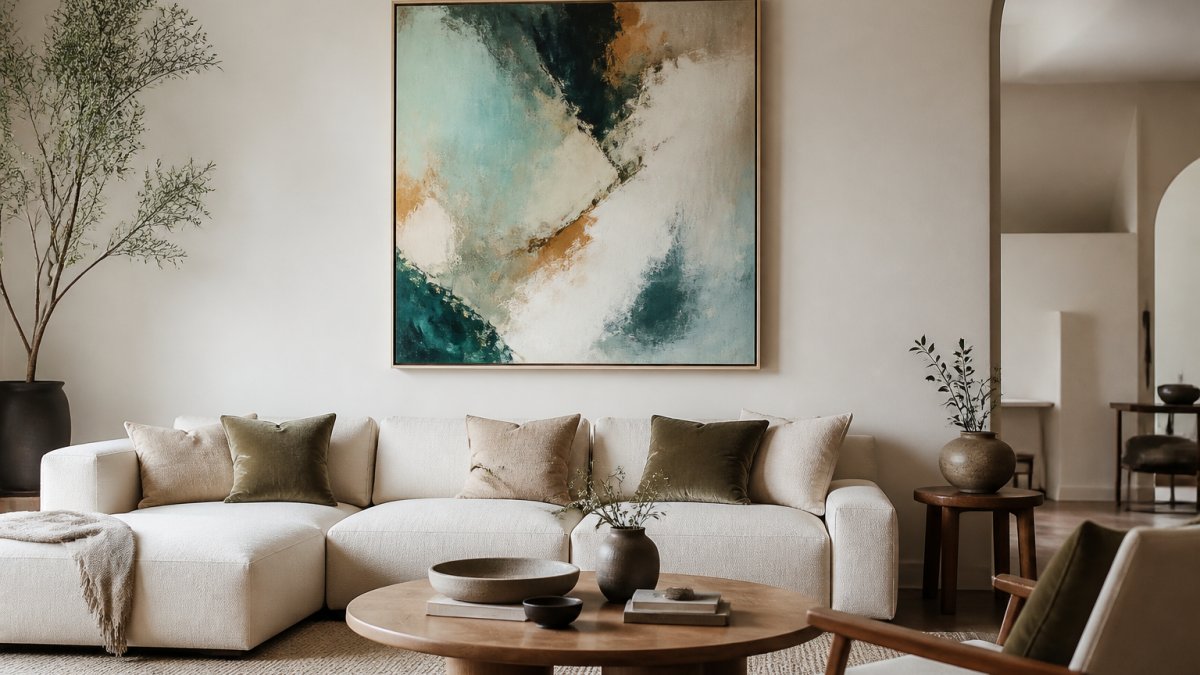
1. Oversized single statement piece. One large work, roughly 40 to 60 inches wide on a standard 8- to 9-foot sofa wall, replaces a cluster of small frames.
2. Graphic confidence with retro influence. Bold illustrations, doodle-inspired line work, and vintage-style posters are back, often in saturated primaries or warm mid-tones.
3. Nature-inspired organic forms. Botanical motifs, abstract landscape shapes, and earth-toned organic abstractions remain the most durable 2026 look.
4. Textural and three-dimensional work. Woven fiber art, sculptural plaster pieces, and layered mixed-media add shadow and depth that flat prints cannot. These work best on walls that receive side light, where raking light reveals the texture.
5. Curated personal collections. A wall of meaningful objects, travel finds, family pieces, small originals, arranged with consistent spacing reads as collected rather than decorated.
What separates a trend-forward wall from a cluttered one is intent, not quantity.
If you are building a wall from scratch, start with the piece that stops you, then size the rest of the arrangement around it. That one decision solves most layout problems before they start.
Large Wall Art for Living Room Impact: Scale, Placement, and Sourcing
Large wall art for a living room works best when it fills roughly 60 to 75 percent of the width of the furniture below it. An oversized artwork is not about size for its own sake. It is about anchoring the room and giving the eye a clear focal point.
Scale mistakes are the most common wall decor problem we see. A small piece floating on a large wall reads as an accident. A large piece crammed onto a narrow wall feels oppressive. Match the art to the wall, not to your wish list.
Placement follows the same logic. Center oversized artwork on the sofa or the main seating axis. In an open-plan room, let the largest piece define the living zone and keep secondary walls quieter.
Sourcing is where 2026 buyers have more options than ever. Original abstract work carries emotional weight and rarity. Prints and framed art offer flexibility at a lower entry point. The trade-off is simple: originals hold meaning and resale value; prints offer easy swaps when your taste shifts.
Living Room Gallery Wall Ideas: Layouts That Look Curated, Not Cluttered
A gallery wall works when it follows a grid or a deliberate rhythm, not when frames are hung at random. The best living room gallery wall ideas in 2026 treat the arrangement as one composition, with consistent spacing and a shared thread of color or subject. Maintaining this visual cohesion requires a careful selection of pieces that align with the broader evolution of interior wall art trends.
Three layouts cover most rooms:
- The grid. Equal-size frames in clean rows. Best for modern and minimalist spaces.
- The salon wall. Mixed sizes filling a defined area. Best for maximalist, collected looks.
- The anchor layout. One large piece with smaller works clustered around it. Best for renters and first-time collectors.
Pattern mixing is having a moment, but it needs a leash. Keep frames consistent even when art styles vary, or vary frames while keeping a single color family. Do one or the other, never both.
The rule we return to: lay the whole arrangement on the floor first. If it looks balanced flat, it will look balanced on the wall.
How to Hang Art Above a Sofa: Measurements That Work
Hang art above a sofa so the center of the piece sits about 57 to 60 inches from the floor, and leave 6 to 10 inches of space between the bottom of the frame and the top of the sofa back. That gap keeps the art connected to the furniture instead of floating toward the ceiling.
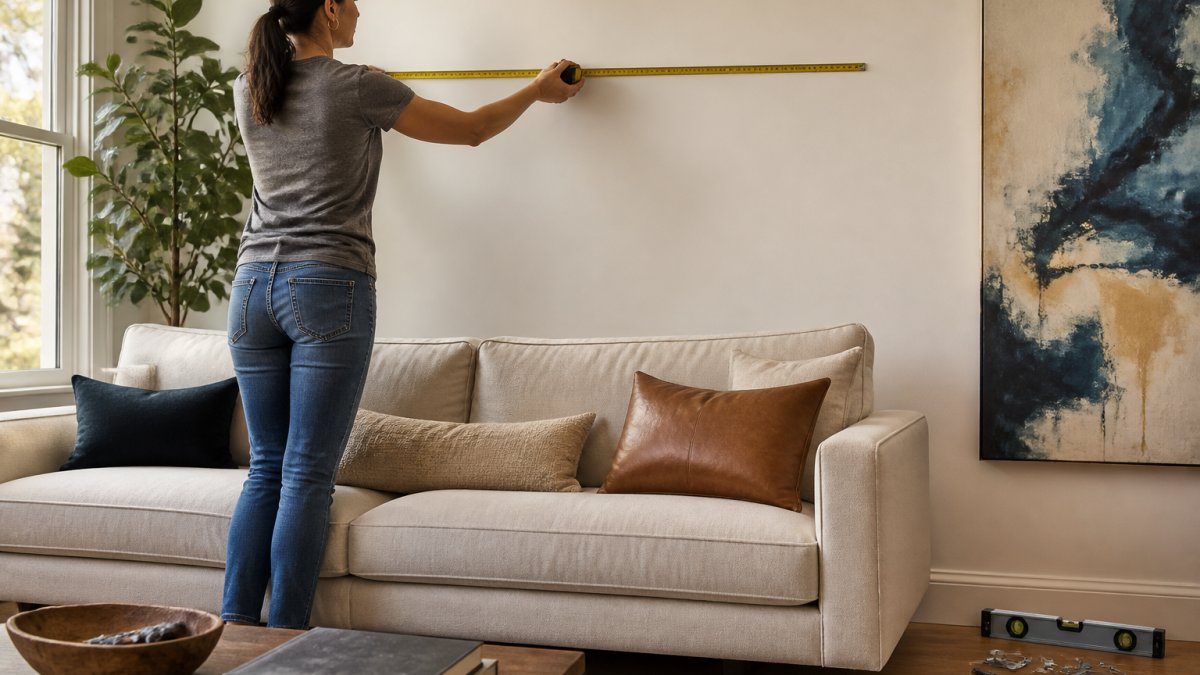
Here is the full measurement sequence we recommend:
- Measure from the floor to eye level, usually 57 to 60 inches, and mark the center point.
- Measure the height of your frame and divide by two.
- Subtract that half-height from your center mark to find the top of the frame.
- Confirm the bottom edge clears the sofa by 6 to 10 inches.
- Use a level before the first nail goes in.
For a gallery arrangement above a sofa, treat the whole cluster as one shape and center that shape on the sofa. Keep spacing between frames at 2 to 3 inches so the group reads as a single unit.
Color, Texture, and Personal Meaning: The 2026 Wall Decor Palette
The 2026 palette is warm and grounded (Design Trends Interior 2026: What's In & What's Out). Earth-derived tones, warm shades, and neutral colors form the base, with chartreuse accents and dark finishes adding contrast. Texture is doing as much work as color. Tactile materials and three-dimensional art add sensory comfort that flat prints cannot match.
Personal meaning is the thread tying it together. Personalized art and meaningful objects turn a wall into a story. That is the core of what we do at Susan Fielder Art: emotionally charged abstract paintings, each carrying a narrative of healing and resilience, with 10% of all proceeds donated to pancreatic cancer research.
The question we hear most is whether that story limits the audience. It does not. Collectors drawn to the work respond to its energy first. The narrative deepens the connection rather than narrowing it.
| Trend Element | What It Looks Like | Best For |
|---|---|---|
| Earthy palette | Warm neutrals, clay tones, dark finishes | Cozy, restorative rooms |
| Chartreuse accents | One bold pop against neutral walls | Adding energy without repainting |
| Texture and dimension | Tactile materials, 3D art, layered frames | Rooms that feel flat |
| Personal meaning | Original art with a real story | Walls you will keep for years |
Renter-Friendly and Budget-Smart Wall Decor Trends for 2026
Renters can hit every 2026 trend without losing a deposit, and budget-conscious buyers can build a collected wall over time instead of all at once. The key is matching the hanging method and the price tier to the wall you actually have.
Damage-free hanging, by weight. Removable adhesive strips are the default for renters, but they are not one-size-fits-all.
Budget tiers, realistically. Pricing depends on quantity, dates, and delivery. For current prices, please visit the Susan Fielder Art website.
Sourcing alternatives. Beyond galleries and print shops, vintage and thrift finds, estate sales, and open-edition print retailers offer the lowest entry points. DIY options, printing your own photography, framing inexpensive posters in upgraded frames, or building a simple canvas float frame, stretch a budget furthest.
The sequencing mistake to avoid. Spending the whole budget on one trend piece leaves nothing for the wall around it. Buy the anchor first, then fill in slowly over months. Walls that grow over time look collected, not purchased in one afternoon.
Conclusion
The hardest part of decorating a wall is choosing pieces that outlast the trend cycle. Color fades from favor, layouts get reworked, but art with a real story stays on the wall. That is the standard we build to at Susan Fielder Art, where every original abstract painting carries a narrative of healing and resilience and 10% of all proceeds go to pancreatic cancer research. Our pieces are one-of-a-kind, sold through a verified secure checkout, and registered with the Art Storefronts Organization.
Start with one piece that means something to you. Get started with Susan Fielder Art and build a living room wall that still feels right long after 2026.
Frequently Asked Questions
How high should you hang art above a sofa?
The general rule is to hang art so the center of the piece sits at eye level, roughly 57 to 60 inches from the floor. Above a sofa, leave 6 to 10 inches of breathing room between the top of the sofa back and the bottom of the frame. For taller sofas or oversized artwork, go closer to 10 inches so the piece feels connected to the furniture rather than floating. Always measure from the hanging wire or bracket, not the top of the frame, before you drill.
What wall art styles are trending in 2026?
Big Wall Decor's 2026 trend report points to personalized galleries, texture, and dimensional decor as leading directions. Earthy palettes and natural materials also show up in 2026 living room forecasts, alongside bold accent colors like chartreuse. Abstract originals, oversized statement pieces, and tactile mixed-media work fit these wall decor trends well because they add depth and a personal story rather than repeating a catalog look.
How do I choose the right size wall art for a living room?
A common guideline is to pick art that covers about 60 to 75 percent of the width of the furniture below it. Above a standard 84-inch sofa, that means a piece or grouping roughly 50 to 63 inches wide. For a large wall art for living room focal point, measure the empty wall space first, then tape out the dimensions on the wall with painter's tape. Step back and check the proportion before you buy or hang anything.
Can I make a living room wall look modern without painting it?
Yes. Swap in a large abstract piece or a tight gallery wall, add a picture light or adjustable sconce to create depth, and mix in one textured or three-dimensional element. Renter-friendly options like adhesive strips, leaning a framed piece on a console, or using a picture ledge let you change the wall without touching the paint. Lighting and scale do most of the work, so focus your budget there first.