 how-to
5 Ways to Detect Digital Prints vs Original Paintings
Last Updated: October 26, 2026
Quick Summary
To detect digital prints original paintings, examine the painted surface for visible brushstrokes, paint buildup, and texture that digital prints lack. Use magnification to reveal individual brushstrokes and pigment particles in originals, or the uniform dot patterns characteristic of inkjet printing in reproductions.
- Original paintings show visible paint buildup, varied brushstrokes, and dimensional surface texture that feel alive with variation
- Digital prints have flat, uniform surfaces with no brushstrokes and no dimensional relief when examined closely
- Under magnification, originals reveal individual brushstrokes and pigment particles while prints show regular CMYK dot patterns
- Check canvas edges and support material for paint wrapping and organic variation found only in hand-painted work
- High-value artworks warrant professional authentication using ultraviolet light, X-ray fluorescence, and pigment analysis
Table of Contents
- Why Knowing the Difference Matters for Art Collectors
- How to Tell If a Painting Is Original: Understanding the Fundamentals
- Examine Paint Layers, Brushstrokes, and Pigment Buildup
- How to Inspect Artwork With a Magnifying Glass
- Limited Edition Print vs Original Painting: Knowing the Distinction
- Check Canvas Edges, Support Material, and Signatures
- When to Seek Professional Authentication and Testing
- Verify Your Artwork's Authenticity and Provenance
- Frequently Asked Questions
Why Knowing the Difference Matters for Art Collectors
Learning to detect digital prints original paintings is essential for anyone building an art collection or making informed purchases.
When you buy an original painting, you're acquiring a one-of-a-kind object created through direct application of paint to canvas or paper.
Whether you're drawn to emotionally charged abstract work or building a thoughtful collection, knowing how to identify the difference between an original and a print can deepen your appreciation for artistic creation.
How to Tell If a Painting Is Original: Understanding the Fundamentals
Original Paintings vs Digital Prints: Key Structural Differences
An original painting is created when an artist applies pigment directly to a support material like canvas, wood, or paper.
A digital print, including giclée and other inkjet reproductions, uses a printer to deposit tiny ink droplets onto paper or canvas. The process is mechanical and repeatable. Each print from the same file produces an identical image. The surface remains uniform and flat compared to hand-painted work.
The key structural differences tell the real story:
- Paint application: Original paintings show visible paint buildup, texture, and dimensional surface relief. Digital prints lay ink flat on the surface.
- Brushstrokes: Hand-painted work displays varied, organic brushwork. Prints show no brushstrokes at all.
- Pigment consistency: Original work uses actual pigment mixed into paint. Prints use colored ink deposited by machinery.
- Support material: Both can use canvas or paper, but the way paint or ink sits on these materials differs dramatically.
Understanding how to detect digital prints original paintings gives you a foundation for the practical inspection steps that follow.
Examine Paint Layers, Brushstrokes, and Pigment Buildup
The most reliable way to distinguish an original from a print is to examine the painted surface directly.
Original paintings show clear evidence of hand application. Paint layers build on top of one another, creating visible depth.
When you look at an original painting at an angle, light catches the peaks and valleys of the painted surface.
Digital prints, by contrast, have no brushstrokes and no paint buildup. The surface stays smooth and uniform.
What to look for:
- Thick, visible paint application in some areas
- Brushstrokes that vary in width and direction
- Surface texture you can see and feel
- Areas where colors are layered on top of one another
- Paint that appears to have dried at slightly different times (older layers underneath, newer on top)
Original paintings and digital prints show distinctly different characteristics when examined closely.
| Characteristic | Original Painting | Digital Print |
|---|---|---|
| Paint application | Visible buildup, texture, dimensional relief | Flat ink on surface |
| Brushstrokes | Varied width, pressure, and direction | No brushstrokes present |
| Surface feel | Alive with variation and texture | Smooth and uniform |
| Light reflection | Raking light reveals peaks and valleys | No dimensional relief |
| Pigment | Actual pigment mixed into paint | Colored ink from machinery |
| Layering | Colors layered on top of one another | Uniform ink coverage |
How to Inspect Artwork With a Magnifying Glass
What to Look for Under Magnification
A magnifying glass or loupe transforms what you can see. Magnification reveals details invisible to the naked eye and makes the difference between original and print unmistakable.
When you examine an original painting under magnification, you see:
- Individual brushstrokes with distinct edges and texture
- Variations in paint thickness across the brushstroke
- Actual pigment particles that make up the paint
- Layering where one color sits on top of another
- Irregularities and imperfections that prove human application
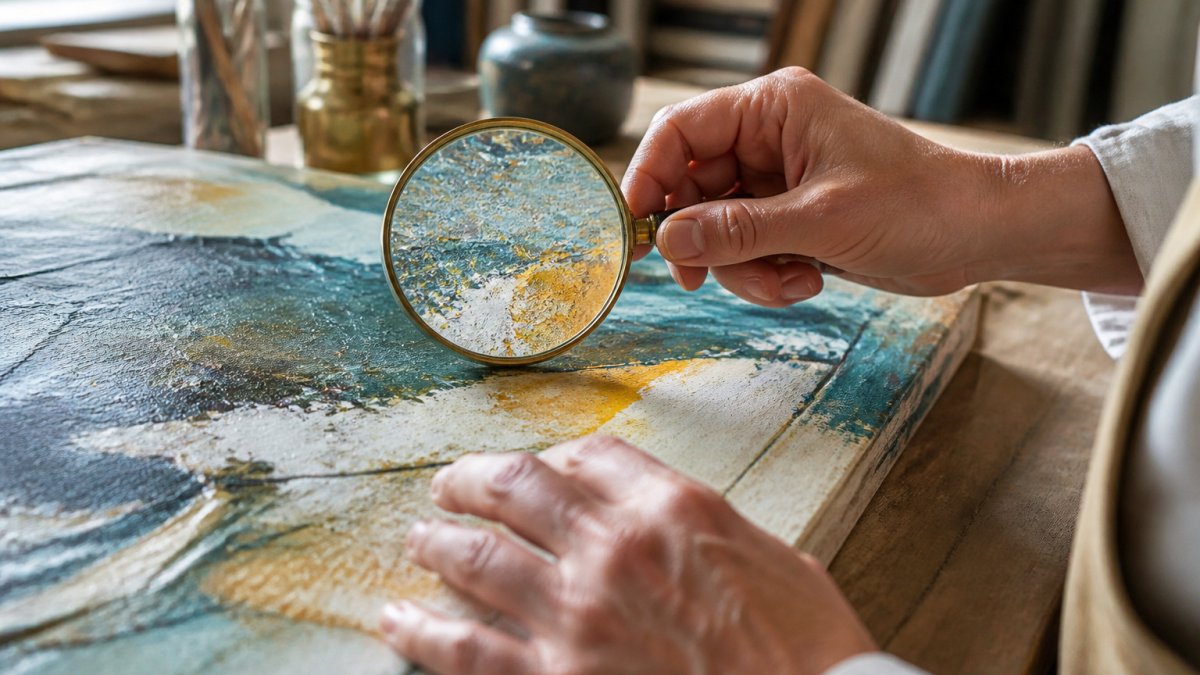
Under magnification, a digital print reveals something entirely different. You see the mechanical precision of a printer at work.
Identifying Dot Patterns and Inkjet Marks
Digital printing technology deposits tiny dots or droplets of ink to build the image. This is how all color printing works, from inkjet printers to professional giclée machines.
A halftone dot pattern appears as regular, repeating dots of cyan, magenta, yellow, and black (CMYK color model). The dots are uniform in size and spacing.
An original painting has no dot pattern because no dots exist. The artist mixed actual pigments into paint and applied them directly. Magnification shows brushstrokes, not dots.
However, one important caveat: according to The Art & Architecture Thesaurus Online, a giclée (a high-quality inkjet print) can have extremely small color pixels with no perceptible dot pattern, even under magnification.
What to examine under magnification:
- Dot patterns in regular, repeating formations
- Uniform ink droplets arranged in grid patterns
- The CMYK color separation (distinct dots of cyan, magenta, yellow, black)
- Absence of any actual brushstrokes or paint texture
- Flat, uniform surface with no dimensional relief
Limited Edition Print vs Original Painting: Knowing the Distinction
A limited edition print is a reproduction created in a controlled quantity.
Limited edition prints are legitimate art products. They have real value and can be beautiful. But they remain reproductions.
An original painting exists as a single, unrepeatable work. The artist created it once.
The distinction matters for value, for how you experience the work, and for what story you're supporting.
Both have merit. But knowing which you're buying ensures you understand what you own and what you're paying for.
Check Canvas Edges, Support Material, and Signatures
What Edges and Wrapping Reveal
The edges and sides of an artwork tell important stories. Original paintings often show paint wrapping around the edges of the canvas or support material. This happens when the artist painted all the way to the edge, even around the sides.
Many original paintings are created on stretched canvas, canvas pulled tight over wooden stretcher bars. If you look at the sides and back of a stretched original, you see:
- Canvas wrapped around the wooden frame
- Paint visible on the sides where the artist worked
- The wooden stretcher bars themselves
- Uneven paint coverage on the back (or no paint at all on the back)
Digital prints created on canvas show a different story. The canvas is printed after being wrapped around stretcher bars, or the print is applied to pre-stretched canvas. The edges show uniform printing, not hand-applied paint.
Paper and support material also reveal clues. Original paintings on paper often show:
- Visible brushstrokes that extend to the paper's edge
- Paint that soaked into or sat on top of the paper differently in different areas
- Natural variations in how the paper absorbed the paint
- Possible discoloration or aging patterns unique to that single work
Prints on paper show uniform ink coverage and no absorption variation.
Signature Placement and Integration
An artist's signature provides important context, but signature placement and style matter.
On an original painting, the signature is typically:
- Painted directly into the work as part of the final layer
- Integrated into the paint surface (raised, textured, visible under magnification)
- Varied in pressure and style (showing the artist's hand)
- Sometimes signed on the back or sides as well as the front
A printed signature appears:
- Printed as part of the image (flat, no texture)
- Identical to any other copy in the edition
- Uniform in appearance under magnification
- Without the dimensional quality of hand-painted lettering
According to Fine Art Restoration guidelines, checking whether a signature appears printed or integrated into the paint layer is one of several important clues. A hand-painted signature feels different to the touch and looks different under magnification than a printed one.
Be cautious of signatures alone as proof of originality. Some prints are signed by the artist after printing. Some originals are unsigned. Signature placement is one clue among many, not a definitive test.
When to Seek Professional Authentication and Testing
Visual inspection and magnification reveal most of what you need to know. But some situations call for professional help.
You should consider professional authentication if:
- The artwork is high-value and you're making a significant investment
- The provenance (ownership history) is unclear or incomplete
- You suspect the work may be a particularly sophisticated reproduction
- You're buying from an unfamiliar source and want absolute certainty
- The artwork is damaged or altered in ways that make visual inspection difficult
Professional appraisers and conservators use tools and expertise beyond magnification. They may use:
- Ultraviolet light to examine the painting surface
- X-ray fluorescence to analyze pigment composition
- Microscopic analysis of paint samples
- Documentation of the work's history and provenance
These methods can definitively establish whether a work is original or a reproduction.
However, WorthWise Appraisers notes an important reality: surface texture alone may not settle the question. A giclée can have a uniform canvas texture that mimics hand-painted work.
One practical step you can take now: how to verify abstract art authenticity online provides guidance on confirming authenticity when professional in-person evaluation isn't immediately available.
Verify Your Artwork's Authenticity and Provenance
Provenance is the documented history of an artwork's ownership and location. Strong provenance supports authenticity. Weak or missing provenance raises questions.
When you're evaluating a painting, gather:
- Documentation of previous owners
- Gallery or exhibition records
- Certificates of authenticity (if provided)
- Photographs of the work from earlier dates
- Any published references or catalogs listing the work
Original paintings from established artists typically have documented histories.
For collectors building a thoughtful collection, understanding provenance deepens your connection to the work.
how to determine market value of original art explains how authenticity and provenance directly affect what an artwork is worth.
Learning to detect digital prints versus original paintings protects your investment and ensures you understand what you're buying.
Susan Fielder Art offers emotionally charged abstract paintings that reflect a narrative of healing and resilience. Shop now to discover one-of-a-kind pieces.
Frequently Asked Questions
How can you tell a digital print from an original painting?
Digital prints typically show uniform, flat surfaces without paint texture, while original paintings have visible brushstrokes, pigment buildup, and surface relief. Under magnification, digital prints reveal halftone dot patterns or ink droplets arranged in regular grids, whereas hand-painted originals show organic, varied brushwork. Check the canvas edges: original paintings often have paint wrapping around the sides, while prints typically have clean, uniform edges. The signature also matters, integrated into the paint layer suggests an original; printed or surface-applied suggests reproduction.
What does an original painting look like under a magnifying glass?
Under magnification, an original painting reveals irregular brushstrokes, visible pigment texture, and color variations where layers overlap. You'll see paint buildup in some areas and thinner applications in others, creating natural surface relief. The paint appears integrated into the canvas support, not sitting uniformly on top. A digital print, by contrast, shows consistent dot patterns (halftone dots or inkjet pixels) in regular rows, uniform color distribution, and a flat, printed surface with no texture variation or paint layer depth.
What is the difference between a limited edition print and an original painting?
A limited edition print is a reproduction created through printmaking or inkjet technology, produced in a numbered series (e.g., 1/50). Each copy is identical and made from the same original artwork or digital file. An original painting is a one-of-a-kind hand-painted work created directly by the artist on canvas or paper. While limited edition prints can be hand-embellished or hand-finished to add value, they remain reproductions. Original paintings have unique brushwork, pigment variation, and surface texture that cannot be exactly replicated, making each work truly singular.
Does a signature prove that a painting is original?
A signature alone does not prove authenticity. Original paintings typically have signatures integrated into the paint layer, appearing as part of the brushwork and sometimes slightly raised. Printed reproductions often have signatures that are either printed as part of the image or applied separately to the surface, appearing flat and uniform. To verify a signature's authenticity, examine whether it's painted with the same pigment and technique as the rest of the work, check for certificate of authenticity or provenance documentation, and consider professional appraisal if the piece has significant value or emotional importance.