 listicle
Social Impact Art Marketplaces: 10 Alternatives for Change
Table of Contents
- Why Social Impact Art Marketplaces Matter
- Comparing the Top Social Impact Art Marketplaces
- 1. Susan Fielder Art: Healing Through Abstract Expression
- 2. ArtLifting: Helping Artists Facing Homelessness
- 3. Art Change Lives: Verified Charity Partnerships
- 4. ART Doing Good: Community Murals and Fundraising Campaigns
- 5. Artsy: Benefit Auctions for Nonprofit Support
- 6. The Art For Charity Gallery: Direct Artist Donations
- How to Verify Social Impact of Art Purchases
- Monetization for Socially-Conscious Artists
- The Role of Art in Societal Transformation
- Frequently Asked Questions
Last Updated: September 2, 2026
Why Social Impact Art Marketplaces Matter
Nonprofit arts and culture organizations generated $151.7 billion in economic activity in 2022, supporting 2.6 million jobs and creating $29.1 billion in government revenue, according to Americans for the Arts Arts and Economic Prosperity 6 Study. Yet only 51% of Americans believe everyone in their community has equal access to the arts, despite 92% agreeing that every student should have access to quality arts education.

Social impact art marketplaces connect collectors who want their purchases to matter with artists and causes that need support. When you buy through these platforms, your money funds pancreatic cancer research, supports artists experiencing homelessness, restores murals in neglected neighborhoods, or advances environmental justice.
Americans for the Arts survey on public perception shows that 76% of Americans view the arts as crucial to their personal well-being, and 72% believe the arts help unite people from diverse backgrounds. Social impact art marketplaces differ from traditional galleries by embedding purpose into every transaction, you're not just buying decoration, you're buying alignment with your values.
Comparing the Top Social Impact Art Marketplaces
Not all social impact art marketplaces work the same way. Some focus on direct artist support, others emphasize community transformation, and some specialize in activism and advocacy.
Direct Artist Support Models
These platforms prioritize getting money directly into artists' hands. ArtLifting features nearly 3,000 original pieces from artists impacted by homelessness or disabilities. Artists earn 55% from each sale, with the remainder supporting art programming at social service agencies, shelters, and disability centers.
Artistree takes a different approach: artists keep 100% of their earnings, while the platform charges clients a 6.5% fee plus $2.60 per transaction. This model works best for commission-based work where artists and collectors collaborate directly.
Community-Focused Platforms
ART Doing Good organizes collaborative community murals and divides large paintings into 100 canvases so multiple collectors can own pieces of a single work. Their print campaigns direct 80% of sales to nonprofit partners, focusing on local storytelling and connection.
The Art For Charity Gallery showcases 40 pieces from diverse artists, with donations purchasing art directly from creators and funding art therapy supplies for people experiencing homelessness.
Activist and Advocacy-Driven Marketplaces
Justseeds Artists' Cooperative is a worker-owned cooperative producing political graphics on labor rights, abolition, environmental justice, and Indigenous sovereignty. Amplifier collaborates with artists and activists to create posters and campaigns on climate justice, mental health, gender equality, and Indigenous rights.
1. Susan Fielder Art: Healing Through Abstract Expression
Susan Fielder Art connects personal healing with systemic impact. Every purchase supports pancreatic cancer research through the iPlaid series. The gallery offers emotionally charged, abstract paintings designed to transform your space with vibrant energy, each reflecting a narrative of resilience.
You're buying art created from the experience of loss and survival, with proceeds funding research that could prevent others from experiencing that same pain. Every piece is original, created by Susan Fielder herself, no mass production or reproductions. The Storefronts Organization registration and verified secure checkout protect your transaction.
Susan Fielder Art works best for collectors who want their purchase to honor someone they've lost or support research that matters personally.
2. ArtLifting: Helping Artists Facing Homelessness
ArtLifting operates on the principle that paying artists fairly enables stability. The platform features nearly 3,000 original pieces from artists impacted by homelessness or disabilities. Artists earn 55% from each sale, substantially higher than most traditional galleries offer.
The remaining revenue supports art programming at social service agencies, shelters, and disability centers. Your purchase funds art access for dozens of people in crisis. The platform offers in-house curation to assist businesses with design, making it easier for corporate buyers to integrate art while supporting the mission.
ArtLifting works best for businesses and collectors seeking original art with direct social impact, particularly those supporting artists facing systemic barriers.
3. Art Change Lives: Verified Charity Partnerships
Art Change Lives operates as a global marketplace connecting verified artists with collectors, embedding social impact into every transaction. The platform requires concrete proof: artists are verified, charities are verified, and the connection between purchase and impact is transparent. The platform focuses exclusively on original, physical art with no reproductions or AI-generated work.
Art Change Lives prioritizes artist empowerment by protecting intellectual property and ensuring fair compensation, particularly important for underrepresented artists expanding their global reach.
Art Change Lives works best for collectors who want absolute certainty that their purchase creates impact.
4. ART Doing Good: Community Murals and Fundraising Campaigns
ART Doing Good uses art as a tool for community storytelling and collective action. The platform organizes collaborative community murals where residents contribute directly to public art. It also offers fundraising paintings divided into 100 canvases, allowing multiple collectors to own pieces of a single work.
Their print campaigns direct 80% of sales to nonprofit partners, keeping focus on local storytelling and connection. The emphasis on collective action creates social cohesion while funding change.
ART Doing Good works best for collectors who want their purchase to be part of something larger, a community project, collective statement, or shared vision for change.
5. Artsy: Benefit Auctions for Nonprofit Support
Artsy operates as a leading online art platform connecting collectors with galleries, auction houses, and artists. The platform has raised over $100 million for nonprofits through benefit auctions. Artsy connects with a global community of over 3.2 million annual active users, with user-friendly bidding tools that make participation accessible.
What distinguishes Artsy is scale and legitimacy. These benefit auctions involve established galleries, recognized artists, and serious collectors.
Artsy works best for collectors with higher budgets seeking fine art from established artists and galleries, particularly those interested in benefit auctions.
6. The Art For Charity Gallery: Direct Artist Donations
The Art For Charity Gallery showcases 40 pieces from diverse artists with a straightforward model: donations purchase art directly from creators and fund art therapy supplies for people experiencing homelessness. The platform combines artist support with therapeutic access, recognizing that art benefits both makers and viewers.
The selection is curated but diverse, featuring 40 original pieces across different styles.
The Art For Charity Gallery works best for donors who want to support both artists and therapeutic access simultaneously.
| Platform | Best For | Key Impact Model | Artist Compensation |
|---|---|---|---|
| Susan Fielder Art | Personal connection to pancreatic cancer research | 10% of proceeds to cancer research | 100% (original artist) |
| ArtLifting | Supporting artists facing homelessness | 55% to artists, remainder to programming | 55% of sale price |
| Art Change Lives | Verified charity partnerships | Direct contribution to verified nonprofits | Fair compensation (verified) |
| ART Doing Good | Community transformation projects | 80% of print sales to nonprofit partners | Variable by project |
| Artsy | High-value benefit auctions | $100M+ raised for nonprofits | Varies by gallery |
| The Art For Charity Gallery | Artist support + therapeutic access | Direct artist purchases + art therapy funding | Direct from donations |
How to Verify Social Impact of Art Purchases
Distinguishing genuine impact from marketing claims requires specific verification steps. Start by asking for transparency on money flow: how much of your purchase reaches the stated cause? Platforms like ArtLifting (55% to artists) and ART Doing Good (80% to nonprofits) publish these percentages clearly.
Second, verify charity partnerships. Americans for the Arts resources on nonprofit accountability emphasize checking whether the nonprofit actually exists and operates legitimately. Art Change Lives verifies both artists and charities.
Third, examine artist representation. Are the artists actually from the communities the platform claims to serve? ArtLifting features artists impacted by homelessness or disabilities with visible work and stories.
Fourth, look for third-party validation. Susan Fielder Art is registered with the Art Storefronts Organization. Artsy's track record of $100M+ in nonprofit fundraising is publicly documented.
Finally, check the artist compensation model. Platforms prioritizing artist empowerment typically publish their commission structure. Artistree (100% to artists), ArtLifting (55%), and Art Change Lives (fair compensation) all disclose how artists benefit.
Monetization for Socially-Conscious Artists
Direct-to-collector platforms like Artistree maximize artist income. Artists keep 100% of their set price while the platform charges only a client fee. These models work best if you have an existing audience or strong commission pipeline.
Commission-based platforms like ArtLifting take a percentage but provide marketing and curation support. ArtLifting's 55% artist share is higher than traditional galleries, and the platform handles all marketing and sales infrastructure.
Donation-based platforms like The Art For Charity Gallery and ART Doing Good operate differently. Your work gets featured and donations support both you and the cause. These work best if your primary goal is impact rather than income maximization.
The key decision depends on your stage and goals: early-stage artists benefit from platform curation, established artists with existing audiences benefit from direct sales models, and mission-driven artists benefit from donation-based platforms.
The Role of Art in Societal Transformation
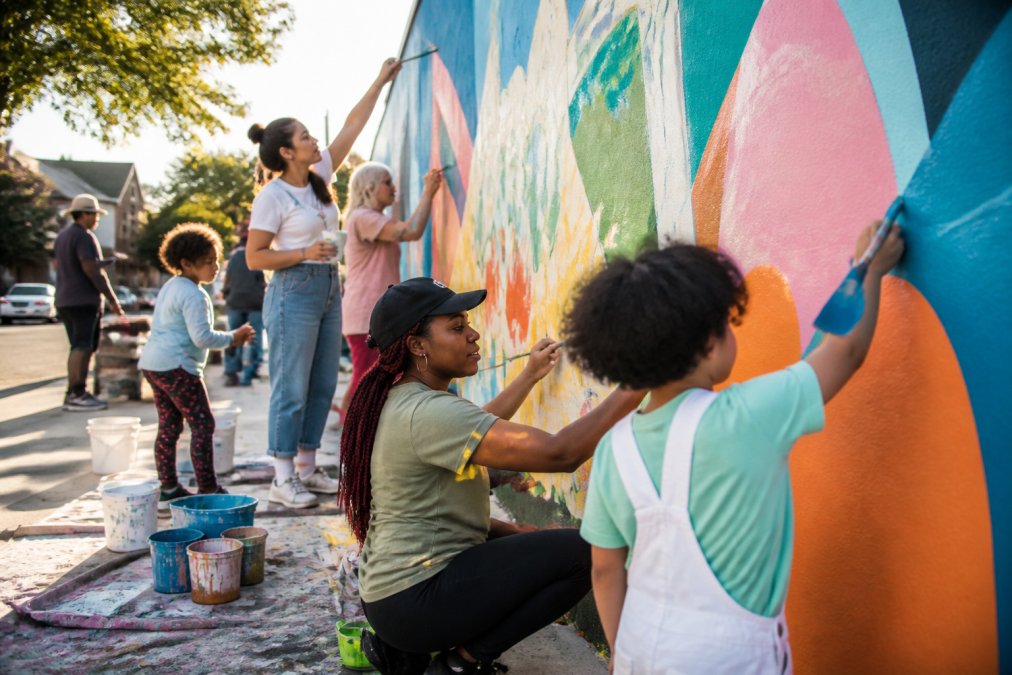
Art's capacity to drive social change is documented. A Philadelphia study of the Porchlight project showed substantial increases in social cohesion and trust in neighborhoods where murals were installed. Arts-rich neighborhoods consistently rank in the top 25% for safety, and disadvantaged neighborhoods with high rates of arts participation have among the lowest rates of juvenile delinquency.
"Engagement in the arts makes the American public feel healthier, more creative, and more empathetic, feeling better about today and more optimistic about tomorrow. These personal benefits also extend beyond the individual, with the public agreeing that investments in the arts strengthen civic pride and improve the social, economic, and educational well-being of their community.", Randy Cohen, Vice President of Research at Americans for the Arts
When residents paint a mural together, they're asserting ownership of their neighborhood, building relationships across difference, and claiming public space for beauty and meaning. Social impact art marketplaces amplify this potential by connecting collectors with artists working on transformation projects, scaling what would otherwise remain local.
Supporting artists and causes through original artwork has never been more accessible. Whether you're drawn to pancreatic cancer research, community murals, artist empowerment, or environmental advocacy, a platform exists that matches your values. Susan Fielder Art offers a direct connection between your purchase and cancer research funding, combining emotionally resonant abstract work with transparent charitable impact. Start by visiting Susan Fielder Art to explore how your next artwork purchase can support a greater cause while transforming your space with vibrant, original expression.
Frequently Asked Questions
Q: How can art be used as a tool for social change?
A: Art creates space for dialogue, builds community, and raises awareness about critical issues. According to a University of Pennsylvania study, arts-rich neighborhoods are in the top 25% for safety, and disadvantaged neighborhoods with high arts participation have among the lowest juvenile delinquency rates. Artists use visual communication to inspire empathy, challenge assumptions, and mobilize collective action. Social impact art marketplaces amplify this by directly connecting artists addressing social justice, environmental advocacy, and human rights issues with collectors who want their purchases to fund meaningful causes.
Q: What should collectors look for in social impact art marketplaces?
A: Verify three key factors: transparency about where your money goes (what percentage supports the cause versus the platform), the legitimacy of charity partnerships, and fair artist compensation. Platforms like Art Change Lives and ART Doing Good publish clear breakdowns, for example, ART Doing Good directs 80% of print campaign sales to nonprofit partners. Check whether the marketplace explicitly states artist earnings, donation percentages, and verified nonprofit relationships. Registered platforms with third-party certifications, like Susan Fielder Art's Art Storefronts Organization registration, add credibility.
Q: Are there platforms that support emerging artists while funding social causes?
A: Yes, several. ArtLifting pays artists 55% from each sale while directing the remainder to art programming at social service agencies. Artistree lets digital artists keep 100% of their commission price while the platform contributes to environmental restoration. Art Change Lives focuses on underrepresented artists and ensures each sale supports a verified charity. These models directly empower emerging creators while embedding social responsibility into every transaction, making them ideal for buyers who want their art purchases to strengthen both individual artists and communities.
Q: How do I know if a social impact art marketplace is legitimate?
A: Look for clear documentation of charity partnerships, published donation percentages, and third-party verification. Legitimate platforms like Artsy have raised over $100 million for nonprofits through benefit auctions. Check if the marketplace is registered with industry organizations (like Art Storefronts), displays secure checkout badges, and publishes artist compensation details. Request direct evidence of their impact, annual reports, nonprofit partner lists, or specific donation amounts. Avoid platforms that make vague claims about 'supporting causes' without naming specific organizations or percentages.