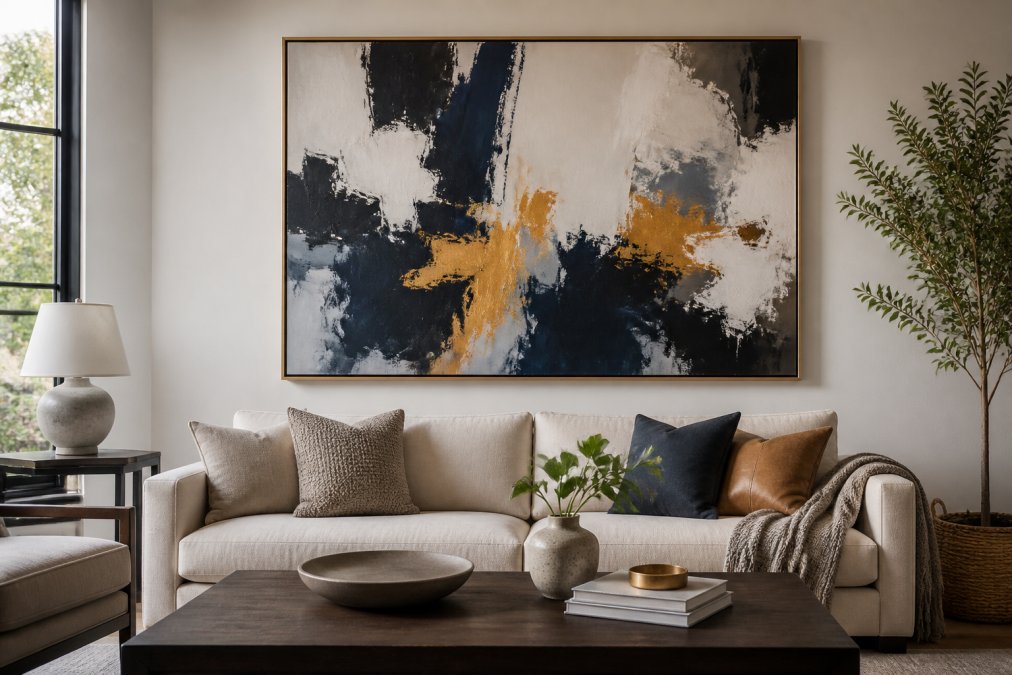
 listicle
Is Large Abstract Wall Art Good for Home Staging?
Table of Contents
- Why Large Abstract Wall Art Works for Staging
- How Large Abstract Wall Art Influences Buyer Perception
- Abstract Paintings for Living Room Decor: Sizing and Placement
- How to Choose Art for Home Staging: A Step-by-Step Framework
- Common Mistakes That Undermine Staging Art
- Budget-Friendly DIY Staging Art and Sustainability Options
- Virtual Staging vs. Physical Staging: Does Art Matter Differently?
- Frequently Asked Questions
Last Updated: September 11, 2026
Why Large Abstract Wall Art Works for Staging
According to The Zebra's home staging statistics report, homes on the market that used professional staging sold for 25% more than homes without it. That single number explains why stagers reach for large abstract wall art first when a listing needs to feel finished, expensive, and move-in ready.
The question "is large abstract wall art good for home staging" has a short answer: yes, when the piece matches the wall, the palette, and the room's focal point. Abstract work is versatile because it suggests a mood rather than a specific subject, so buyers project their own taste onto it instead of rejecting someone else's.
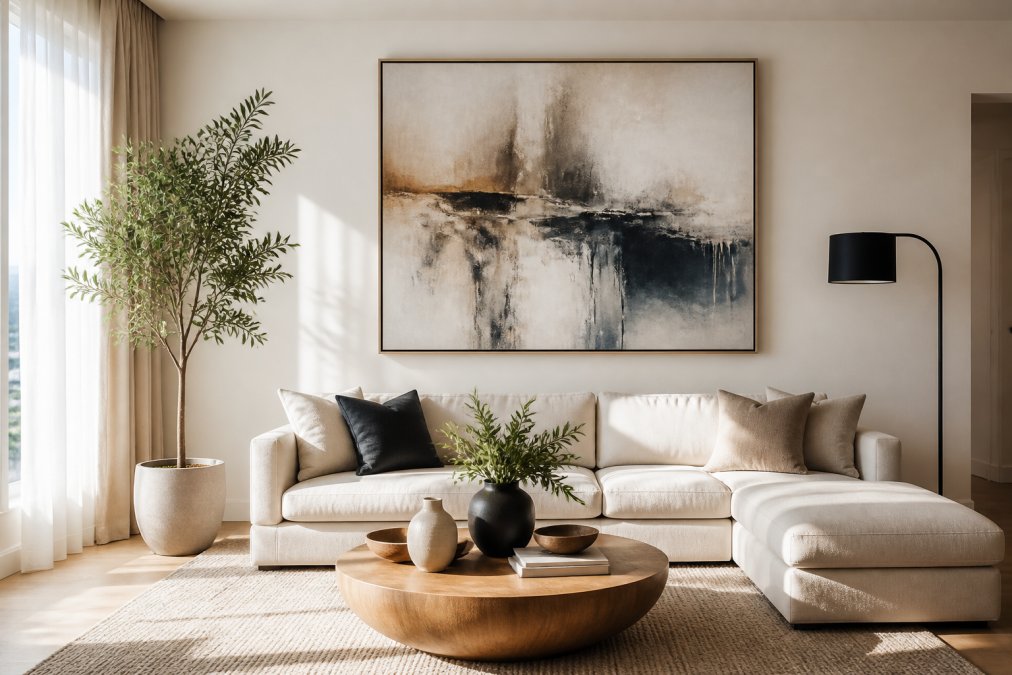
How Large Abstract Wall Art Influences Buyer Perception
Buyer psychology rewards scale. Industry reporting from Big Wall Decor's staging guide notes that large-scale pieces, or groups of compatible pieces covering significant wall space, make a home look and feel more expensive to potential buyers. That perception converts: a listing that photographs well online earns more showings, and more showings create competing offers.
What most guides miss is the mechanism behind that effect. Three things happen at once when a buyer walks into a room anchored by a large abstract piece:
- The eye gets a landing point. A room without a focal point forces the buyer's gaze to wander across outlets, door frames, and ceiling lines. A single oversized canvas gives the eye one place to rest, which the brain reads as calm and intentional.
- The wall stops reading as empty square footage. Empty wall space is mentally priced as 'something I have to fix.' A filled wall is priced as 'finished.' That shift changes how a buyer estimates the cost of moving in.
- The photo performs. Listing photos are viewed on phones, often at thumbnail size. A large, high-contrast abstract survives that compression; a cluster of small frames turns into visual noise. Most buyers decide from photos before they ever walk through the door, so the piece that photographs cleanly earns the showing.
Abstract work also does something figurative art cannot: it lets the buyer project their own taste onto the piece instead of rejecting someone else's subject. A landscape painting invites a reaction to the landscape. An abstract invites a reaction to the color and scale, which are the two things a stager controls.
"Abstract artwork is a wonderful choice for home staging." -- Professional Staging (2026)
Abstract Paintings for Living Room Decor: Sizing and Placement
Abstract paintings for living room decor should span roughly two-thirds to three-quarters of the furniture width beneath them, with the center of the canvas hung at 57 to 60 inches from the floor (thezebra.com). That range puts the artwork at average eye level, which is the single fastest fix for a room that feels off.
Placement rules that hold up in practice:
- Hang the center at 57-60 inches, not near the ceiling
- Match canvas width to 2/3 of the sofa or console below it
- Leave 3-6 inches between a grouping and surrounding furniture
- Keep 8-10 feet of viewing distance for oversized pieces
How to Choose Art for Home Staging: A Step-by-Step Framework
Choosing art for home staging comes down to matching palette, scale, and mood to the room rather than to personal taste. Work in this order and the decision takes minutes, not hours.
- Audit the palette. Pull three colors from the room's existing furniture and textiles.
- Measure the wall. Note usable width and the height from floor to ceiling.
- Pick the scale. One oversized piece for walls over 8 feet wide; a pair for narrower walls.
- Choose the mood. Neutral, calm abstracts for bedrooms; energetic pieces for living areas.
- Test before hanging. Tape paper templates to the wall and photograph them.
- Hang at eye level. Center at 57-60 inches and check from the doorway.
Common Mistakes That Undermine Staging Art
The most common staging error is hanging art too high, which breaks the visual connection between the piece and the furniture below it and makes even expensive work look cheap. Staging Diva (2026) flags this alongside groupings spaced too far apart and small pieces stranded on large walls, all of which create imbalance instead of luxury. Homeowners also worry that a bold piece will be too dark or polarizing for buyers, a concern that shows up constantly in home design communities. The fix is not an empty wall; it is a piece with enough neutral ground to feel safe and enough color to feel alive.
Beyond the standard hanging mistakes, three errors show up repeatedly in rooms that are not the living room, and most staging guides never address them:
- Home office. A single small print above the desk leaves the wall looking like an afterthought on video calls and in listing photos. A large abstract behind the desk reads as a backdrop and makes the room look intentional on camera, which matters because home offices are now a top-three search filter for buyers.
- Primary bedroom. Oversized art hung directly above the headboard can crowd the bed and make the room feel smaller in photos. Offset the piece to one side, or choose a wide horizontal canvas that spans the headboard without touching the ceiling line.
- Laundry room and mudroom. These spaces are photographed more often than sellers expect. A single large abstract on the longest wall turns a utility room into a 'moment' in the listing, while leaving the wall bare signals 'unfinished.'
- Dining room. Art hung too high above a sideboard floats away from the furniture. Center the piece 57-60 inches from the floor and keep the bottom edge within 6-8 inches of the sideboard top.
A second mistake that competitors miss is treating virtual staging and physical staging as the same problem. In virtual staging, art can be scaled and repositioned per image at no cost, so the temptation is to oversize the piece to fill the frame. That works in the photo but creates a mismatch when the buyer walks in and sees a smaller wall than the image suggested. The practical fix: use virtual staging to test which wall wants a focal point, then commit to a real oversized piece at the same scale for the showings that follow.
Budget-Friendly DIY Staging Art and Sustainability Options
Budget staging art does not mean bare walls. Print-on-demand services let you match a specific palette for far less than gallery pricing, and large-format fabric prints swap out between listings without damaging drywall. If you are weighing options, here is how the common routes compare:
| Option | Typical Starting Cost | Best For | Trade-Off |
|---|---|---|---|
| Print-on-demand custom prints | Around $25 | Color-matched staging | Needs design files |
| Framed print retailers | Around $80 | Ready-to-hang variety | Shipping on large frames |
| Oversized fabric prints | Around $129 | Easy swaps, light walls | Frame assembly required |
| Original gallery artwork | Varies by artist | One-of-a-kind impact | Higher investment |
Original work from a gallery like Susan Fielder Art sits at the top of that list for a reason: a one-of-a-kind piece carries a story, and 10% of all proceeds go to pancreatic cancer research. On the sustainability side, choosing original or small-batch prints over mass-produced disposables keeps staging art out of landfills between listings.
Virtual Staging vs. Physical Staging: Does Art Matter Differently?
Art matters in both, but it does different work. In virtual staging, art is a digital layer that fills wall space in listing photos, and it can be swapped per image at no cost. In physical staging, the art is part of the walkthrough, so scale and texture have to hold up in person, not just on screen. The practical rule: use virtual staging to test which wall wants a focal point, then commit to a real oversized piece for the showings that follow.
Frequently Asked Questions
What is the best type of art for home staging?
Abstract artwork is one of the strongest choices for staging because it adds visual interest without imposing a specific narrative that could clash with a buyer's taste. Professional staging guidelines categorize abstract pieces as excellent for staging, noting they provide structure and a sense of intention. Nature and landscape themes also work well, but abstract art's versatility makes it a top pick for creating a curated aesthetic that appeals to a wide range of buyers.
How big is too big for wall art in a staged living room?
Art becomes too big when it crowds the wall edges or competes with architectural features like windows and doorways. A common guideline is to keep the piece within two-thirds to three-quarters of the width of the furniture below it. Oversized art is a leading 2026 trend, with designers favoring one large statement piece over multiple smaller items. The goal is anchoring the room, not overwhelming it, so leave breathing room on all sides.
Is abstract art too polarizing for a home staging environment?
Abstract art is less polarizing than literal imagery because it does not depict specific subjects that buyers may dislike. The 2026 trend data shows buyers prefer interpretive, emotion-driven designs over literal photography. However, art that is too dark or visually aggressive can still turn buyers off. Choose pieces with a balanced color palette that complements the room's existing tones, and avoid anything that feels chaotic or overly specific.
How does large-scale art influence buyer perception of room size?
A single large canvas can make a small living room appear more spacious and intentional, contrary to the belief that big art overwhelms small spaces. Large-scale pieces or groups of compatible works covering significant wall space make a home look more expensive to potential buyers. The key is scale and proportion: the art should relate to the furniture below it and the wall it occupies, creating visual balance rather than visual clutter.
Does professional art increase the perceived value of a home?
Yes. National data from The Zebra shows that homes on the market with professional staging sold for 25% more than homes without staging. Large-scale art contributes to this by making spaces feel finished and move-in ready. A Puget Sound Business Journal case study highlighted how using abstract art to connect color schemes helped sell a $4.6 million home. The right art signals intentional design, which buyers associate with higher property value.