 listicle
Benefits of Gifting Art Workshops and Classes
Table of Contents
- Why Creative Experience Gifts Beat Physical Presents
- The Mental Health Benefits of Art Classes for Gift Recipients
- How to Choose an Art Class for a Beginner
- Matching Workshop Types to Personality and Interests
- Gifting Logistics and Etiquette: What to Know Before You Buy
- The Long-Term ROI of a Creative Hobby
- Frequently Asked Questions
Last Updated: September 28, 2026
Why Creative Experience Gifts Beat Physical Presents
U.S. charitable giving rose to $617.20 billion in 2025, and a growing share of that generosity now flows toward experiences rather than objects, according to Giving USA's annual philanthropy report. That shift matters for anyone weighing the benefits of gifting art workshops and classes.
The Research Behind Experience-Based Gifting
Creative experience gifts are presents built around participation, such as a paint-and-sip session, a ceramics course, or a guided watercolor workshop, rather than a physical item the recipient unwraps and shelves. Prioritizing these shared moments fosters a lasting connection that far outweighs the fleeting joy of a material object, and exploring further creative gift ideas can help you tailor these meaningful encounters to the unique passions of your loved ones.
The evidence favoring them keeps stacking up. The Wallace Foundation's Gifts of the Muse report found that arts participation improves creativity and test scores while also helping revitalize local economies. Meanwhile, ClassBento's 2026 trend analysis notes that paint-and-sip classes and creative workshops are increasingly marketed as primary experience gifts for social connection.
Here's what most gift guides miss: an object depreciates the moment it's opened.
The Mental Health Benefits of Art Classes for Gift Recipients
The mental health benefits of art classes are measurable, not just anecdotal. Research from the University of Arizona Health Sciences found that 45 minutes of art-making significantly reduces cortisol, the body's main stress hormone. That's a shorter window than most lunch breaks.

How Art Reduces Stress and Builds Emotional Resilience
Art gives the nervous system somewhere to put what it can't verbalize. The hands move, the mind quiets, and emotional regulation stops feeling like a chore.
How to Choose an Art Class for a Beginner
Choosing well comes down to three filters: medium, format, and time commitment. Get those right and the recipient shows up excited instead of intimidated.
- One-off workshop: low commitment, great for testing interest
- Multi-week course: builds real technique and routine
- Digital or self-paced: flexible, but weaker on social connection
- Museum or studio program: structured instruction with community built in
Matching Workshop Types to Personality and Interests
Most gift guides stop at "pick something they'll like." That's not a method. The gift-giver's real problem is that they're choosing a class for someone else's brain, schedule, and comfort zone, and the wrong match turns a thoughtful present into an obligation.
| Personality Type | Best Workshop Match | Why It Works | Watch Out For |
|---|---|---|---|
| Social and outgoing | Group paint-and-sip, wreath making, sip-and-sketch | Built around conversation and shared energy; the art is almost secondary | Silent, technique-heavy studios where chatting is discouraged |
| Focused and detail-oriented | Structured drawing, oil technique, printmaking course | Rewards precision, progression, and visible improvement week over week | Loose "express yourself" sessions with no instruction |
| Stress-heavy professional | Mindfulness-based studio session, slow ceramics, botanical drawing | Prioritizes calm over output; low stakes, no critique | Timed challenges or competitive formats |
| Hands-on and physical | Pottery, sculpture, glasswork, welding intro | Uses the whole body, not just the eye; satisfying tactile feedback | Long seated sessions with fine brushwork |
| Curious but uncommitted | Single introductory workshop, 90-minute sampler | Low risk, no long-term obligation, easy to decline gracefully | Multi-week courses that lock in a schedule |
| Analytical and skeptical | Photography, cyanotype, or color-theory class | Framed as a system to learn rather than a talent to have | Anything marketed as "find your inner child" |
Reading the Recipient Before You Buy
A few signals do most of the work:
- What do they already do with their hands? Gardeners, cooks, and woodworkers tend to take to clay and glass quickly. People who journal or bullet-plan often enjoy lettering and printmaking.
- How do they talk about their job? Someone who says they're "always on" usually wants a session with a defined end time and no homework. Someone who says they're "bored" wants a multi-week course with a skill curve.
- What's their tolerance for being bad at something in public? This is the single biggest predictor of a bad experience. Beginners who hate looking incompetent do better in small studios or private intro sessions than in a 30-person paint-and-sip.
- Do they have a friend who'd go too? A two-person gift card converts a solo risk into a shared outing, which raises follow-through dramatically.
When You Genuinely Don't Know Their Taste
The right class for the wrong person is still the wrong gift. Match the format to how they actually spend their energy, and the medium becomes almost interchangeable.
Gifting Logistics and Etiquette: What to Know Before You Buy
Most workshop providers sell gift cards with open scheduling, which solves the hardest part of experience gifting: the recipient picks the date that fits their life. But the transaction is the easy part. The etiquette around presenting, scheduling, and following up is where experience gifts either land or fall flat.
The Five Things to Confirm Before You Pay
- Expiration window. Gift cards with short windows create pressure instead of pleasure. Look for at least 12 months, and ask whether the card can be extended.
- Location and transit. A beautiful studio an hour away becomes a burden, not a treat. Check parking, transit access, and whether the session runs into rush hour.
- Materials and dress code. Some classes include supplies; others expect students to bring their own. Clay and glass studios often require closed-toe shoes and tied-back hair, worth knowing before the recipient shows up in sandals.
- Class size and format. A 30-person paint-and-sip and a six-person studio course are different social experiences. Confirm which one you're buying.
- Transfer and refund policy. Life happens. A card that can be transferred to a friend or rescheduled without a fee is worth more than a slightly cheaper one that can't.
How to Present a Workshop as a Gift
An experience gift has a presentation problem: there's nothing to unwrap. A few approaches solve it cleanly.
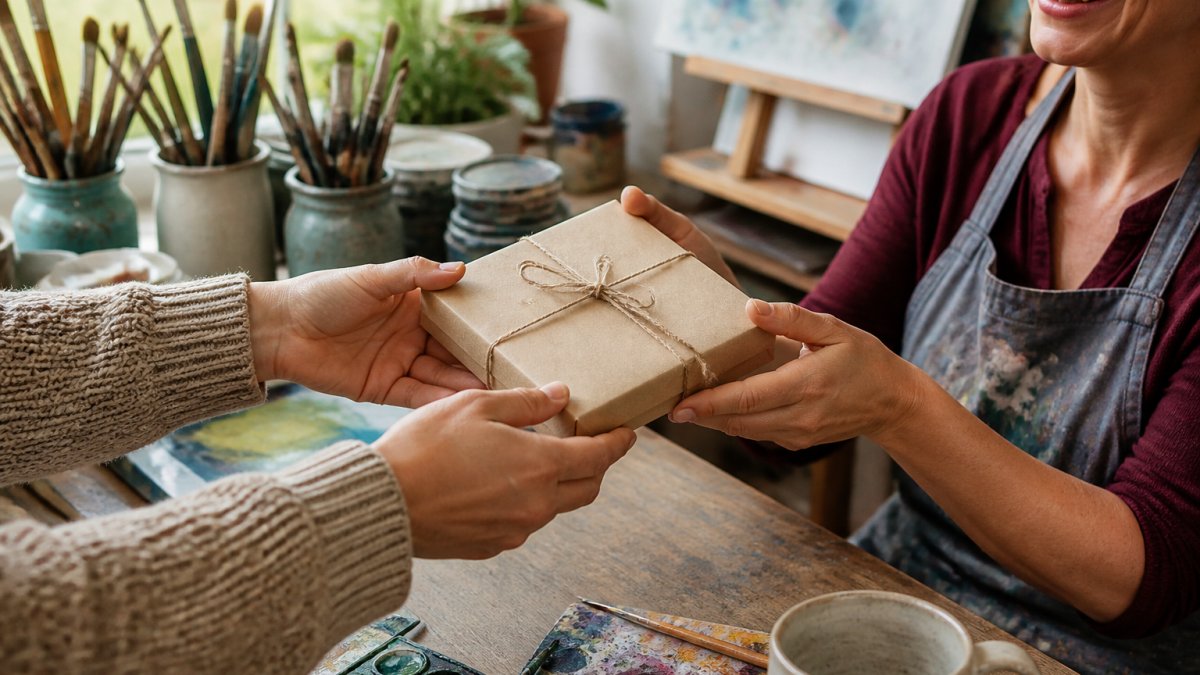
- Printable voucher in a small box. Print the confirmation, roll it into a kraft tube or small gift box, and add one physical item tied to the medium, a brush, a small sketchbook, a pair of studio socks.
- A handmade "ticket" card. Write the class name, date window, and a one-line note about why you chose it. The note is the gift; the class is the delivery mechanism.
- Pair it with a shared element. If you're giving a two-person card, present it as an invitation rather than a solo assignment. "I booked us both" reads very differently from "here's a class."
Scheduling Without Creating Obligation
The fastest way to turn a gift into a chore is to book a specific date the recipient didn't choose. Unless you're giving a two-person experience and coordinating together, buy the open voucher and let them pick.
If They Can't or Won't Go
It happens, and it isn't a rejection of you. Common reasons: the schedule doesn't fit, the medium turns out not to be their thing, or the social format is more than they want. The graceful move is to make the card transferable, most studios allow this, and to say so up front. "If it's not your thing, pass it to a friend" costs you nothing and protects the relationship.
The Long-Term ROI of a Creative Hobby
A creative hobby pays dividends long after the wrapping paper is gone. Regular participation in art workshops is linked to lower cortisol levels, reduced anxiety, increased workplace creativity, and higher job satisfaction, according to Forma's 2026 analysis of LSA-eligible creative workshops.
Frequently Asked Questions
Why are art workshops considered a good gift?
Art workshops offer a creative experience gift that creates lasting memories rather than a one-time object. Research from the University of Arizona Health Sciences shows that 45 minutes of art-making significantly reduces cortisol, the body's main stress hormone. Unlike physical items that may be forgotten or unused, a workshop gives the recipient a chance to learn a new skill, connect with others, and enjoy a dedicated break from daily stress.
What are the psychological benefits of attending an art class?
Attending art classes delivers measurable mental health benefits of art classes, including stress reduction, improved emotional regulation, and increased self-esteem. A study published in ResearchGate found that participants in eight workshops over one year showed improvements in divergent thinking and reduced creativity anxiety. The Wallace Foundation also notes that arts participation supports cognitive function and can help revitalize local economies through community engagement.
How does gifting an experience compare to gifting a physical product?
Gifting an experience like an art workshop often creates a stronger emotional connection than a physical product because it invites the recipient to participate actively. Industry trends show that paint and sip classes and creative workshops are increasingly marketed as primary experience gifts for social connection. While a physical gift may be set aside, a workshop becomes a shared memory and a chance for personal development.
What should I look for when choosing an art workshop gift?
Focus on the recipient's interests, skill level, and schedule. For beginners, look for classes that provide all materials and welcome no experience. Check whether the provider offers flexible scheduling or gift cards, which the Incentive Research Foundation notes provide essential flexibility. Also confirm the class size, location, and whether the workshop aligns with the recipient's preferred medium, such as painting, pottery, or mixed media.