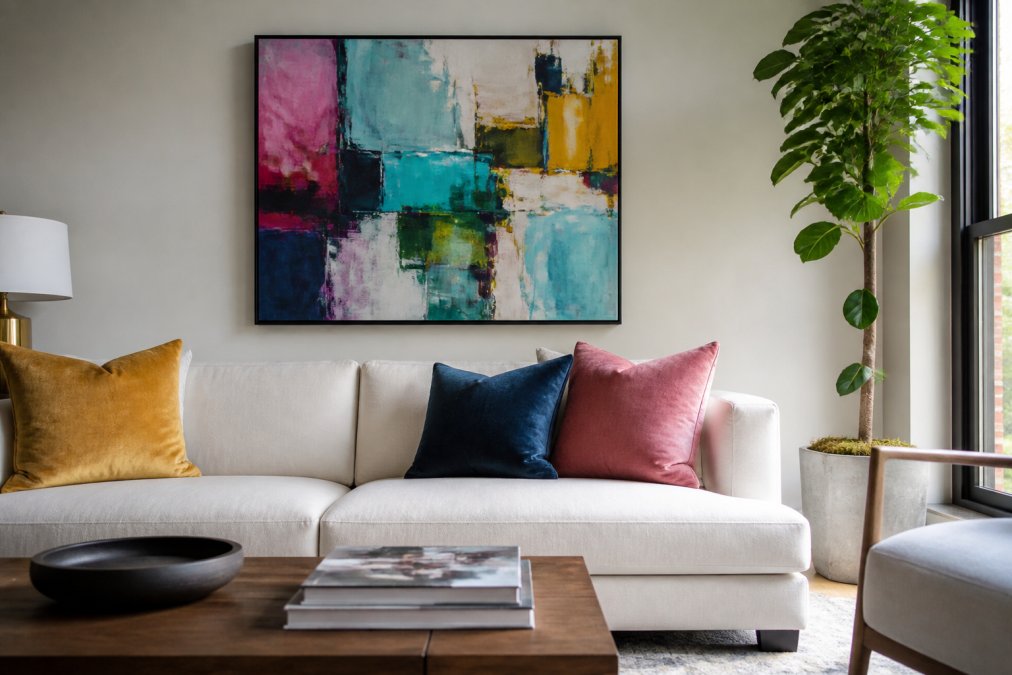
 listicle
Abstract Paintings for Living Room Decor: 8 Top Styles
Table of Contents
- Why Abstract Paintings Transform Living Room Decor
- Abstract Art Styles for Living Room Walls: A Visual Guide
- Abstract Expressionism: Raw Emotion on Canvas
- Color Field Painting: Bold, Immersive Washes of Color
- Geometric Abstraction: Clean Lines and Modern Structure
- Gestural Abstraction: Energy and Movement in Every Brushstroke
- Minimalist Abstraction: Quiet Power for Modern Spaces
- Textured Abstract: Dimension You Can Almost Feel
- Abstract Impressionism: Dreamy, Atmospheric Layers
- Narrative Abstract: Art That Carries a Story
- Colorful Abstract Art for Living Room Spaces That Feel Alive
- Large Abstract Paintings for Living Room Impact
- How to Choose Abstract Art for Your Living Room
- Abstract Paintings for Living Room Decor: Where to Buy With Confidence
- Frequently Asked Questions
Last Updated: July 30, 2026
Choosing the right abstract paintings for living room decor is one of the highest-impact decisions you can make for your home interior. At Susan Fielder Art, we've helped collectors and homeowners find original abstract work that genuinely transforms a room. Below, we'll walk you through eight distinct abstract art styles, show you how to scale and place them correctly, and explain what separates a meaningful purchase from a forgettable one.
Here's what most guides get wrong: they treat abstract art as a decorating accessory. The best abstract paintings don't match your sofa. They lead the room.
Why Abstract Paintings Transform Living Room Decor
Abstract paintings work because they invite the viewer to complete the meaning. A landscape tells you what to see. An abstract painting asks what you feel. That distinction matters enormously in a shared living space, where different people occupy the room with different moods and needs.
Abstract art is also compositionally flexible. A well-chosen piece anchors a room's color story, introduces tension where everything else is neutral, or softens a space that's become too structured. According to the American Art Therapy Association's research on art and psychological wellbeing, visual art in living environments can meaningfully influence emotional regulation and stress response. Abstract work also tends to age better than trend-driven decor because it doesn't reference a specific moment in time.
Abstract Art Styles for Living Room Walls: A Visual Guide
Abstract painting is not a single style. It's a broad category containing movements with genuinely different visual languages. Knowing which style suits your space is the difference between art that resonates and art that just occupies wall space.
Abstract Expressionism: Raw Emotion on Canvas
Abstract expressionism is characterized by large, gestural marks, emotional intensity, and a sense of spontaneous energy captured in paint. For living rooms with high ceilings, exposed brick, or industrial elements, this style creates an immediate focal point. The best pieces have a clear internal logic, a dominant movement, and a rhythm in the brushwork that pulls the eye through the composition.
Color Field Painting: Bold, Immersive Washes of Color
Color field painting prioritizes large areas of flat or softly blended color over gesture or line. The effect is immersive: standing in front of a well-executed color field canvas, the color seems to radiate rather than sit on the surface. This style is ideal for minimalist or Scandinavian-influenced living rooms where the architecture is restrained and the art needs to carry the room's emotional weight.
Geometric Abstraction: Clean Lines and Modern Structure
Geometric abstraction uses precise shapes, grids, and mathematical relationships to create visual order. It suits modern and contemporary interiors with clean furniture lines and neutral palettes. A well-placed geometric canvas over a fireplace or behind a sofa reads as intentional and considered.
Gestural Abstraction: Energy and Movement in Every Brushstroke
Gestural abstraction sits between expressionism and pure mark-making. The brushstroke itself is the subject: you can read the speed, pressure, and direction of the artist's hand in every passage of paint. For living rooms that feel static or overly composed, a gestural abstract painting introduces genuine kinetic energy. Gestural work photographs poorly, the texture and physical presence of the paint surface only become apparent in person.
Minimalist Abstraction: Quiet Power for Modern Spaces
Minimalist abstraction reduces painting to its essential elements: one or two colors, a single compositional gesture, maximum negative space. This style suits open-plan living areas where the art competes with views and architecture. A minimalist abstract painting holds its own without overwhelming the space.
Textured Abstract: Dimension You Can Almost Feel
Textured abstract paintings incorporate physical material into the paint surface through palette knife work, impasto, or built-up layers that create genuine three-dimensional relief. The result is a piece that changes appearance as light shifts throughout the day.
Abstract Impressionism: Dreamy, Atmospheric Layers
Abstract impressionism blends the loose, atmospheric quality of impressionist painting with non-representational composition. Colors bleed into each other and edges dissolve. For living rooms with soft furnishings, layered textiles, and warm lighting, abstract impressionist work feels completely at home.
Narrative Abstract: Art That Carries a Story
Narrative abstract painting encodes experience, memory, or emotion into visual language that a viewer can sense without fully decoding. The best narrative abstract work rewards sustained looking. Susan Fielder Art works within this style directly. The iPlaid series carries a specific narrative of healing, resilience, and awareness around pancreatic cancer research. You don't need a personal connection to that story to feel its emotional weight in the work.
Colorful Abstract Art for Living Room Spaces That Feel Alive
Colorful abstract art for living room walls is the most searched category in abstract decor. Color is the fastest way to shift the emotional register of a space. Warm palettes, reds, oranges, ochres, and burnt siennas, create energy and intimacy, working well in rooms used for socializing. Cool palettes, blues, greens, and muted purples, promote calm and suit rooms where you read, work, or decompress.
The most effective colorful abstract art doesn't try to match the existing palette exactly. It introduces one or two colors that aren't already present, creating visual tension that reads as sophisticated. According to research published in the journal Color Research and Application, color saturation in visual art significantly affects perceived room temperature and mood.
| Color Palette | Best Room Type | Mood Effect | Works With |
|---|---|---|---|
| Warm reds and oranges | Social living rooms | Energizing, intimate | Neutral furniture, dark wood |
| Cool blues and greens | Multi-use spaces | Calming, expansive | White walls, natural materials |
| Earth tones: ochre, sienna | Layered, textured interiors | Grounding, organic | Linen, rattan, terracotta |
| High-contrast black and white | Modern, minimal spaces | Graphic, architectural | Chrome, glass, concrete |
| Jewel tones: emerald, sapphire | Formal or evening-lit rooms | Luxurious, dramatic | Velvet, brass, deep wood |
Large Abstract Paintings for Living Room Impact
Large abstract paintings for living room walls are the single most effective way to anchor a space. A piece that fills a significant portion of the wall above a sofa or fireplace becomes the room's organizing principle.
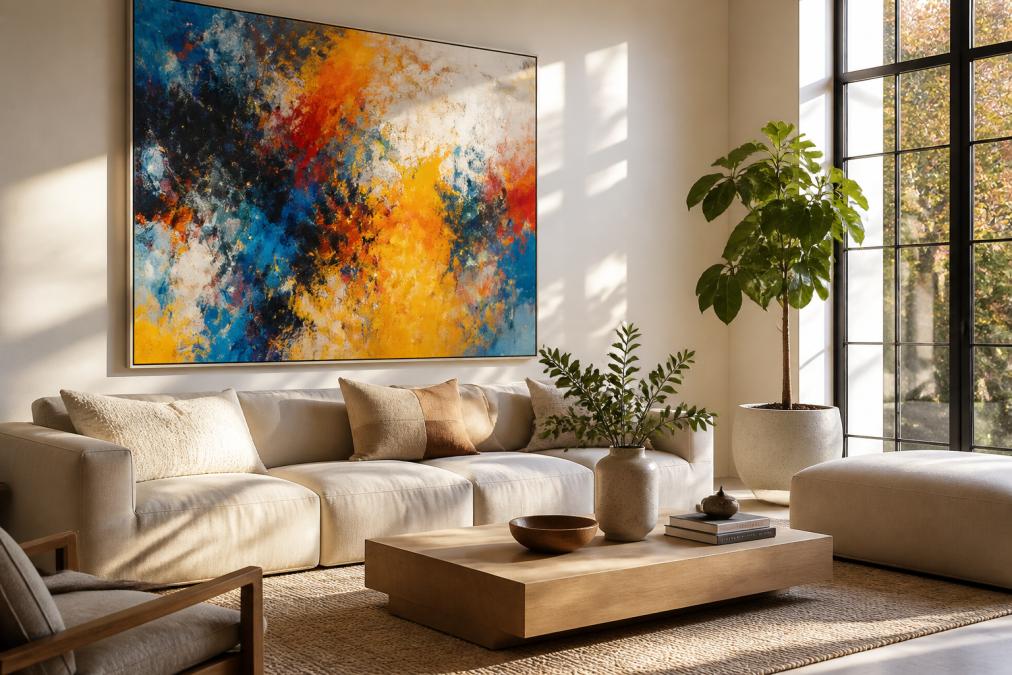
The mistake most people make is buying too small. A piece that feels enormous in a gallery can disappear on a 12-foot wall. The visual weight of large abstract paintings comes from scale, and scale requires commitment.
How to Scale Art to Your Wall Without Guessing
The standard guideline is to select a painting that covers roughly two-thirds of the wall width above your primary seating piece. For a standard 84-inch sofa, that means a canvas in the range of 54 to 60 inches wide.
A practical approach:
- Cut kraft paper or newspaper to the intended canvas dimensions
- Tape it to the wall and live with it for 24 hours
- View it from your primary seating position, from the room entrance, and from adjacent spaces
- Adjust before committing to a purchase
How to Choose Abstract Art for Your Living Room
Choosing abstract art comes down to two things most guides ignore: mood alignment and long-term livability. A painting that excites you in a gallery needs to sustain that quality over months and years of daily exposure.
Match the Mood, Not Just the Color Palette
Before asking "does this go with my sofa," ask "how does this painting make me feel after five minutes of looking at it?" If the answer is energized, curious, or calm in a specific way, that's a painting worth owning. If the answer is "it matches," keep looking. A painting that carries a story gives you a reason to keep engaging with it. Art that's purely decorative tends to become invisible within weeks.
Original Paintings vs. Prints: What You're Really Buying
An original painting is a unique physical object made by a specific person at a specific moment. A print is a reproduction of that object, often of high quality, but without the physical presence, texture, or singular nature of the original.
For living room decor where the art is meant to be a focal point, original paintings generally outperform prints in presence and impact. According to the Art Storefronts Organization's guidance on buying original art online, buyers of original artwork consistently report higher long-term satisfaction than buyers of prints.
When buying original abstract paintings online, look for:
- A verifiable artist identity and body of work
- Clear documentation of the medium, dimensions, and substrate
- Secure checkout and clear policies on damage in transit
- Registration with a recognized platform or organization
Abstract Paintings for Living Room Decor: Where to Buy With Confidence
The market for abstract paintings ranges from mass-produced canvas prints to gallery-quality originals. For buyers who want original work with genuine emotional resonance, Susan Fielder Art offers a curated collection of abstract paintings where each piece reflects a specific narrative of healing and resilience. Ten percent of all proceeds are donated to pancreatic cancer research. The gallery is registered with the Art Storefronts Organization and operates a verified secure checkout.
For buyers exploring the broader market, Saatchi Art offers a large selection of original abstract paintings from emerging and established artists worldwide, with a 14-day satisfaction guarantee and free shipping on many works. Great Big Canvas and iCanvas are strong options for large-format abstract prints when budget is a primary consideration. Juniper Print Shop and Minted both offer curated print collections with strong customization options, including custom framing. Minted also offers complimentary art styling services.
Decorating a living room with abstract art is straightforward in theory and genuinely difficult in practice: the wrong scale, the wrong style, or a piece chosen purely for color matching will never quite feel right. Susan Fielder Art offers original abstract paintings that carry both visual impact and a meaningful narrative of resilience, with 10% of every purchase supporting pancreatic cancer research and a verified secure purchasing process. Shop now at Susanfielder.com and find the piece that leads your room rather than follows it.
Frequently Asked Questions
How do I choose an abstract painting for my living room?
Start with the mood you want the room to project, energizing, calm, or emotionally resonant. Consider your existing color palette, but don't feel locked in: abstract paintings for living room decor often work best when they introduce one bold accent color. Think about scale next, a piece that's too small on a large wall loses its impact. Finally, choose art that genuinely moves you, not just art that matches your couch. Emotional connection makes a piece timeless.
What kind of abstract art is best for a living room?
The best abstract art styles for a living room depend on your interior aesthetic. Abstract expressionism and gestural abstraction add energy and warmth to casual, eclectic spaces. Geometric abstraction suits modern or minimalist rooms. Color field paintings work beautifully in open-plan layouts where you want a calming anchor. If your space leans traditional, abstract impressionism offers a softer, more painterly feel. Original works tend to carry more visual depth than prints, especially at larger scales.
What colors work best for abstract art in a living room?
Colorful abstract art for living rooms works best when it picks up at least one color already present in your furnishings or textiles, this creates visual cohesion without being matchy. Warm tones like terracotta, amber, and deep red energize a space. Blues and greens add calm. Neutrals with one bold accent color are a reliable choice for almost any style of room. If your walls and furniture are neutral, a vibrant abstract painting becomes the room's natural focal point.
How big should an abstract painting be for a living room?
For large abstract paintings in a living room, a general guideline is that wall art should fill roughly two-thirds to three-quarters of the wall width above a sofa or key furniture piece. For a standard 8-foot sofa, that suggests a canvas between 54 and 72 inches wide. In open-plan spaces or rooms with high ceilings, going even larger creates a more commanding presence. Always measure your wall before buying, and use painter's tape to mock up the size before committing.
How do I know if an abstract painting I buy online is genuinely original?
Look for artists who provide certificates of authenticity, are registered with recognized art organizations, and sell through verified, secure platforms. Original abstract paintings are typically signed by the artist and described with specific details about medium, canvas size, and creation process. Legitimate galleries will also have transparent information about the artist's background and creative process. Buying directly from an artist's own verified storefront, rather than an anonymous marketplace, is one of the strongest signals of authenticity.