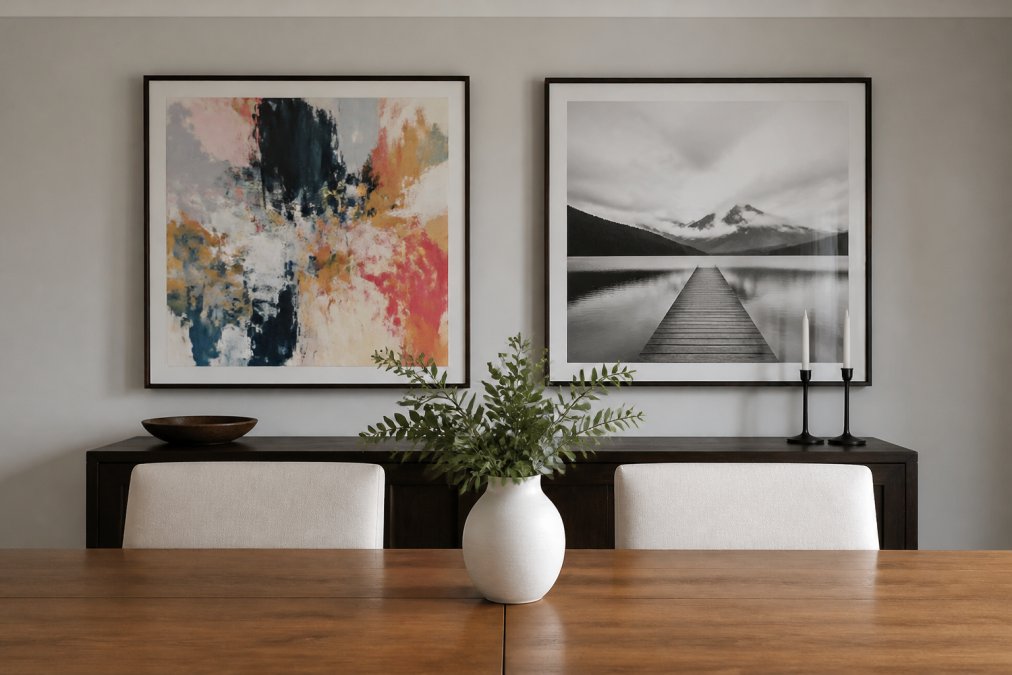
 comparison
Abstract Art vs Photography for Dining Rooms: 2026 Guide
Table of Contents
- Abstract Art vs Photography: Which Defines Your Dining Space?
- Quick Comparison: Abstract Art vs Photography
- How to Hang Dining Room Wall Art for the Best Effect
- Why a Large Abstract Canvas for Dining Room Walls Works
- Matching the Art to Your Dining Room's Style and Mood
- Maintenance, Longevity, and Investment: Prints vs Original Paintings
- Lighting and Placement: The Final Step for Both Art Forms
- The Verdict: Choosing the Right Art for Your Home
- Frequently Asked Questions
Last Updated: September 7, 2026
When redesigning a dining space, the choice between abstract art vs photography for dining rooms often comes down to one question: do you want a conversation starter or a window to another place? Abstract paintings hold a 30.49% share of the wall art market in 2026, and industry analysis suggests their adaptability across interior styles makes them a more dominant choice than other categories Fortune Business Insights wall art market analysis. Susan Fielder Art offers a curated collection of emotionally charged, abstract paintings and unique lifestyle products designed to transform your space with vibrant energy. Each piece reflects a profound narrative of healing and resilience, providing customers with one-of-a-kind artwork that serves as a meaningful addition to any home or office.
The real difference is how each medium performs in a room where people gather, eat, and linger: photography anchors a space in reality, while abstract art changes the room's energy.
Abstract Art vs Photography: Which Defines Your Dining Space?
Abstract art is the safer bet for dining rooms needing warmth and visual movement without competing with the table setting. Photography excels when you want a specific mood, like coastal calm or urban sophistication, rendered with precision.
The visual impact on your room's atmosphere starts with how each medium handles color and form. Abstract pieces in 2026 are trending toward textured, layered, or tonal styles rather than aggressively loud designs Framed Art 2026 trend analysis. That shift matters because a dining room should feel composed, not chaotic.
Quick Comparison: Abstract Art vs Photography
| Factor | Abstract Art | Photography | Winner |
|---|---|---|---|
| Visual movement | High, via brushstrokes and texture | Moderate, via composition | Abstract |
| Mood control | Emotion-driven, interpretive | Literal, scene-specific | Tie |
| Versatility | Adapts to most decor styles | Best with themed interiors | Abstract |
| Longevity | Original, one-of-a-kind | Reproducible prints | Abstract |
| Maintenance | Minimal, canvas ready to hang | May need glass and matting | Abstract |
| Starting price | Varies widely | $12 to $50+ per print | Photography |
The comparison table above shows why abstract art is the dominant category for home interiors in 2026, with reports noting its position as a preferred design element is more secure this year than in previous periods Modern Wall Art Co. popularity ranking. Photography prints, landscape, and floral artwork round out the top styles, but none match abstract's flexibility.
How to Hang Dining Room Wall Art for the Best Effect
The center of a large abstract canvas for dining room walls should sit at eye level, roughly 57 to 60 inches from the floor to the center of the piece. This rule holds for both abstract art and photography, but the medium changes how you handle the edges and finish.
For photography, professional framing with protective glass matters because it prevents fading and glare from dining room lighting. For abstract canvas, the piece arrives ready to hang with no glass required.
- Measure the wall width and aim for art that covers 60 to 75 percent of the available space above a sideboard or table.
- Center the piece over the furniture, not the wall, to create a focal point.
- Leave 6 to 8 inches between the top of a sideboard and the bottom of the frame.
- For a gallery arrangement, keep 2 to 3 inches between frames for a cohesive look.
Why a Large Abstract Canvas for Dining Room Walls Works
A large abstract canvas for dining room walls works because it delivers visual impact at a scale that photography prints rarely match. Oversized abstract wall art has evolved into a near-essential element for modern living and dining spaces, according to Extra Large Wall Art industry report.
A dining room's main wall is often the largest blank surface in the home, and a single expansive canvas fills it with color, texture, and movement in one decisive gesture. Photography often requires grouping multiple frames to achieve the same presence, which can feel busy.
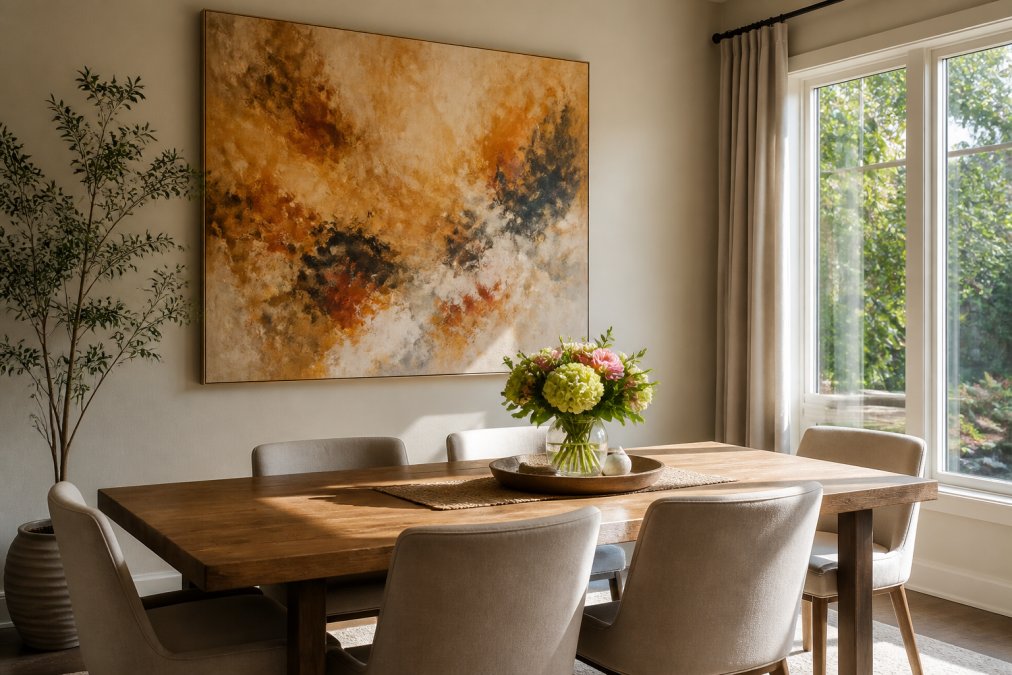
Scientific research indicates that houses with carefully chosen artwork produce better moods among diners and influence their perception of the space Osnat Fine Art research summary. A large canvas with layered brushstrokes and warm tones invites that response more readily than a smaller, framed print.
Matching the Art to Your Dining Room's Style and Mood
Start with your room's existing palette and architectural character, then decide whether abstract art or photography reinforces that identity.
Color theory in abstract art directly influences mood during meals. Warm hues like terracotta, ochre, and burnt sienna stimulate appetite and encourage lingering conversation, which is why they dominate in hospitality design. Cool tones, deep blues, sage greens, promote calm but can suppress appetite if used in large expanses. A common pattern is to use a large abstract canvas with warm undertones on the main wall, then balance it with cooler-toned accents in textiles or tableware.
Photography, by contrast, works through recognition and memory. A crisp black-and-white architectural shot of a familiar city skyline triggers a sense of place and sophistication, but it does not actively shape the metabolic or emotional response to food.
For modern, minimalist dining rooms, abstract pieces with geometric designs and a monochromatic palette maintain sophistication while allowing the table setting to remain the star. For coastal or nature-inspired interiors, photography featuring aerial beach imagery and minimalist seascapes complements the theme effectively Andrew Shoemaker Photography dining room gallery. But if you want to avoid the cliché of beach-themed decor, a tonal abstract canvas in sand, driftwood gray, and seafoam achieves the same coastal calm without literal imagery, a strategy that reads as more curated and less decorative.
The risk of visual chaos is real. Some abstract wall decor can feel overwhelming if not balanced with the room's furniture and architecture Rossetti Art design guidance. If your dining room already has bold wallpaper or patterned flooring, opt for tonal abstract pieces or black and white photography with soft contrast.
- Modern or industrial rooms: abstract with geometric designs, ultramarine blue accents, or architectural photography. The blue tones cool the space; the geometry echoes the room's lines.
- Traditional or farmhouse rooms: warm tones, serene landscapes, or abstract pieces with organic forms. Warm pigments like amber and rust align with the room's existing wood tones and create a cohesive, hearth-like feel.
- Coastal or airy rooms: aerial ocean photography, minimalist seascapes, or tonal abstract canvases. Choose tonal abstracts if you want the mood without the literal postcard effect.
A practical test: hold a sample of the art against the wall during an evening meal with your dining room lights at their typical dimmed setting. Abstract art with warm pigments tends to feel like a participant in the conversation; photography tends to recede unless it is large enough to dominate.
Maintenance, Longevity, and Investment: Prints vs Original Paintings
Original abstract paintings hold their value and require almost no upkeep beyond occasional dusting, while photography prints need protective glass and careful placement away from direct sunlight to prevent fading.
For collectors who want a one-of-a-kind piece with a narrative, an original abstract painting is the stronger investment. Susan Fielder Art offers emotionally charged, abstract original artwork, with 10 percent of all proceeds donated to pancreatic cancer research.
Lighting and Placement: The Final Step for Both Art Forms
Dining room lighting determines how both abstract art and photography are perceived, yet it is the most overlooked factor in art selection. Abstract canvases with texture respond to directional light, while photography under glass demands controlled, diffused illumination to avoid glare.
Warm vs. cool light changes the art itself.
Most dining rooms use warm LED bulbs (2700K-3000K) to flatter skin tones and create intimacy. Warm light enriches the ochres, golds, and reds in abstract paintings, making them feel more saturated and inviting, but casts a yellow cast over black-and-white photography, making prints look aged or dull. If you prefer photography, install a dedicated picture light with a neutral or cool white temperature (3500K-4000K) aimed at the frame.
Glare is the enemy of photography.
Photography prints are typically framed behind glass, creating two problems under dining room lighting: specular glare from overhead fixtures and reflections of windows or pendant lamps. Position picture lights above the frame at a 30-degree angle to direct light onto the image without bouncing it back into the viewer's eyes. Use non-glare or museum-grade glass with an anti-reflective coating.
Texture reveals itself under grazing light.
Abstract canvases with heavy impasto or layered brushstrokes respond dramatically to grazing light, light that hits the surface at a shallow angle. Wall sconces or track lighting aimed at the art from above or below emphasize the physical ridges and valleys of the paint, creating a sculptural effect that changes throughout the day.
Maintenance in a dining environment is a real concern.
Dining rooms involve food, humidity, and potential spills. Cooking steam from an adjacent kitchen can warp unframed paper prints and cause matting to ripple. Photography should always be framed with a sealed backing and, ideally, UV-protective glass. Abstract canvases are more forgiving: they have no glass to fog or crack, and a gentle dusting with a microfiber cloth handles most upkeep.
Placement rules that account for the room's function.
- For a formal dining room used primarily for evening entertaining, a dramatic, large-scale abstract canvas under a dimmable warm spotlight creates a focal point that shifts as the meal progresses.
- For a casual eat-in kitchen or breakfast nook with bright morning light, choose smaller tonal pieces or a curated collection of black and white prints with UV-protective glass. Morning sun is the most damaging to prints.
- If your dining room has a chandelier, position the art so it is not directly behind the fixture. The light source will create a halo effect that washes out the piece. Instead, center the art on the wall and let the chandelier hang over the table, not between the viewer and the artwork.
The final decision between abstract art and photography in a dining room often comes down to how the piece performs under your specific lighting conditions. An abstract canvas rewards warm, directional light with depth and texture. A photograph demands controlled, diffused lighting to preserve its clarity. Measure your room's light sources, consider the maintenance realities of a space where food is served, and choose the medium that will look its best at the hour you actually use the room, dinner time.
The Verdict: Choosing the Right Art for Your Home
Choose photography when you want a specific scene, a coastal theme, or a polished, framed look that fits a minimalist interior. Choose abstract art when you want visual movement, emotional depth, and a piece that adapts as your decor evolves. For most dining rooms, abstract art is the stronger choice because it creates a focal point without dictating a theme.
The deciding factors are scale and longevity. A large abstract canvas fills the dominant wall with presence and requires no glass or special lighting. Photography excels in curated gallery walls and themed spaces, but demands more attention to framing and light exposure.
When you are ready to invest in a piece that transforms your dining space and carries a deeper meaning, explore the original abstract paintings at Susan Fielder Art. Each canvas brings vibrant energy to your room while supporting pancreatic cancer research through every purchase. Shop now to find a piece that speaks to your space and your values.
Frequently Asked Questions
What kind of art looks good in a dining room?
Art that fosters conversation and matches your room's atmosphere works best. Abstract art with textured or tonal styles adds sophistication without being distracting, while photography, such as black and white prints or serene landscapes, provides a clean, classic look. Consider the room's color palette and lighting. A well-chosen piece acts as a focal point, enhancing the dining experience for you and your guests.
Should I choose abstract art or photography for a small dining area?
For a small dining area, scale matters more than the art form. A single, moderately sized piece can create a focal point without overwhelming the room. Abstract art with a light or monochromatic palette can make the space feel larger, while a large-format photograph with soft contrast can add depth. Avoid overly busy designs, and use the 70/30 rule to keep the arrangement balanced.
What is the 70/30 rule in art?
The 70/30 rule is a design guideline suggesting that 70% of your wall space should remain empty, with the remaining 30% dedicated to art or decor. This prevents a room from feeling cluttered and ensures your chosen piece has visual breathing room. For example, a large abstract canvas for a dining room wall should be sized so it occupies roughly one-third of the available wall area, ensuring it stands out as a focal point.
Does abstract art increase the perceived value of a dining room?
Yes, well-chosen abstract art can elevate the perceived value of a dining room. An original, emotionally resonant painting adds a layer of uniqueness that mass-produced prints cannot match. This transforms the space from a simple eating area into a curated environment, reflecting a thoughtful design aesthetic.
How do I choose between black-and-white photography and colorful abstract paintings?
Your choice should depend on the room's existing palette and the mood you want to create. Black-and-white photography with soft contrast offers timeless sophistication and works well in minimalist or coastal-themed spaces. Colorful abstract paintings inject vibrant energy and can become a conversation starter. If your dining room features neutral tones, a colorful abstract piece provides a striking contrast, whereas a monochromatic photo complements a bold, colorful decor.