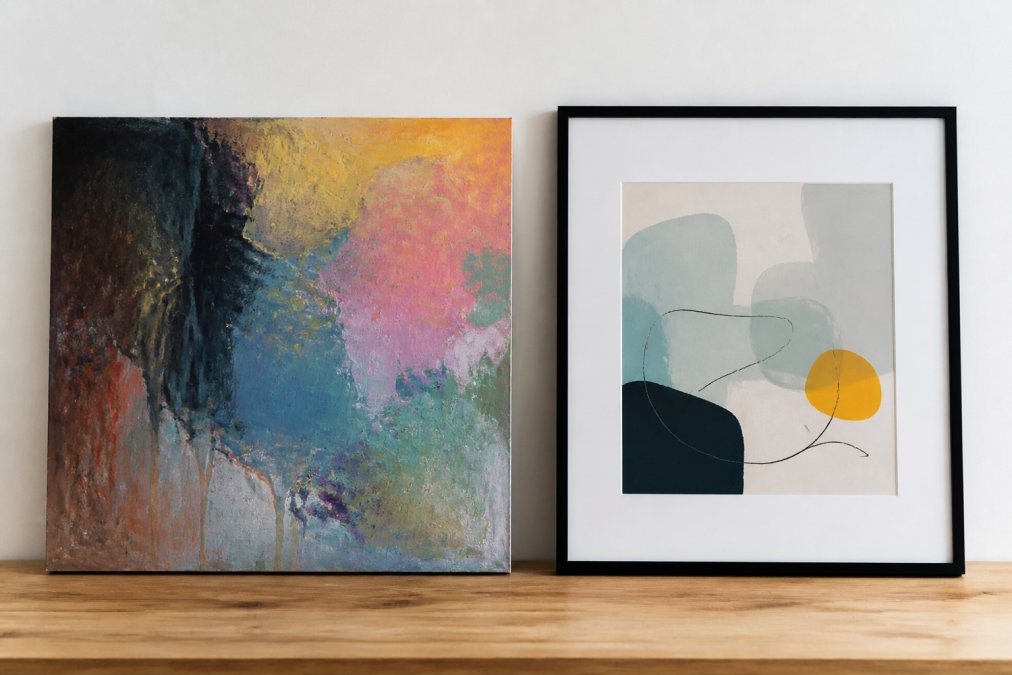
 comparison
Abstract Art vs Mass-Produced Prints: Key Differences
Table of Contents
- Abstract Art vs Mass-Produced Prints: Understanding the Core Differences
- Original Abstract Painting vs Print: What Sets Them Apart
- Print Quality and Resolution: Identifying Mass-Produced vs Fine Art
- How to Identify High-Quality Art Prints: A Technical Guide
- Art Investment for Beginners: Original vs Reproduction
- Environmental Impact: Mass Manufacturing vs Sustainable Practices
- Making Your Choice: Pros and Cons Comparison
- Frequently Asked Questions
Last Updated: August 10, 2026
Abstract Art vs Mass-Produced Prints: Understanding the Core Differences
When shopping for wall art, the choice between an original abstract painting and a mass-produced print feels straightforward, one is unique, the other isn't. But the distinction runs deeper, touching on creation, value retention, visual impact, and what you're supporting with your purchase.
Understanding what separates these categories isn't just about price; it's about recognizing what you're getting and whether that aligns with what matters to you.
This guide breaks down the core differences, explores print quality realities, and helps you make a choice that fits both your space and your values.
Original Abstract Painting vs Print: What Sets Them Apart
An original abstract painting is a one-of-a-kind work created directly by the artist's hand. A print is a reproduction created through mechanical or digital processes. This distinction carries profound implications for authenticity, value, and visual impact.
The Role of the Artist in Production
With an original abstract painting, the artist controls every decision: brush pressure, color mixing, layering, texture, and composition adjustments made mid-creation. Each mark is intentional and unrepeatable.
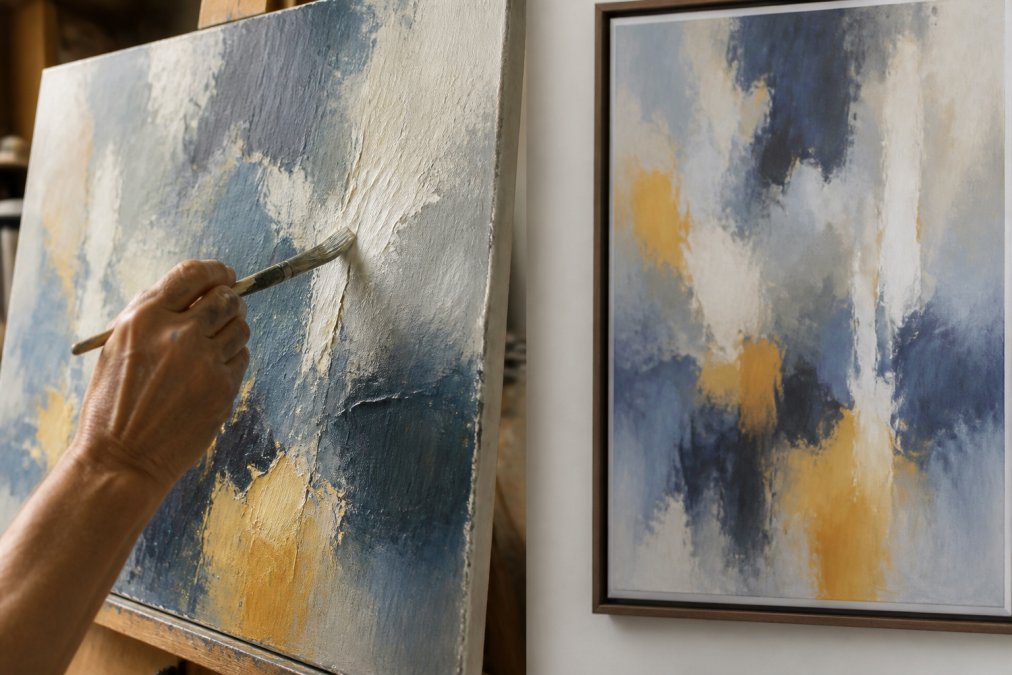
With mass-produced prints, the artist's role ends once the original is complete. Reproduction is handled by production facilities, scanners, and printers. The artist typically has no involvement in how their work is reproduced at scale.
Limited edition prints occupy a middle ground. The artist may oversee reproduction, approve color profiles, or hand-embellish prints, reintroducing the artist's hand into production in a different way than with originals.
Exclusivity and Authenticity
An original painting is exclusive by definition, one person owns it. This exclusivity carries weight psychologically and in terms of investment potential.
Mass-produced prints are designed for unlimited reproduction. Thousands of identical copies can exist. The value proposition shifts from "this is mine alone" to "this is affordable and accessible."
Limited edition prints introduce scarcity within reproduction. If an artist releases 100 numbered prints, each copy is part of a defined set. Once sold out, no more will be made. This creates a middle-ground value proposition: more accessible than originals, more exclusive than open-edition prints.
A mass-produced print is a legitimate reproduction, not a fake. But it's also not the work the artist created, it's an interpretation filtered through scanning technology, color profiles, printing equipment, and substrate choices.
Print Quality and Resolution: Identifying Mass-Produced vs Fine Art
Not all prints are created equal. The difference between a high-quality fine art print and a mass-market reproduction is visible to the naked eye.
Compression Artifacts and Pixelation
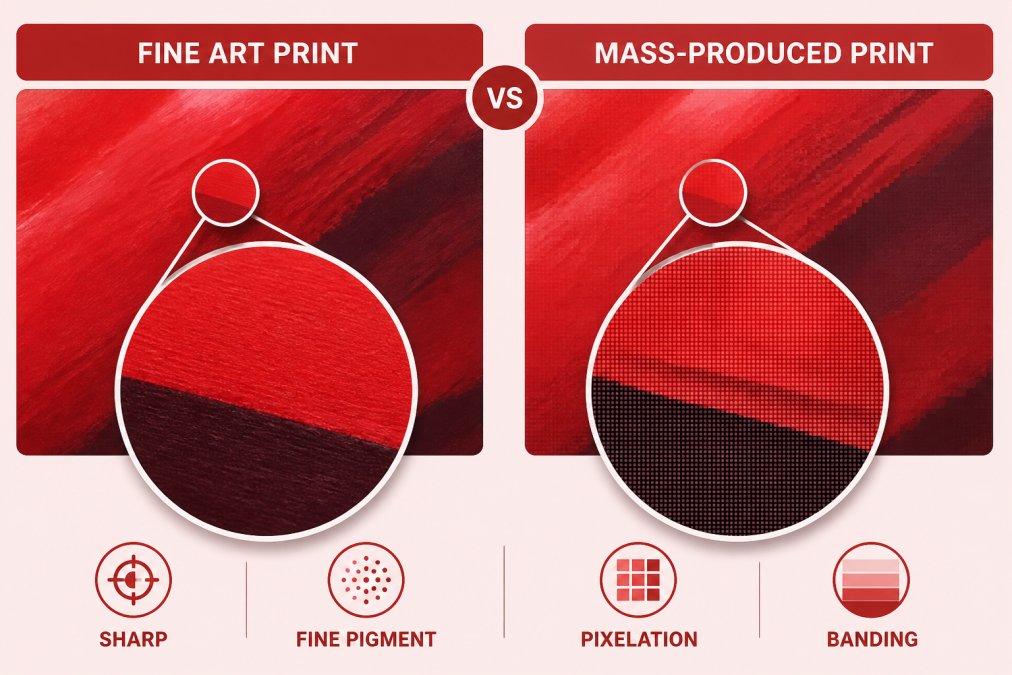
Mass-produced prints often start with digital scans that are compressed to reduce file size. Compression removes data, subtle color transitions, fine details, and tonal gradations get simplified.
When printed, this loss becomes visible. You see pixelation, banding (visible lines where color shifts in steps rather than smoothly), and flattened details.
Fine art prints using giclée technology start with high-resolution scans and minimal compression. The file maintains color depth and detail throughout production. When printed, the result retains the visual complexity of the original.
Color Fidelity and Vibrancy
Mass-market prints often use dye-based inks, which are cheaper but fade over time and don't reproduce colors accurately. Fine art prints use pigment-based inks, the same technology used in professional photography and museum-quality reproductions. Pigments are more stable, more lightfast, and reproduce color with significantly higher fidelity.
Color accuracy also depends on substrate, the material the image is printed on. Fine art canvas or cotton rag paper renders colors differently than cheap glossy-coated paper.
How to Identify High-Quality Art Prints: A Technical Guide
If you're considering a print, knowing how to evaluate quality protects you from disappointment.
Substrate and Archival Quality
Fine art prints use materials designed to last decades without degradation. Cotton rag paper (100% cotton fiber) is archival and won't yellow or become brittle. Canvas substrates made from poly-cotton blends are durable.
Mass-produced prints often use wood-pulp paper with sizing that traps acid. Within 5-10 years, the paper yellows, becomes brittle, and degrades. The image may fade or shift in color.
Check product specifications for "acid-free," "archival," "100% cotton," or "museum-quality" language. Vague descriptions are a red flag.
Pigment-Based Inks and Durability
Pigment-based inks are the standard for archival prints. If product information doesn't specify ink type, assume it's dye-based.
Lightfastness measures how long a print resists fading under light exposure. Archival pigment-based prints last 100+ years without significant fading. Dye-based prints typically fade noticeably within 5-15 years.
This matters if you're buying art you plan to keep long-term.
Art Investment for Beginners: Original vs Reproduction
If you're thinking about art as an investment, the economics shift dramatically.
Value Retention and Artistic Integrity
Original paintings appreciate in value over time, assuming the artist gains recognition. A painting bought for $2,000 from an emerging artist might be worth $5,000 or more a decade later.
Prints, including limited editions, rarely appreciate significantly. The market for reproductions is flooded. The value proposition for prints is primarily aesthetic and emotional, not financial.
When you buy an original, you support the artist directly. When you buy a print, the artist receives a royalty while the bulk of revenue goes to the printer, distributor, and retailer.
For artists like Susan Fielder Art, whose work carries a social mission, 10% of proceeds support pancreatic cancer research, the economics matter. An original sale generates significantly more contribution to that mission.
Limited Edition Prints: The Middle Ground
Limited edition prints bridge the gap between affordability and exclusivity. By capping production at a defined number, artists create scarcity without requiring each buyer to own a one-of-a-kind original.
The value of limited edition prints depends on the artist's reputation, how quickly the edition sells out, whether the artist remains active, and reproduction quality. A limited edition from an emerging artist that sells out quickly can gain value as collectors recognize the artist's rising prominence, though this isn't guaranteed.
Limited editions are more valuable than open-edition mass-produced prints but typically less valuable than originals from the same artist.
Environmental Impact: Mass Manufacturing vs Sustainable Practices
The environmental footprint of art production is rarely discussed but worth considering.
Mass-produced prints consume significant resources through printing facilities, substrate production, and global shipping. The efficiency argument cuts both ways: a single facility producing thousands of copies uses less energy per unit than creating thousands of individual originals, but total environmental impact is substantial.
Original artworks use fewer resources per piece, assuming sustainable materials and practices. Limited edition prints represent a middle path: fewer copies than mass production but still benefiting from production efficiency.
Environmental responsibility is increasingly recognized as part of artistic integrity.
Making Your Choice: Pros and Cons Comparison
The decision between original abstract art and mass-produced prints depends on your priorities, budget, and what you value in art.
| Factor | Original Painting | Limited Edition Print | Mass-Produced Print |
|---|---|---|---|
| Price | Higher | Medium | Lower |
| Uniqueness | One-of-a-kind | Limited copies | Unlimited copies |
| Investment potential | Strong | Moderate | Minimal |
| Visual quality | Highest | High (if well-produced) | Variable |
| Longevity | Decades+ | 50+ years (archival) | 5-15 years (typical) |
| Artist support | Maximum | Moderate | Minimal |
| Accessibility | Limited | Moderate | High |
When Mass-Produced Prints Make Sense
Mass-produced prints are appropriate if you're decorating a rental space, experimenting with an artist's work before committing to an original, furnishing a large space where original art isn't feasible, or want to support an artist while keeping costs low.
They're also suitable if you're drawn to a specific image but the original is unavailable or unaffordable. A high-quality mass-produced print of work you genuinely love beats buying art you don't care about just because it's cheaper.
The risk is disappointment. A print that looked vibrant in the product photo may arrive looking flat. Product reviews and return policies are your safety net.
When Original Abstract Art Is Worth the Investment
Original abstract art makes sense if you're building a collection, investing in emerging artists whose work you believe in, seeking a unique statement piece for a space you'll inhabit long-term, or wanting to support artists directly and meaningfully.
Living with a one-of-a-kind piece carries different weight than living with a reproduction. You know no one else owns exactly what you own. That sense of exclusivity and personal connection is real.
For collectors and art enthusiasts, originals offer deeper engagement. You're entering into a relationship with the artist's vision, supporting their practice, and potentially watching their career unfold over years.
The choice between abstract art and mass-produced prints isn't about which is objectively better, it's about what you value and what serves your needs. A thoughtfully chosen mass-produced print that brings you joy is infinitely better than an original you don't genuinely connect with.
If you're drawn to meaningful, emotionally resonant artwork that carries a story of healing and impact, Susan Fielder Art offers original abstract paintings designed to transform your space while supporting a greater cause. Each piece reflects artistic integrity and intentionality, the kind of work that deepens rather than fades over time. Discover how original art can become part of your home's narrative.
Frequently Asked Questions
How can you tell the difference between an original painting and a print?
Original paintings show visible brushstrokes, texture variation, and hand-applied imperfections that prints cannot replicate. Examine the surface under light, originals display depth and dimensional paint layers, while prints appear flat. Check for artist signatures (originals often have hand-signed signatures, not printed ones) and ask for a certificate of authenticity. Prints may show pixelation or compression artifacts under magnification, especially near edges and color transitions.
Does original abstract art hold its value better than prints?
Original abstract art typically retains or appreciates in value over time, especially from established artists, because of its uniqueness and artistic integrity. Mass-produced prints depreciate as they're easily replaceable and lose exclusivity. Limited edition prints fall between these extremes, they hold value better than unlimited reproductions but less than originals. The artist's reputation, provenance, and condition all influence long-term value.
What makes a fine art print different from a mass-market reproduction?
Fine art prints use archival-quality substrates, pigment-based inks, and higher print resolution (typically 300 DPI or higher) to ensure color fidelity and durability for decades. Mass-market reproductions often use lower-resolution files, dye-based inks, and cheaper paper, leading to color shifts and faster deterioration. Fine art prints may also be hand-embellished or limited in quantity, adding to their value and visual impact.
Is it worth investing in original abstract art for home decor?
Yes, if you value artistic integrity and long-term investment potential. Original abstract art transforms a space with unique visual impact and emotional resonance that mass-produced prints cannot match. Beyond aesthetics, originals appreciate over time and support the artist directly. For renters or those with tight budgets, high-quality limited edition prints offer a middle ground, better quality and value retention than mass-produced options at a lower cost than originals.