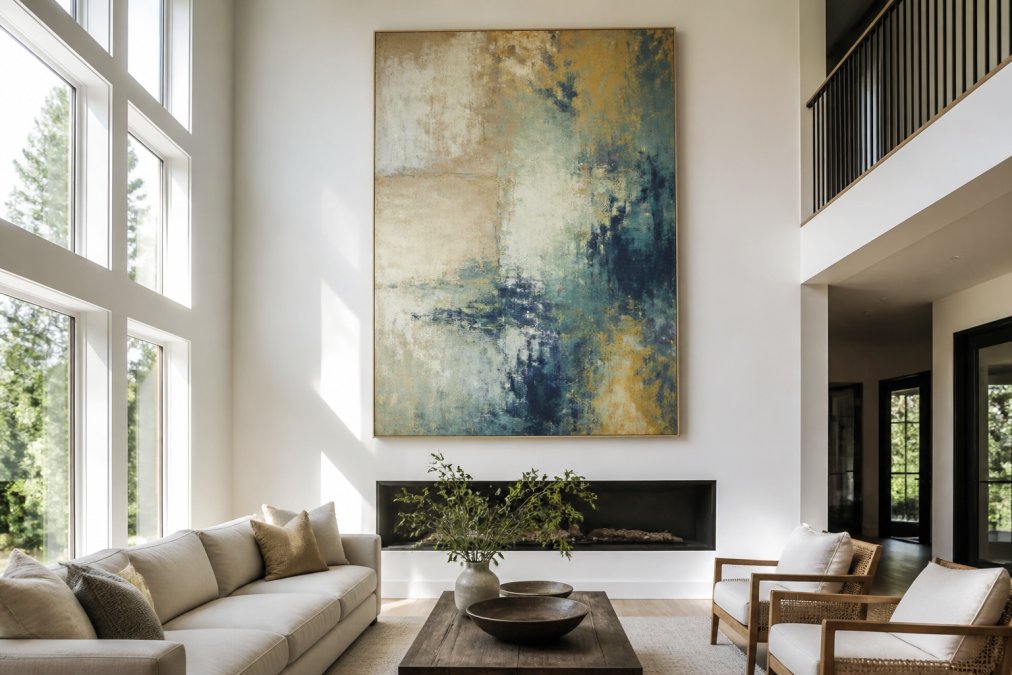
 how-to
How to Choose Large Abstract Art for High Ceilings
Table of Contents
- Step 1: How to Measure Wall Space for Art
- Step 2: Sizing Large Abstract Art for High Ceilings
- Step 3: Art Placement Rules for Interior Design
- Step 4: Choosing Oversized Abstract Wall Art for Living Rooms
- Step 5: Installation Safety and Lighting for Large Abstract Art
- Step 6: Digital Visualization and Acoustic Benefits
- Frequently Asked Questions
Last Updated: September 14, 2026
Step 1: How to Measure Wall Space for Art
The global wall art market is projected to reach $70.94 billion in 2026, driven partly by homeowners facing a question that trips up even experienced decorators: how to choose large abstract art for high ceilings without the piece looking lost or overwhelming. This guide from Susan Fielder Art covers the measurements, placement rules, and installation considerations that separate a room that works from one that feels unfinished.
Start with the wall, not the art. Measure the wall's full width and height, then your furniture below it; the usable zone is what remains.
Behind a sofa, art should span roughly two-thirds to three-fourths of the furniture width, a 72-inch sofa calls for art 48 to 54 inches wide.
Large abstract art is any piece whose scale matches the architectural volume of the room, not simply a canvas that happens to be big. According to Great Big Canvas design guidance, high-ceiling environments call for pieces at least 48 inches in dimension to prevent the artwork from appearing lost.
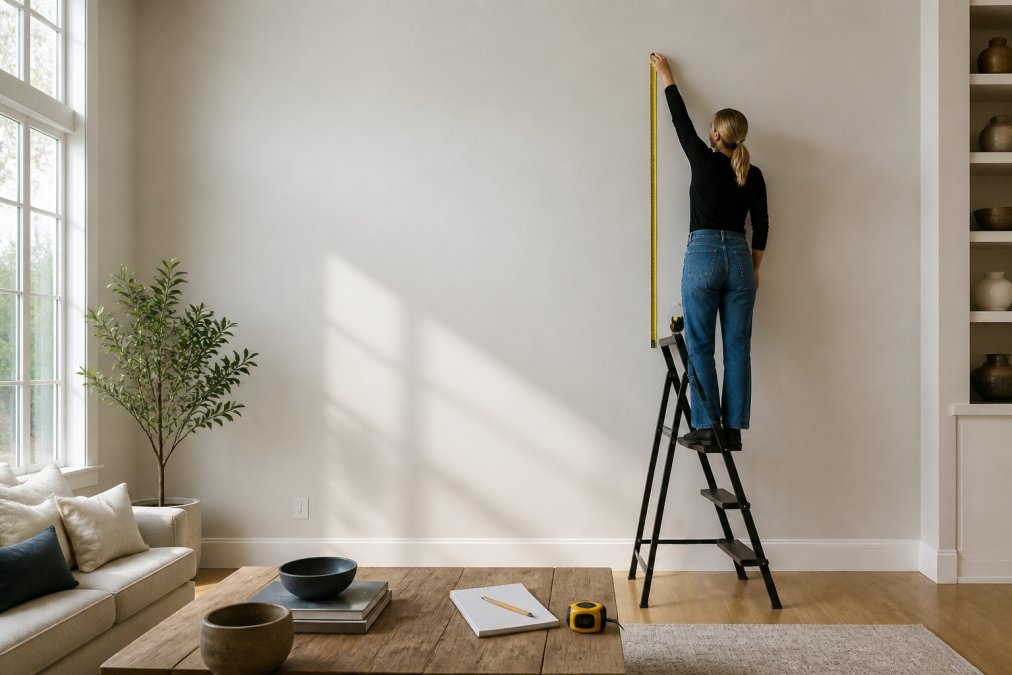
Calculating the two-thirds and three-fourths rules
The two-thirds rule keeps art proportional to furniture: an 84-inch sofa calls for art 56 to 63 inches wide. The three-fourths rule applies when art is the focal point and you want more visual weight, same sofa, 63 to 84 inches of art. Neither works in isolation: on a 20-foot wall, a 48-inch canvas that follows the two-thirds rule for a narrow console still looks undersized against the ceiling height.
Step 2: Sizing Large Abstract Art for High Ceilings
For rooms with ceilings of at least 10 feet, industry standards classify truly oversized abstract art as pieces measuring 60x40 inches or larger, according to Extra Large Wall Art's 2026 sizing guide. That threshold exists because smaller pieces visually shrink in tall rooms.
The 48-inch minimum applies to the longest side. Anything shorter reads as a postage stamp on a 12-foot wall.
The 48-inch minimum and 60x40-inch oversized threshold
Treat these as markers, not rigid categories.
- Under 48 inches: Works for standard 8-9 foot ceilings and secondary walls
- 48-59 inches: Minimum viable scale for 10-12 foot ceilings
- 60x40 inches and larger: True oversized territory for ceilings above 12 feet
Vertical vs. horizontal orientation for tall walls
Vertical orientation emphasizes height: a 40x60 vertical canvas draws the eye upward, making a tall room feel intentional rather than cavernous. Horizontal orientation widens the room, use it when the wall is wide but ceilings are moderate, or to anchor a long furniture grouping. Aspect ratio matters more than raw dimensions: a 48x48 square reads differently than a 36x64 vertical, even though both clear the minimum.
Step 3: Art Placement Rules for Interior Design
The standard recommendation places the center of artwork 57 to 60 inches from the floor, according to Sacksteder's Interiors placement guidance. This eye-level rule works for most rooms, but high ceilings require adjustment.
In rooms with ceilings above 12 feet, shift the center point higher, often 62 to 66 inches, to align with the room's vertical scale.
The 57-60 inch eye-level standard and the 5-5-75 rule
The 5-5-75 rule offers a simpler framework: hang art with its center 5 feet (60 inches) above the floor, and keep the bottom edge 5 inches above furniture, per Houzz design guidance. The "75" refers to the approximate percentage of viewers whose eye level falls near that height.
For high ceilings, treat 60 inches as your baseline and adjust upward based on how the piece reads in the space.
Step 4: Choosing Oversized Abstract Wall Art for Living Rooms
Living rooms with high ceilings need art that bridges furniture and architecture. The problem isn't just size, it's the vertical dead zone between sofa top and ceiling. On an 8-foot wall that zone is small and the eye reads furniture and art as one composition; on a 14-foot wall it can be 6 feet or more, and art that doesn't address it leaves the room feeling like two disconnected halves.
Balancing art with furniture scale and room volume
Match art scale to room volume, not just wall width. A 20-foot ceiling in a 400-square-foot room demands different treatment than in an 800-square-foot space, because of viewing distance: in a small room you stand closer, so a 60-inch canvas fills more of your field of view and reads larger than in a great room viewed from 15 feet away.
For oversized abstract wall art for living rooms, consider these pairings:
| Room Volume | Ceiling Height | Recommended Art Size |
|---|---|---|
| Small (under 300 sq ft) | 10-12 ft | 48-60 inches wide |
| Medium (300-500 sq ft) | 12-14 ft | 60-72 inches wide |
| Large (500+ sq ft) | 14+ ft | 72+ inches or gallery wall |
These are starting points, not rules. The two-thirds rule still governs width relative to furniture and the vertical-third rule governs height relative to the ceiling. When they conflict, a narrow sofa on a very tall wall, prioritize the vertical rule and choose a vertical-oriented canvas that meets the height requirement without overrunning the furniture width.
Composition choices that work at scale
Abstract art can feel chaotic in large spaces when size is prioritized over composition. At 60 inches and above, every decision is magnified: a bold color field confident at 30 inches can read as aggressive at 72 inches, and a busy, high-contrast composition energetic at small scale can feel noisy on a high wall.
A few patterns that tend to work in high-ceiling living rooms:
- Large color fields with generous negative space hold a tall wall without competing with the architecture; negative space gives the eye a place to rest, which matters more as scale increases.
- Vertical-oriented compositions (taller than wide) reinforce the room's height and draw the eye upward. A 48x72 vertical canvas often reads as more substantial on a high wall than a 60x60 square, despite the square's greater area.
- Two-piece pairings segment a very tall or wide wall where a single canvas would be too small or too dominant. Two 40x60 vertical canvases hung side by side with 2-4 inches between them cover a wide span while keeping each piece at human scale.
- Gallery walls work on high walls only when anchored. A loose grid of small pieces on a 14-foot wall reads as clutter; a tight 2x2 or 3x2 grid of matched-size pieces reads as a single large composition.
Handling the most common high-ceiling living room layouts
- Sofa against a tall wall: Center the art over the sofa, keep the bottom edge 6-10 inches above the sofa back, and choose a piece tall enough to occupy at least the middle third of the wall height. On very tall walls, a vertical canvas or stacked pair beats a single wide piece.
- Open-concept great room: The art must work from multiple viewing angles. Choose strong composition from a distance, bold shapes, clear value contrast, rather than fine detail that disappears across the room.
- Double-height wall with a staircase or loft: Treat the art as a focal point for the whole volume, not just the lower level. Hang it higher than the standard eye-level rule suggests, and light it so it reads from the upper level as well as the floor.
Susan Fielder Art's collection addresses this directly: each piece is composed with the spatial awareness that large-scale work demands, and 10% of all proceeds support pancreatic cancer research.
Step 5: Installation Safety and Lighting for Large Abstract Art
Oversized canvas weighs more than most homeowners expect, and the failure mode is rarely the canvas, it's the wall. A 60x40-inch gallery-wrapped canvas on a solid wood stretcher typically lands between 8 and 15 pounds, but on a heavy float frame or with thick impasto it can push past 20. That's within standard drywall anchors' capacity, but the load concentrates at two or three points, where installations fail.
Hanging hardware by weight and wall type
- Under 10 pounds: Two 50-pound-rated self-drilling drywall anchors are sufficient on 1/2-inch drywall. Space them at roughly one-quarter and three-quarters of the canvas width.
- 10-25 pounds: Use two toggle bolts or strap toggles rated for 50 pounds each. Toggle bolts spread load behind the drywall face and are the standard choice for oversized canvas on drywall without a stud.
- 25 pounds and up, or any piece wider than 60 inches: Anchor into studs wherever possible. If studs do not align with the hanging points, install a French cleat spanning at least two studs. A French cleat distributes weight along its full length rather than at two points, keeps the canvas flush to the wall, and prevents the top edge from tipping forward, a common problem with wire-hung oversized pieces.
A wire system is fine for a 24-inch canvas, but on a 60-inch canvas it concentrates the entire load at one hook and lets the piece swing, cracking stretcher corners over time. Most framers and gallery installers won't warranty a wire-hung piece above 40 inches wide.
Locating studs and planning the anchor points
Before buying hardware, find the studs. A magnetic or deep-scan electronic finder locates framing behind 1/2-inch or 5/8-inch drywall. Mark stud centers with painter's tape, then lay out hanging points with tape before drilling. On a high wall this matters more than on a standard wall, since you're often on a ladder and can't easily reposition.
Lighting high-ceiling art without glare
High ceilings create a specific lighting problem: the farther a light source sits from the canvas, the flatter and more shadowed the surface reads. A single recessed fixture 14 feet up washes the wall but won't reveal the texture, brushwork, or depth that make abstract work worth buying.
- Picture lights mounted 12-18 inches above the frame's top edge work for pieces up to about 48 inches wide. Choose 90+ CRI and a warm-to-neutral color temperature (2700K-3000K) so colors read accurately. On high walls, a plug-in with a discreet cord cover is often the practical choice.
- Track lighting suits canvases wider than 48 inches or gallery-wall arrangements. Aim two or three adjustable heads at different points, not all at the center, so light rakes across the surface and reveals texture. Use a narrow beam spread (around 25-36 degrees) so light lands on the art, not the surrounding wall.
- Wall-washing fixtures at the ceiling work for very tall walls but tend to flatten the surface. Use them as ambient fill, not primary light on the art.
Matching light output to canvas size
A useful rule of thumb: aim for roughly 30-50 foot-candles on the canvas surface in a residential setting. A 60x40-inch canvas needs more total light than a 30x40-inch piece to hit the same surface brightness, which is why a single small picture light often looks dim on oversized work. If unsure, buy a dimmable fixture, most abstract art looks best at 70-80% of full output, where texture reads without hot spots.
The right lighting makes a $500 canvas look like a $5,000 piece. The wrong lighting makes a $5,000 canvas look like a poster. Budget for lighting, and for the right anchors, before you buy the art.
Step 6: Digital Visualization and Acoustic Benefits
Before committing to a large piece, use digital visualization tools to preview scale: upload a photo of your wall and overlay the canvas dimensions to confirm proportions before purchase. Susan Fielder Art's verified secure website and Art Storefronts Organization registration give buyers confidence.
Large canvas art also absorbs sound. In rooms with high ceilings and hard surfaces, a 60x40-inch canvas functions as a soft acoustic panel, reducing echo and softening the sound profile; the thicker the canvas and frame, the more noticeable the effect. For open-concept living spaces where sound travels, oversized art does double duty: visual anchor and acoustic buffer.
Homeowners with open-concept layouts and high ceilings who want art that addresses both visual scale and sound management.
High ceilings are an asset until they make your walls feel empty. The measurement rules, placement standards, and installation considerations in this guide give you a framework, but the emotional connection to a piece matters as much as the math. Susan Fielder Art offers emotionally charged, original abstract paintings designed for spaces that demand presence, with every purchase supporting pancreatic cancer research through a 10% donation. Browse the collection, find the piece that speaks to your space, and shop now.
Frequently Asked Questions
What is the 2/3 rule for wall art?
The 2/3 rule says artwork should cover about two-thirds to three-fourths of the available wall width above a piece of furniture. For a sofa that is 84 inches wide, aim for art that is 56 to 63 inches wide. This prevents the art from looking too small or dominating the space. For high ceilings, measure the wall section you want to fill, not the entire room width.
Should art be centered on a high wall or at eye level?
For high ceilings, center the art at 57 to 60 inches from the floor for eye-level viewing. However, if the ceiling is very tall, you can raise it slightly to 62-66 inches to better align with the room's vertical scale. The 5-5-75 rule suggests 60 inches as a starting point. Always test the placement with painter's tape before hanging.
How do you choose the right size abstract art for a living room with high ceilings?
Start by measuring your wall. For ceilings at least 10 feet high, choose pieces at least 48 inches on the longest side. If the wall is very large, go for 60x40 inches or larger. The art should cover two-thirds to three-fourths of the furniture width below it. Also consider the room's volume: a 20-foot ceiling may need two oversized pieces to segment the space and create balance.
What are the best ways to display oversized art in tall rooms?
Use proper installation hardware rated for the weight, such as heavy-duty French cleats or wall anchors. For very tall walls, consider hanging the art slightly higher than eye level to fill the vertical space. Add picture lights or adjustable spotlights to highlight the art.